Alcide
Journey to the End of the NightAlcide is a re-enlisted sergeant in the colonial outpost of Topo, Lieutenant Grappa’s second in command, and the person through whom the settlement’s limited commerce passes. The narrator initially sees a gruff, resigned man absorbed in the outpost’s monotonous routines. A photograph of a little girl, kept in a biscuit tin, discloses what that picture of indifference conceals: Alcide has arranged his life around supporting his orphaned niece, Ginette. His years of isolation are not simply resignation but a sustained, largely unseen act of care.
Identity and Life in Topo
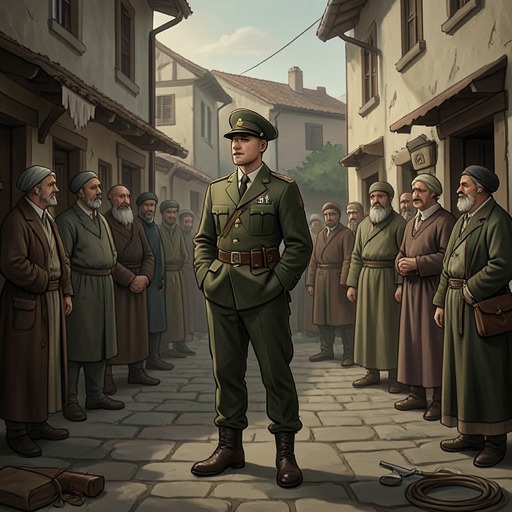
Alcide serves under Lieutenant Grappa in a place so isolated that, as Grappa tells the narrator, no traveler has arrived in two years. The two officers have little affection for one another. Grappa complains that Alcide tends to become too familiar, while Alcide’s authority among the militiamen rests on a different kind of closeness. He drills the twelve recruits, who endure the punishing heat in the outpost, and Grappa handles the local court sessions and repeatedly supervises the rebuilding of the dock, which mollusks consume between the monthly visits of the Papaoutah.
The official business of Topo is largely a performance of administration. Alcide prepares batches of reports saying there is “Nothing to report,” and Grappa signs them for the Governor General. The surrounding tribes, already diminished by disease and poverty, pay a small tax collected with clubs; some young men are recruited into the militia that wields those clubs. The outpost’s paperwork and routines therefore sit alongside coercive colonial rule, even as daily life there seems to offer almost nothing beyond drill, court sessions, and waiting.
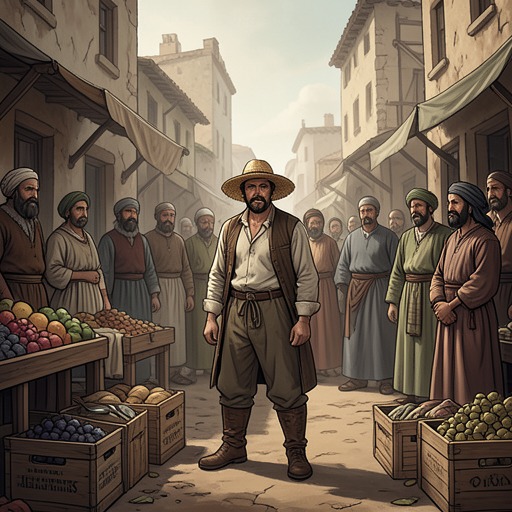
Alcide also holds the settlement’s small stock of goods: packaged and loose tobacco, several liters of brandy, and a few bolts of cotton. Since this is nearly all the trade available in Topo, commerce passes through his hands. The militiamen like him despite his scolding and unjust kicks. Their bond is not an equality of position but a recognition of shared poverty: tobacco, in the narrator’s account, creates a tie across the difference between them. Alcide’s small business and his place in the outpost’s economy are thus inseparable from the deprivation around him.
The Narrator’s First Impressions
The narrator shares Alcide’s food and hut for two weeks, along with his bed fleas, sand fleas, quinine, and the nearby well’s tepid water. Their quarters contain little beyond their folding beds and a few crates. The narrator repeatedly teases Alcide about the money he imagines the sergeant is saving and invents stories about the grand celebration that will supposedly accompany Alcide’s return to Bordeaux. Alcide simply laughs; the narrator’s jokes mistake quietness for a lack of deeper attachments.
That misreading is reinforced by Alcide’s apparent detachment from the world beyond Topo. When the narrator offers him newspapers from Europe, Alcide tries several times to read them but cannot sustain interest. He explains that after three years in the outpost the news no longer matters to him. The narrator understands this not as a pose but as the consequence of being disregarded by the wider world: Alcide has come to regard life beyond Topo as remote. The picture of the indifferent, self-contained sergeant is convincing enough to hide the personal commitment that structures his choices.
Ginette and the Photograph
The narrator discovers the truth while preparing a letter to Monsieur Puta to ask for money. Alcide keeps his writing materials in a small biscuit tin, like the one Sergeant Branledore had possessed in the hospital. When Alcide sees the narrator opening it, he moves to stop him, then relents. Inside the lid is a photograph showing only a little girl’s head and face. The narrator closes the tin quickly, embarrassed by the intrusion, but the image has already made Alcide’s reserve legible as something more than mere secrecy.
Alcide tells him the child is Ginette, his dead brother’s daughter. Her parents are both dead, and so is Alcide’s mother. Ginette is being brought up in Bordeaux by a religious order that Alcide distinguishes as a high-class school rather than a charitable institution. He takes responsibility for her and insists she will want for nothing. She writes to him and is doing well at school; he pays for her education and hopes she can also have piano lessons and learn English. The details reveal care expressed through practical provision: fees to meet, lessons to plan, and a child’s prospects to protect from far away.
The cost of that provision becomes clear when the narrator asks whether Alcide will visit her soon. Alcide expects he will not be able to go for another three years. His small business at Topo helps support Ginette, and if he takes leave, someone else may take his position before he returns. He has therefore requested a double hitch, agreeing to remain in Topo for six consecutive years rather than the usual three. His decision binds him to the outpost’s isolation for the sake of a niece he knows through letters and the photograph in his tin.
Character and Significance
Alcide worries that Ginette has nobody to spend the holidays with. The concern makes the distance between them more than a matter of travel or money: he can support her education, but he cannot readily be present in her ordinary life. Even so, he does not frame his choice as a bargain. He asks for nothing in return, and the narrator presents his willingness to endure years of monotony as an unshowy tenderness toward a child to whom he is only vaguely related.
The revelation changes the narrator’s estimate of Alcide. Having joked about the sergeant’s supposed savings and imagined pleasures in Bordeaux, he now sees how Alcide must have saved from meager wages and small allowances while keeping his business going in Topo. He is ashamed of having held the man at a distance and looked down on him. Yet there is no outward sign that separates Alcide’s goodness from an ordinary appearance: when the narrator looks at him asleep in the candlelight, Alcide seems entirely commonplace. The scene leaves goodness visible through actions and obligations, not through any mark of status or display.
Alcide’s character also sharpens the novel’s attention to class. The narrator reflects that he and others took years and the war to understand how differently the rich and poor inhabit the same world. At Topo, that divide appears through the outpost’s meager resources and through Alcide’s willingness to prolong his posting because Ginette’s support depends on it. The narrator’s own poverty and vulnerability elsewhere in the book contrast with Alcide’s generosity: both are poor, but Alcide directs what little he can secure toward someone more vulnerable still.
In the wider narrative, Alcide’s episode is a quiet counterpoint to scenes of official patriotism, social competition, and exploitation. The narrator has seen public displays of heroism and the advantages conferred by connections; in Topo he encounters a goodness that makes no public claim for recognition. Alcide remains a sergeant within a coercive colonial system, and the account does not erase that setting. Instead, it shows an individual care emerging within a life constrained by poverty, isolation, and institutional routine. His hidden devotion to Ginette revises the narrator’s judgment of him and offers a rare example of kindness whose importance lies precisely in its lack of display.