Bébert’s Fatal Typhoid
Journey to the End of the NightBébert’s Fatal Typhoid is the prolonged illness and death of a seven-year-old boy in Rancy, a crisis that tests Ferdinand Bardamu’s skill and conscience while laying bare the poverty and helplessness surrounding his medical practice. As Bébert wastes away despite repeated treatment, his aunt’s grief, the neighborhood’s scrutiny, and the evasions of medical authority gather around his bed; the outcome is not a cure but Bardamu’s sense that he has done everything possible and still has nothing to offer.
Illness and the Household
Bébert falls ill just after Easter, when Bardamu returns to Rancy. His colleague Frolichon has gone on vacation, and Bébert’s aunt eventually asks Bardamu to take the case, probably because he charges less than the other doctors she knows. Bardamu visits twice daily through weeks of illness. The first warm southerly winds carry factory soot onto the neighborhood windows, while residents wait near the lodge or linger on doorsteps for news. The case becomes a public spectacle as well as a private emergency: people offer advice, judge Bardamu’s intelligence, and gather in a lodge that smells of petticoats and rabbit urine.
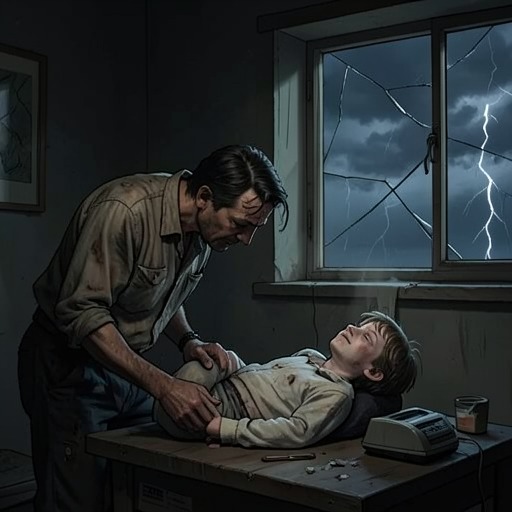
The boy’s decline is visible in his body. He is not yet delirious, but he has lost the desire to move and grows thinner by the day. Yellow, flabby flesh clings to his bones and quivers with every heartbeat; after more than a month of sickness, Bardamu feels that the heart seems to be everywhere in his shrunken body. Bébert still gives him a lucid smile when he visits, even as his temperature rises from 102 to 103 degrees. He lies with a pensive expression for days and weeks, his alertness making the physical wasting all the more difficult to dismiss as an abstraction.
Treatment and Its Limits
Bardamu identifies the illness as a malignant form of typhoid that defeats his attempts to treat it. He tries baths, serum, a dry diet, and vaccines, but nothing works. His practical efforts are accompanied by a sense of impotence: Bébert seems to be carried away by the fever while the doctor remains below, making a fool of himself. The treatments register not as a path toward recovery but as a mounting list of actions that cannot alter the course of the illness.
Bardamu’s low fees also make him vulnerable to neighborhood judgment. The other residents question his competence, and Bébert’s aunt has to hear advice to dismiss him and call a more imposing, experienced doctor. The earlier incident involving a girl “with the responsibilities” has already circulated through the neighborhood and become material for comment. Yet the other doctors show little eagerness to take Bébert’s case once they learn its nature. They leave Bardamu in place on the practical assumption that, since the boy has fallen to his care, he may as well see him through.
The Aunt and the Neighborhood
Bébert’s aunt first fills the crisis with words, then falls silent after saying everything she knows. Her grief arrives when speech runs out. She blubbers in corners of the lodge, tries to wipe away her tears, and starts sobbing again; the alternation of collapse and renewed sorrow continues for weeks. The neighbors keep her from forgetting to eat, stuffing food between her sobs and telling her that she needs to keep up her strength. At the height of the illness they bring her cooked Brussels sprouts, whose smell becomes overpowering; she admits that they strengthen her and make her urinate.
At night, the aunt fills herself with coffee so that she can sleep lightly and hear the doorbell at its first ring, rather than let tenants ring repeatedly and wake Bébert. When Bardamu visits in the evening, she continues to search for an explanation, wondering whether rum and chamomile tea the boy drank at a fruit shop during a bicycle race made him sick. The idea has been troubling her from the beginning. Bébert’s faint repetition of “Camomile!” is an echo from within his fever, not a correction that can resolve her uncertainty. Bardamu performs the few professional motions she expects, then leaves to face the night, unable to feel entirely innocent of what is happening.
Seeking Advice
Around the seventeenth day of the illness, Bardamu goes to the Joseph Bioduret Institute near La Villette. He wants advice or a possible vaccine and hopes that, if Bébert dies, he will at least have tried every available avenue. At first he wanders through laboratories in search of a scientist. The rooms are empty of staff and crowded with disordered objects: gutted small animals, cigarette butts, chipped gas jets, jars in which mice are suffocating, retorts, broken stools, books, and dust. The scientific institution, approached as a possible source of help, offers Bardamu an image of disorder and absence before it offers counsel.
He also seeks help from doctors in Paris hospitals, calling them from a bistrot. Their advice is excellent but ineffectual. Nonetheless, he takes comfort in hearing respected physicians make an effort, without payment, for the unknown child he has taken under his wing. He visits Serge Parapine, who once taught him to use a microscope and had shown him kindness during medical school. Parapine is willing to help, but twenty years of learning about typhoid have left him unable to formulate a definite opinion. His questions about serums and vaccines lead into qualifications and competing views rather than a clear course of action. The more Bardamu seeks expertise, the more medical knowledge appears divided against itself.
Death, Guilt, and the Meaning of the Case
Bardamu admits that preventing Bébert’s death matters more to him than preventing the death of an adult. An adult’s death, he suggests, may seem to remove one more unpleasant person from the world; a child’s death leaves the future itself in question. Yet even his concern cannot produce a remedy. After visiting the Institute, he has nothing to bring back to Rancy, either for Bébert or for the aunt. He thinks the boy has nothing left on earth—not even in Montaigne—and then considers whether nothingness may be everyone’s final condition.
Bébert’s death does not end the consequences of the illness for Bardamu. The aunt does not blame him, but the loss harms his standing in the neighborhood, where his already precarious reputation depends in part on being a doctor who charges very little. Soon he finds himself dwelling on whether he has done enough, repeating the pressure to try everything so that he will not feel eternally guilty. In the larger movement of the narrative, the episode also sets his later encounters with death against the same vulnerable body and fear: the memory of Bébert’s suffering belongs to a story in which the living are repeatedly brought up against helplessness, and in which neither professional procedure nor reassuring explanation can make death manageable.