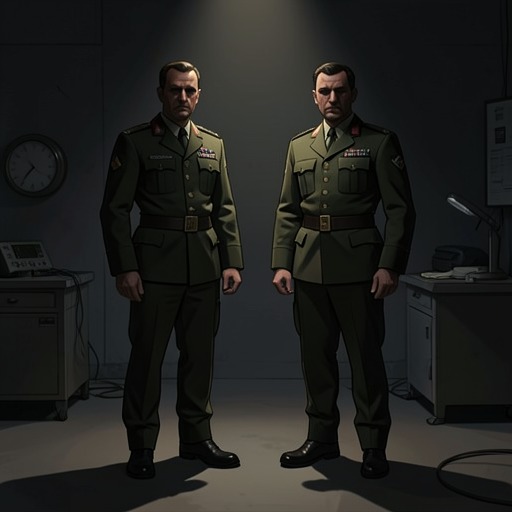
Bardamu and Robinson attempt to surrender to the Germans
Journey to the End of the NightFerdinand Bardamu and Robinson attempt to surrender to the Germans during a reconnaissance mission that turns into a search for escape from the French army. Their effort brings the exhausted, frightened Bardamu together with Léon Robinson, a reservist who says plainly that he wants to be taken prisoner; in the town they hope will deliver them to the enemy, civic duty and the protection of a fifteenth-century church become reasons to send them back into danger. The episode makes surrender less a military maneuver than a test of what wartime society will permit its soldiers to say about wanting to live.
The reconnaissance mission
Bardamu is not sent out because he has proved brave. Having decided that cowardice is the sensible response to war, he has nevertheless inspired a paradoxical confidence in Captain Ortolan, who assigns him a delicate mission on a night of contradictory patrol reports. General des Entrayes wants a firsthand answer about whether the enemy has reached Noirceur-sur-la-Lys, a weavers’ town roughly ten miles from the village where the troops are camped. Bardamu may choose one of the platoon’s less purulent horses, and the prospect of riding alone briefly resembles the beginning of a journey. That sense of deliverance proves illusory: he is so tired that he cannot even properly picture his own murder.
The mission makes him conspicuous rather than covert. Moving from tree to tree, he hears his equipment clank; his saber makes as much noise as a piano. When a light appears over a doorway, he heads toward it instead of continuing toward Noirceur. He knocks repeatedly and calls into the darkness in a mixture of German and French, hoping to make himself understood. A voice asks who he is. Bardamu answers that he is a dragoon, and the encounter saves him from having to proceed alone into the night.
Meeting Robinson
Farther along, Bardamu encounters a French foot soldier whose cap bears the broken peak of someone who has given up on the army. Bardamu holds his revolver and admits that he might have fired, without knowing why. The stranger asks whether he has seen the enemy. Bardamu has not; he has come to look for them. The man identifies himself as a reservist, a type of soldier Bardamu has not previously met in the war. Although Bardamu cannot see his face, the reservist’s voice sounds sadder and therefore kinder than those of the regular troops. Bardamu finds himself trusting him, at least a little.
The soldier is Robinson. He does not hide his purpose: he is fed up and intends to get himself captured by the Germans. When Bardamu asks how he plans to manage it, Robinson has no method ready. Bardamu, however, is immediately interested in the problem. He recognizes that being taken prisoner is not as simple as wanting it to happen, and Robinson rejects the difficulty with a blunt proposal: he will simply surrender. Asked whether he is scared, he says that he is; he also says the war is stupid and that the Germans have done nothing to him. Their shared desire to get out of the fighting begins not in patriotic argument but in fear and a refusal to treat the enemy as a personal cause for hatred.
A plan formed in the dark
The two men estimate their chances by looking toward the silent, luminous city as if it were a card spread that might disclose their future. Bardamu’s mission and Robinson’s plan now converge: rather than return with a report, they decide to move toward the place where the Germans are believed to be. They set off knowing that the railway tracks lie in their way. If sentries are there, they may be seen; perhaps there will be an overpass, perhaps a tunnel. The alternatives are guesses, but forward movement seems better than remaining where they are.
Robinson argues that such things must be done at night. Daylight, he says, makes people perform for an audience; even war becomes a circus. The observation is borne out when the pair walk through the streets in daylight looking harmless, as though returning from leave. They recall the story of the 1st Hussars, who were supposedly captured in Lille after marching into the city with their colonel at the head of the column. German soldiers appeared at the windows and in the streets until the French were trapped like rats. The story makes capture sound both enviable and almost effortless. Its neatness sharpens the irony of their own attempt: a dramatic mass surrender has happened to others, while these two men cannot find a way to surrender themselves.
The mayor’s appeal to duty
In Noirceur, the shops and houses are shuttered, but one unusually white house is fully lit. Bardamu and Robinson ring the bell with their horse still behind them. A thickset, bearded man opens the door and immediately announces that he is the mayor and is expecting the Germans. He had been informed of their anticipated arrival and had arranged matters with the Prefecture, including where the German colonel and field hospital would be placed. The two French soldiers are an unwelcome complication: if the Germans arrive while they are still there, the mayor expects trouble.
Instead of openly stating that he wants them gone for the sake of his arrangements, the mayor talks about the public interest and Noirceur’s artistic patrimony. He invokes the town’s fifteenth-century church and the possibility that the Germans might burn it, as they had burned the one at Condé-sur-Yser. His wife and two daughters reinforce the appeal. The argument turns the soldiers’ presence into a threat to the community and frames their departure as a public obligation. Bardamu sees the sentimental, archaeological, patriotic, and ethical language gathering around them, but also sees it dissolve under the pressure of fear and self-interest. The mayor’s rhetoric resembles the coercion of Major Pinçon, though it is delivered in an undertone rather than as a direct order.
The failure of escape
Bardamu and Robinson have little to set against the mayor’s arguments beyond their wish not to die or be burned alive. In wartime, that wish is contemptible in the eyes of the people wielding power: it cannot be offered as a respectable public reason. They leave the mayor’s house and wander through other deserted streets, with Bardamu reflecting that everyone he has met that night has exposed something of himself.
As they move off, Robinson complains that his luck has failed him. If Bardamu had been German, he says, Bardamu would have been obliging enough to take him prisoner, and the problem would have been solved. Bardamu answers by imagining the reverse: had Robinson been German and captured him, perhaps Robinson would have received the French Military Medal, or some German equivalent. The joking exchange cannot change their predicament. With no demand for them as prisoners, they sit on a park bench and open the can of tuna Robinson has been warming in his pocket since morning. Gunfire sounds far away. Their hope is reduced to the wish that both sides remain at a distance and leave them alone.
The episode gives Robinson an important first shape in the story: he appears not as an enemy or a symbol of military heroism, but as a soldier who shares Bardamu’s fear and makes his rejection of war explicit. Their proposed surrender fails not through a decisive battle but through practical uncertainty and a French mayor’s appeal to communal interests. The contrast between the grand capture of the 1st Hussars and the two men’s unspectacular, fruitless search exposes a wartime order that can celebrate soldiers as a public spectacle while denying them a credible language for self-preservation.