Bardamu's War Trauma and Fear
Journey to the End of the NightBardamu's War Trauma and Fear is the defining personal consequence of his first direct experience of war: he sees collective violence not as a noble cause but as a catastrophe that ordinary patriotic language conceals. His fear becomes both a bodily crisis and a dissenting judgment. The military and medical systems classify that dissent as sickness, while Bardamu insists that refusing war is a choice grounded in the wish to live.
Recognition Under Fire
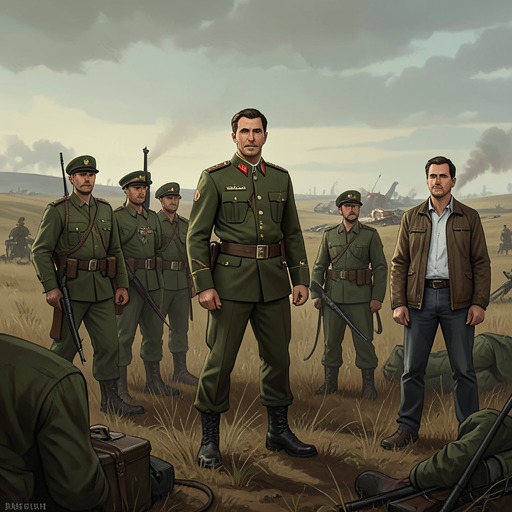
Before the front, war has approached without Bardamu fully understanding what it means. A discussion with Arthur Ganate leaves him exhausted and upset, but the argument ends in reconciliation: they agree about almost everything. The ease of that agreement contrasts with the rupture that follows when war becomes immediate. Amid bullets passing close overhead, Bardamu feels useless and experiences the scene as a vast, universal mockery. The surrounding countryside seems temporarily left in soldiers’ hands, without civilians present to witness their conduct.
That absence of witnesses sharpens his sense of the soldiers’ behavior and of the violence unfolding around them. The colonel moves calmly through the fire, while Bardamu imagines the war continuing indefinitely because there may be millions of men who, unlike him, cannot conceive of their own deaths. He understands that his terror is not simply a private reaction to danger: it is a response to a mass movement toward killing that presents itself as ordinary and legitimate.
Bardamu describes this discovery as a loss of innocence in horror. Before entering the war, he could not have imagined its full reality; now he finds himself caught in what he calls a collective flight into murder. The war appears to have been switched on and to keep burning, with the implication that it will consume the brave as well as the fearful. His trauma thus begins as a belated recognition: only direct exposure makes the scale and character of the violence imaginable.
Breakdown and Institutional Observation
The fear that has become an intellectual conviction also erupts as a public crisis. Bardamu shouts that people are going to be shot and urges those in the lobby to flee. A concierge leads him to the bar and gives him a drink; military police then take him away in handcuffs, with Lola helping them. At the hospital, his condition is described as delirium and madness driven by fear. Bardamu does not settle the question of whether that diagnosis is correct; he observes that, in such a world, getting out of it may seem preferable whether a person is considered crazy or merely afraid.
The authorities do not immediately agree on what his conduct means. Some call him an anarchist and demand that he be shot; others regard him as genuinely insane and want him confined for the duration of the war or for several months. Bardamu draws a political conclusion from the dispute: the majority decides what counts as madness, and sufficient nerve can make nearly any behavior appear normal when the majority supports it. His uncertain diagnosis leads instead to a period of observation.
He and other wounded soldiers are lodged in a secondary school at Issy-les-Moulineaux, adapted for men whose patriotism is judged impaired or dangerously ill. The institution aims to get them to confess, by persuasion or force, while silent male nurses watch them closely. After observation, men may be sent to an asylum, back to the front, or, in some cases, before a firing squad. The school makes the treatment of Bardamu’s fear part of a wider disciplinary process: men who do not display acceptable patriotism are monitored and sorted toward different forms of confinement or renewed danger.
Refusal and the Meaning of Cowardice
When Lola asks whether he will be treated, Bardamu answers, “There’s no treatment for fear, Lola.” He does not present fear as a temporary inconvenience that medicine or encouragement can remove. In the same conversation, he explains that the possibility of death has altered how he thinks about what may remain after it, and Lola calls him an absolute coward. Bardamu accepts the label rather than trying to recover an appearance of courage.
His response is a direct rejection of the war and of those fighting in it. He says he does not deplore or resign himself to the war and does not want any part of it; even an overwhelming majority would not change his judgment. The grounds he gives are starkly personal: he knows what he wants, and he does not want to die. This is not a claim that fear has made him unaware of the surrounding danger. It is a refusal to let the language of national necessity overrule his recognition of what participation risks.
Bardamu also challenges the idea that military deaths acquire lasting meaning through patriotic sacrifice. He asks Lola whether she remembers the names of soldiers killed in the Hundred Years War and argues that the dead become anonymous and indifferent to later observers. His conclusion—that they died for nothing—makes memory part of the conflict. The celebrated abstraction of sacrifice is set against the eventual disappearance of the individual soldier from public attention.
Patriotism as an Opposing Script
The hospital’s official rhetoric gives Bardamu’s refusal an institutional counterpoint. A professor presents patriotism as the highest concept for inspiring altruism and links it to glory. He argues that soldiers’ first experience of fire strips away self-preservation and merges them with the nation. In this formulation, intelligence obstructs essential truths, while the nation is treated as a truth of the heart.
Bardamu’s experience reverses that hierarchy. The institution praises the abandonment of self-preservation as a moral achievement; he regards survival as an honest desire that should not be erased by collective slogans. His comrades also feel the instability and danger surrounding them, but Bardamu says they do not interpret the professor’s speech as he does—as a challenge or insult. His attention to the rhetoric exposes the gap between an official account of noble sacrifice and the threatened lives of the men being observed and prepared for return to the front.
Narrative and Thematic Significance
The account places fear at the point where abstract belief meets physical exposure. Bardamu’s judgment changes as bullets pass overhead and the apparent distance between patriotic talk and actual death collapses. The earlier discussion with Arthur Ganate, in which the two men make up and agree, gives way to a more consequential division between the language of established order and Bardamu’s refusal to treat national duty as self-evidently righteous.
The episode also unsettles the boundary between sanity and madness. Bardamu is called mad for reacting to a war that the supposedly sane majority continues to conduct; the observation school then makes that majority’s standards concrete through watching, interrogation, and the possibility of return to the front. His fear is both suffering and testimony: it records what the accepted heroic account leaves out, while his narration preserves the individual judgment that public military language would dissolve into collective consent. The contrast between the soldier’s wish to live and patriotism’s demand for self-sacrifice remains unresolved by treatment; it becomes the central terms of Bardamu’s resistance.