Baryton Institute admission policy
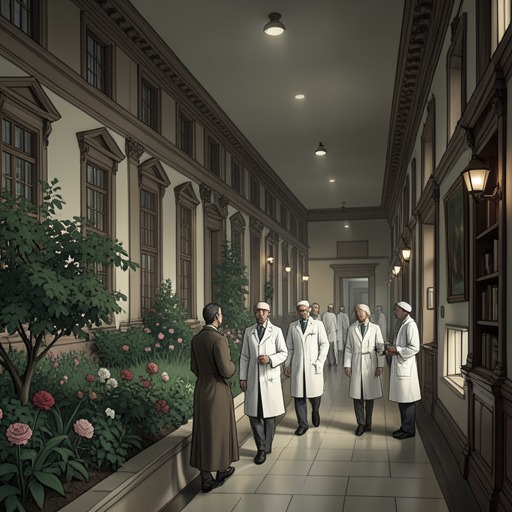
Journey to the End of the NightThe Baryton Institute admission policy defines the rest home through selective admission: it accepts patients regarded as manageable and excludes those considered overtly homicidal. The policy’s calm, therapeutic appearance is qualified by the institution’s continual supervision and regulation of residents, making admission less a simple promise of care than entry into a carefully controlled environment.
Admission and Exclusion
At the rest home, only patients judged easily managed were admitted; people deemed vicious or unmistakably homicidal were not. The distinction presents the institution as a place for cases that can be contained without extensive security: it had few bars and only a small number of isolation cells. Yet the policy also draws a firm boundary around whom the institution is prepared to care for, sorting patients by perceived risk and manageability.
The novel sets this criterion against the earlier observation ward for wounded soldiers at Issy-les-Moulineaux. There, men whose patriotism was considered impaired or dangerously ill were watched by silent male nurses and could be sent on to an asylum, back to the front, or, in some cases, before a firing squad. The comparison shows different institutions classifying people according to different demands: the military ward scrutinizes patients for their fitness and loyalty, while the rest home admits only those its staff believe it can manage.
Supervision and Daily Regulation
At the Baryton Institute, control is exercised through ordinary routines as well as confinement. Staff make rounds of the rooms at night and monitor residents’ behavior, particularly before Sunday visits, when the institution is concerned about its public reputation. The schedule of roll call, return to quarters, and nightly rounds turns supervision into a routine feature of residence rather than an exceptional response to a crisis.
The policy’s practical limits become visible in the treatment of episodes of agitation. When a group of inmates is suddenly swept into prolonged frenzy, staff respond with tepid baths and opium extract, handling the incidents without major alarm. This measured approach fits an institution designed for patients considered manageable, while also showing how its definition of manageability depends on staff oversight and methods of control.
Institutional Image and Significance
The rest home is described as not wholly sinister: it has few bars, few isolation cells, and staff who handle disturbances without dramatic displays. But the restriction on admission and the routines of surveillance complicate that reassuring picture. Patients’ private behavior is monitored, their daily movements organized, and disruptive episodes treated according to the institution’s capacity to contain them.
The policy belongs to a wider pattern in which institutions assess people through categories of normality, fitness, risk, and usefulness. The wounded soldiers are watched and classified in relation to military service; factory applicants are told their health is immaterial and that they are expected to follow instructions rather than think; residents of the rest home are admitted only if their condition is considered manageable. Across these settings, care and order do not stand apart from discipline: institutional protection is conditional on a person being legible and controllable within the system.