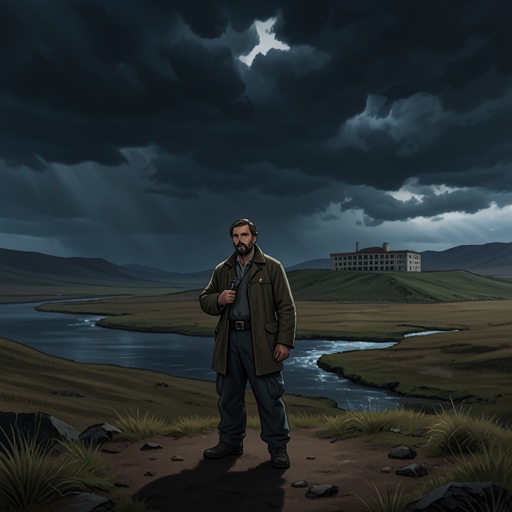
Cowardice and self-preservation
Journey to the End of the NightCowardice and self-preservation are the terms through which the novel tests the moral language of war. Ferdinand Bardamu does not disguise his fear or convert it into a noble sacrifice: he wants to survive, rejects the war, and challenges the assumption that patriotism makes death meaningful. His position is socially condemned as cowardice, yet the narrative treats his instinct to live as a lucid refusal of collective violence and its official stories.
Identity and Central Tension
The concept takes shape in opposition to the soldierly ideal of patriotic self-sacrifice. In a conversation with Arthur Ganate, Bardamu imagines workers conscripted into a galley: below deck they labor under harsh conditions, while their masters enjoy comfort above; when war is declared, those same authorities summon the workers to fight. The image links wartime service to class hierarchy and shows how patriotic appeals can disguise who bears the danger. Bardamu and Arthur make up after their disagreement, but reconciliation does not resolve the conflict between political rhetoric and the vulnerable body expected to serve.
At the front, Bardamu’s fear becomes inseparable from his recognition of the scale of collective violence. He imagines millions of armed men caught up in a mass flight into killing and wonders whether he is the only coward among them. The question is not a bid for distinction. His terror comes from seeing that the war may continue because the people driving it are celebrated as brave, and that the accepted standard of courage offers no reliable limit to destruction.
Fear, Survival, and the Front
Bardamu’s response to danger is practical and unheroic. Faced with the possibility of death in battle, he wishes he had committed a minor crime before enlistment, because prison seems more survivable than the front. The imagined jail at Saint-Germain becomes a refuge in thought: he remembers having once feared it, but now sees confinement as preferable to a war from which men do not return. This reversal measures how radically experience has altered his understanding of danger and authority.
The prospect of capture offers another narrow escape. Bardamu hopes that the enemy might take him prisoner, even though he understands that an opposing soldier is dangerous and cannot be expected to welcome him. His uncertainty about who that soldier might be—a shop clerk, a professional soldier, or a gravedigger—reduces the abstract enemy to a person with an unknown civilian identity. Against the soldiers’ required enthusiasm, he observes that horses are not expected to believe in the war. Self-preservation appears here not as a confident plan but as a fragile wish for release from the demand to perform belief.
His fear is conveyed through the body as well as through argument. Bardamu compares his heart to a frightened rabbit and likens his helplessness to falling from a great height while wishing to stop in midair. The image makes the wish to live immediate and involuntary: it is not an abstract doctrine but the body’s response to mortal danger. His imagined escape routes, meanwhile, remain uncertain, bounded by the possibility of capture, punishment, or death.
Refusal and Public Judgment
The moral dispute becomes explicit when Bardamu tells Lola that he rejects the war and everything in it because he does not want to die. Lola calls him a coward and maintains that only the insane or cowardly could refuse to fight while the country is in danger. Bardamu accepts the label rather than pretending that fear is absent. He argues that the majority’s judgment cannot settle whether dissent is right, and makes the simplest possible claim for his own position: he knows that he wants to live.
His refusal also challenges the meaning assigned to the dead. Bardamu asks Lola whether she remembers the names of soldiers killed in the Hundred Years War and argues that the forgotten dead did not achieve lasting significance by dying. He predicts that the present war, however momentous it seems to its participants, will eventually be forgotten except by a few scholars attending to its causes or the dates of its major losses. His conclusion that the soldiers died for nothing turns survival into a protest against the stories that make anonymous death seem glorious or necessary.
This argument carries a personal cost. After hearing Bardamu speak without shame about his refusal, Lola withdraws her sympathy. She does not kiss him when they part at the hospital gate, and his question about their pancakes goes unanswered. Their separation shows that war’s moral pressure reaches into private relationships: refusing the expected role can make the refuser contemptible even to someone close to him.
Institutions and the Manufacture of Courage
Bardamu’s position is also shaped by institutional responses to dissent. After he falls ill, some people identify him as an anarchist and advocate execution; others regard him as genuinely insane and want him confined. The authorities cannot settle on a diagnosis and instead keep him under observation at a school adapted for soldiers whose patriotism is considered impaired or dangerously sick. The conflicting labels reveal how easily refusal can be treated as a threat, a political offense, or a medical disorder rather than an intelligible response to war.
The institution’s language of care does not remove the coercive pressure. Bardamu and the other wounded men feel watched, counted, and marked for a return to the front; even the documents they are asked to sign and the tags they wear make their military status visible. The contrast between gentle treatment and the feared prospect of renewed service sharpens the difference between formal compassion and the larger system’s demands. In the hospital, as at the front, the question is whether a person may refuse the role assigned to him.
A professor articulates the opposite ideal when he presents patriotism and glory as the highest grounds for altruistic action. In his account, soldiers under fire discard self-preservation and merge with the nation; intelligence, he claims, obstructs this truth of the heart. The speech makes the ideological conflict explicit. What Bardamu experiences as a necessary awareness of danger, the professor recasts as a failing to be overcome; what the institution praises as sacrifice depends on dismissing the very instinct that might protect a soldier from needless death.
Narrative Significance
The narrative does not transform Bardamu’s fear into conventional heroism. Instead, it makes fear a means of seeing what patriotic confidence obscures: the ordinary individual’s exposure to mass violence, the social divisions behind military obligation, and the ease with which institutions classify dissent as abnormal. Bardamu’s wish to survive remains vulnerable and often desperate, not a promise that he can escape danger. Its importance lies in refusing the claim that a soldier’s willingness to die proves the justice or value of the cause.
The recurring opposition between imagination and official courage deepens that refusal. Bardamu believes that imagining death makes its cost harder to dismiss, while the colonel’s apparent composure and the professor’s rhetoric leave little room for such attention to individual survival. Against patriotic performance, Bardamu offers an unheroic but consistent measure: a human life is not made worthless by refusing to be spent. That measure binds his fear, his arguments with Lola, his scrutiny of military authority, and his distrust of the stories told about the dead.