Director
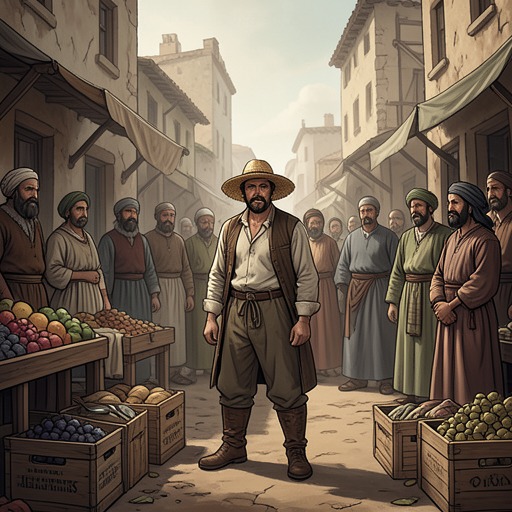
Journey to the End of the NightThe Director is the head of the Compagnie Pordurière’s colonial operation who hires Ferdinand Bardamu and dispatches him to the isolated trading post at Bikomimbo. A mixture of employer, disciplinarian, and habitual embezzler, he presents colonial rule as a project of commercial order while relying on violence and deception to sustain it. His authority makes the same logic visible in two different labor systems: the Company’s colonial warehouse and, later, the mechanized factory where Bardamu works in America.
Identity and Appointment
The Director lives near the Government House in a large straw bungalow raised on piles. When Bardamu applies for work, he first questions him about his past and examines his papers, learning that he has studied medicine. The Director treats that training as a practical convenience rather than a qualification: it may come in handy at an isolated post, but the job he offers is commercial, and the employee he wants is one who can be sent where the Company needs him.
Bardamu’s refusals of whisky and tobacco make the Director suspicious. He remarks that employees who do not drink or smoke may be untrustworthy, and speculates, without evidence, that a homosexual employee might steal less and become attached to the Company. The exchange establishes the Director’s coarse, instrumental view of people: he assesses prospective workers by whether their habits seem likely to make them useful, loyal, or manageable.
He assigns Bardamu to Bikomimbo, replacing an employee he calls dishonest and unreliable. The posting is a ten-day journey, first by sea and then upriver, deep in the bush. The Director tells Bardamu to take inventory, says the post has three months of food and a year’s supply of merchandise, and insists that the Company’s accounts and stock come first. His instructions are mixed with warnings that the predecessor may be ill, may have tampered with his quinine, or may arrange for Bardamu to be thrown overboard. The advice conveys both the danger of isolation and the Director’s instinct to interpret every difficulty as possible deceit by someone else.
Authority and Violence
The Director’s authority is not merely verbal. During Bardamu’s interview, a houseboy is slow to arrive, and the Director strikes him and kicks him before returning to his seat. He then treats his own outburst as an ordinary lapse of temper and asks Bardamu to hand him his whip and quinine. The scene compresses the hierarchy around him: violence toward a subordinate is immediate, while the Director’s account of the incident turns quickly to his own irritation and self-control.
The Company’s routine operations extend the same coercion beyond the household. In its main warehouse, Bardamu learns to number sacks and falsify weights among the workers handling the goods. Overseers strike workers who continue their labor without protest, while the Director visits to check that Bardamu is mastering both the counting system and the falsification. Commercial procedure and physical discipline thus operate together: the clerical task is not neutral bookkeeping, but part of a system that extracts labor and manipulates the recorded quantities.
The Director frames this system as civilizing progress. He tells Bardamu that when he first came to the region, nearly thirty years earlier, people lived by hunting, fishing, and intertribal warfare; now, he claims, the Company has replaced that life with labor producing peanuts and rubber, which are taxed. In his telling, the transition from independent subsistence to a colonial labor force is an achievement. The warehouse scene, however, shows the actual terms of that order: workers crowded into exhausting conditions, the blows of overseers, and goods whose weights the Company expects Bardamu to falsify.
Company Interests and Character
The Director’s talk repeatedly turns people and circumstances into instruments of business. He insists that the Company comes first, describes the distant employee’s illness as no excuse for failing to send accounts, and emphasizes the post’s inventory and stock. Even his reassurances about supplies are paired with suspicion and warnings. The employee is expected to protect the Company’s interests in a place where communication is difficult and supervision intermittent, while the Director retains the power to define what counts as diligence or misconduct.
His own loyalty to the Company is compromised by his appetite for personal gain. In Fort-Gono, Bardamu regards him as consumed by the desire to defraud the Company. The Director speaks indirectly, through muffled hints, and is understood to be engaged in conspiring, spying, and betrayal. Bardamu hears that he steals and embezzles more than the other officials combined and says that this reputation is easy to believe. The Director therefore does not simply enforce the commercial order from outside it: he manipulates that order for himself even as he demands that subordinates obey it.
His public language of improvement also sits uneasily beside his own conduct. He condemns the absent employee’s failure to provide accounts and warns Bardamu against dishonesty, yet his own dealings are represented as more corrupt than those of his fellow officials. The contrast is not an accidental flaw in an otherwise impartial administrator. It defines a hierarchy in which rules are imposed downward, while the person enforcing them can bend the Company’s resources to his own advantage.
Bardamu’s Service and Aftermath
Before Bardamu leaves, the Director describes the conditions of the journey and the post in detail, but he does not accompany him. Bardamu must make the trip and manage the remote station on the strength of the Director’s instructions. At the post, his later experience of sickness and isolation is accompanied by letters from the Director in Fort-Gono. Bardamu describes these as insulting, foolish, and threatening; rather than offering help, they extend the employer’s authority through a distant stream of demands.
The Director’s correspondence becomes part of Bardamu’s growing inability to respond to the Company. Sick and unable to rise, Bardamu does not answer the letters from his employer or his mother. He recognizes that silence does not improve his situation, but writing seems equally useless. The Company’s administrative reach remains present, yet it arrives as pressure rather than assistance. The post’s isolation therefore does not free Bardamu from the institution; it leaves him exposed to its demands with fewer means to resist them.
The Director’s significance reaches beyond the colonial episode when Bardamu later enters the Ford factory. There, a medical assistant tells him that his health does not matter and that he is not being hired to think, but to perform assigned movements. Bardamu’s prior experience of Company labor—numbering sacks and falsifying weights under surveillance—forms a stark counterpart to the factory’s task assignment and machinery. The institutions differ in setting and technology, but both reduce the worker’s judgment and body to something usable and replaceable. The Director is a particularly vivid agent of that process: he makes colonial exploitation personal, combining the Company’s bookkeeping, its labor discipline, and his own self-serving corruption in one figure.