Disease and bodily decay
Journey to the End of the NightDisease and bodily decay recur as both lived bodily experience and a measure of the institutions that claim to manage human life. Soldiers, colonists, workers, and poor patients are variously watched, exploited, neglected, or treated with uncertain means; the narrator moves among these settings as both witness and doctor, repeatedly confronting the limits of care and the body’s decline.
Disease in the Colonial Climate
On the voyage toward the colonies, the narrator observes that the officers aboard the Admiral Bragueton are themselves visibly unwell. Malaria, alcohol, and other illnesses accompany the heat and exposure; the mosquitoes, parasites, and failing organs he describes make colonial authority look less like mastery than another form of defeat. The ship’s slow passage becomes an image of bodies deteriorating in a place where, in the narrator’s account, decay comes quickly. He contrasts this with the relative preservation of northern bodies, presenting colonial life as a condition in which bodily decline seems to begin almost on arrival.
The company’s warehouse at Bikomimbo makes the connection between disease and exploitation more direct. To learn the work of counting sacks, the narrator must labor among crowded, sick workers while overseers use clubs to drive them on. The Director expects him to learn not only the counting but the falsification of weights. The workers’ physical suffering is therefore inseparable from the commercial system that extracts their labor; the warehouse’s procedures turn bodies into instruments of production while the company’s authority polices both work and output.
At Fort-Gono, disease also weakens the colonial military. European conscripts are repeatedly hospitalized with malaria and parasites, leaving the military ranks depleted. The hospital offers the narrator a brief refuge from company and military authority, but it is no secure escape: regulations send many patients back to the bush, while those who die are buried nearby. Some of the strongest patients manage to board a transport to France, but such departures are exceptional. The hospital thus stands between temporary shelter and continued exposure, with illness determining whether a colonist returns to labor, leaves the colony, or dies there.
Illness, Work, and the Body as Instrument
Disease and bodily harm are not confined to the colonies. In the Ford factory, the narrator is told that intelligence is unnecessary and that workers are wanted for obedient movements. The machinery’s noise and vibration overwhelm him; labor reduces the task to repetitive motions, first passing linchpins to a blind worker and then moving washers on a trolley. His reassignment after only three days marks him as a failure, but the larger effect is a sense of bodily and mental conversion: the factory’s demands make workers seem like extensions of the machinery. The scene places industrial exhaustion beside colonial labor, showing distinct systems that both subordinate the body to an imposed task.
The factory also changes what the narrator seeks outside work. The labor leaves him longing for contact with a living body, and his visits to a clandestine house consume his wages. He describes this as a means of recovering from the physical horror of factory life. The contrast is not a cure for illness, but it reveals how thoroughly industrial routine has unsettled his sense of embodied life: after the machine’s relentless noise, he seeks an experience he associates with warmth and vitality.
Earlier, in the colonial bush, the narrator’s isolation and weakness become concrete when he eats the only chicken Robinson had left him. The meal is followed by an illness that leaves him unable to rise; when he reaches the medicine chest, it contains only iodine and a map of the Nord-Sud Métro. With no customers and little practical help, his body becomes an object of helpless observation. The episode links disease to isolation and deprivation: in a remote post, even a sick man with medical training may have almost nothing with which to treat himself.
The Poor Patient and the Limits of Medical Care
Back in Paris, the narrator’s work brings him into households where sickness is compounded by poverty, fear, and family denial. At the Gagat household, he finds a young woman who has lost a dangerous amount of blood. Her mother is consumed by the shame of what neighbors might think, while the father remains apart in the next room. The narrator cannot carry out a useful examination and can do little beyond tending to the immediate situation. The scene makes the medical crisis inseparable from the household’s social anxieties: the need for care is evident, but the family’s response is shaped by appearances and fear.
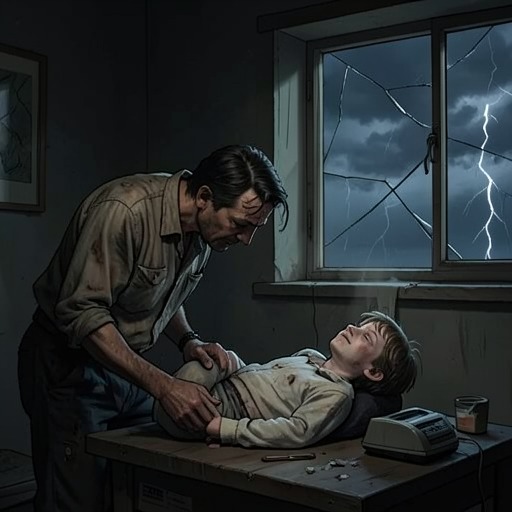
Bébert’s illness presents a longer and more difficult test. The child grows steadily thinner and weaker, while the narrator tries baths, serum, a restricted diet, and vaccines without success. Bébert’s aunt moves between silence and renewed grief; she also entertains an explanation involving rum and chamomile tea, which the child faintly repeats in his fever. Neighbors urge her to dismiss the narrator, partly because the story of another difficult case has damaged his reputation. Yet other doctors are reluctant to take Bébert on after learning what the illness is, so the narrator remains responsible for him.
Around the seventeenth day, the narrator seeks advice at the Joseph Bioduret Institute. The visit does not provide a decisive answer. He finds the laboratories disordered and has to seek out Serge Parapine, a former teacher who had once shown him kindness and taught him to use a microscope. Parapine is willing to help, but twenty years of competing and contradictory medical claims have left him unable to offer a firm view of typhoid treatment. The narrator’s consultation therefore exposes a gap between the authority of scientific institutions and the uncertain knowledge available at the bedside. He seeks advice partly because he wants to know he has tried everything, and partly because he fears the guilt of failing to do so.
The narrator’s attention to Bébert also reveals a difference in how he responds to a child’s illness. He admits that preventing the child’s death matters to him more than preventing an adult’s, because a child’s future remains imaginable. That distinction does not change the outcome: his efforts fail, and Bébert dies. The episode makes medical responsibility painfully personal while refusing the comforting idea that effort or professional knowledge can command recovery.
Bodies under Observation and Control
During the war, the narrator’s body is treated as a problem to be observed and classified. Wounded men whose patriotism is considered impaired are lodged in a secondary school at Issy-les-Moulineaux, where staff watch them and authorities try to induce or compel confessions. The men may be sent to an asylum, back to the front, or to a firing squad. Here, medical observation and military discipline converge: a soldier’s condition becomes a question not only of health but of whether he can be made to return to the war.
The narrator later describes the signs of this administrative control as visible even when personnel speak gently. Papers, precautions, and identification tags around the necks and wrists make the wounded feel counted and assigned to the multitude expected to return to the front. The institution’s apparent care does not remove the threat that governs it. Instead, the body is monitored as a unit of military manpower, with illness or psychological distress judged partly by its implications for service.
A related uncertainty surrounds Robinson after an attempted murder leaves his face badly injured. The Henrouilles keep him in their house because a hospital admission could prompt gossip, while returning him to his own lodgings is considered impossible. The narrator tends the wound and fears that scarring may impair Robinson’s sight. The blinds are kept drawn, neighbors gather to speculate, and the family tells them false stories; Robinson, meanwhile, is terrified of being expelled and prosecuted. His care takes place in secrecy, with the injured body entangled in the family’s fear of exposure and legal consequences.
Significance
Across these episodes, disease is never simply an isolated medical fact. In the colonies, it accompanies labor extraction and can determine whether a worker is returned to the bush or buried; in the factory, bodily and mental exhaustion follow the subordination of workers to machinery; in poor Paris households, illness meets limited resources, family shame, and uncertain expertise. Military authorities likewise inspect and classify wounded men according to their usefulness and perceived fitness. The body is repeatedly made the point where economic, social, and administrative power becomes tangible.
The narrator’s position as both medically trained observer and vulnerable body sharpens this pattern. He cannot keep himself safe in the bush, cannot secure a cure for Bébert, and cannot separate his professional actions from the guilt they leave behind. The novel’s treatment of illness therefore resists a clean division between expert and patient or between institutional care and coercion. Bodies suffer in particular circumstances, while the systems around them offer incomplete protection and often make their prospects worse. Disease and bodily decay give physical form to the novel’s broader vision of precarious life, but their force rests in specific conditions of work, poverty, exposure, and care rather than in abstraction alone.