Ferdinand Bardamu
Journey to the End of the NightFerdinand Bardamu is the novel’s first-person narrator and central character, a physician whose life moves through military service, poverty, and precarious work. His defining break comes almost at the outset: after a conversation with his friend Arthur Ganate about national pride and public rhetoric, he impulsively enlists when a regiment passes. The decision sets his own fear of death against the collective performance of patriotism, and establishes the skeptical, self-examining voice through which he recounts the rest of his life.
Identity and Introduction
Bardamu introduces himself through a conversation rather than a conventional account of his origins. He meets Arthur Ganate, a friend from medical school, at Place Clichy. As they talk, Ganate disparages the claims of modern progress and the French press’s defense of the French race. Bardamu answers that the French race needs defending because it does not exist. Their exchange makes him a participant in political argument before it makes him a soldier: he is quick to respond, but the scene also shows how words and public claims can turn into action.
When a regiment marches past the café, Bardamu rises and announces that he will go see whether Ganate’s account of the world is right, then hurries to enlist. Ganate calls after him not to be foolish. Bardamu admits that the rebuke hurts his feelings, but he falls in with the regiment anyway. His enlistment is therefore neither presented as a considered political commitment nor as a reasoned military choice; it follows a moment of enthusiasm and wounded pride, with consequences that sharply exceed the casual exchange that preceded it.
War, Fear, and Refusal
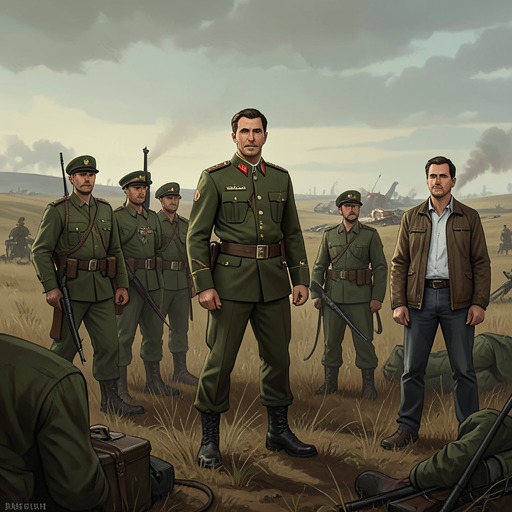
The narrator’s experience of war exposes the distance between patriotic ceremony and the reality he anticipates for himself. After a ceremony in a meadow, where the colonel urges the regiment onward and proclaims “Vive la France!”, Bardamu walks through the rain-soaked fields of Flanders. Alone, he thinks about the possibility of a bullet finding him and about the death the army is bringing near. The contrast is not simply between a speech and a battlefield: it is between the colonel’s confident public performance and Bardamu’s acute, individual awareness that death is irreversible.
Bardamu imagines the court-martial that might follow if he wandered away from the regiment. In his account, military authority can punish flight through a hurried trial and execution; fear does not offer an easy escape from the system that produces it. He also imagines the colonel as a figure fit for a music-hall stage, a public star whose bravery looks spectacular from the outside. That theatrical image sits beside his private dread and deepens his suspicion of heroism as performance.
In conversation with Lola, Bardamu makes his refusal explicit. He says that he rejects the war and everything in it, insists that he does not want to die, and refuses to treat the soldiers’ deaths as meaningful simply because they serve a national cause. He points to the anonymity of the dead in the Hundred Years’ War: Lola cannot name them or say who they were. His argument turns the grand language of sacrifice toward the individuals it erases, while his own blunt insistence on survival leaves him open to being called a coward. For Bardamu, fear is not a temporary embarrassment that patriotic language can cure; it is a truth that the public performance of courage attempts to cover.
Work and Poverty
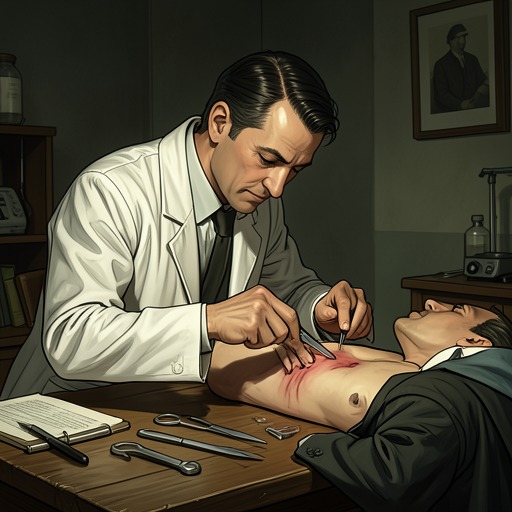
After returning to civilian life, Bardamu practices medicine amid the poverty of the Parisian outskirts. For a time, he is placed in charge of a small tuberculosis dispensary, which brings in eight hundred francs a month. His patients come largely from the Zone, a settlement that remains mired in mud and refuse. The practice makes clear how little a poor doctor can alter the conditions around him: Bardamu says that he performs no miracles, while the people he treats are less focused on cure than on the possibility that their illness might qualify them for a government pension.
The patients’ hope is tied to the prospect of moving from absolute misery to a less desperate condition supported by a small income. They wait in the dispensary’s corridor and doorway, hoping for proof of tuberculosis that will strengthen a pension claim. Their sputum results matter not only as medical evidence but as a possible route to economic survival. Bardamu’s account thus complicates the role of physician: he observes illness and treats patients, but the social circumstances that make a pension more compelling than recovery exceed what his practice can remedy.
His own livelihood is likewise insecure. In a later encounter, he tells an acquaintance about his adventures with a husband he has just lost by the wayside. The story earns a laugh, but the man’s coughing interrupts the exchange. Their surroundings are marked by drafts and fleas, which Bardamu says he brings home from his patients. Poverty appears not as an isolated misfortune but as a condition that travels between homes, patients, and the doctor who attends them.
Relationships and Self-Presentation
Bardamu’s relationships bring out the conflict between frankness and social performance. With Lola, he speaks directly about his fear and his rejection of the war, even though he knows that this position makes him contemptible in her eyes. Their exchange gives his private survival instinct a public test: he does not soften it into a more acceptable account of patriotic feeling, and he does not claim to mourn a cause he rejects.
His connection to Robinson remains a source of unease. After a night out, Bardamu wakes beside Tania and says he is unwell to get her to leave, then goes out himself because remorse about Robinson has returned. He recognizes that he abandoned Robinson to his fate and to the care of Abbé Protiste. Although he has heard that things are going well in Toulouse and that Grandma Henrouille is treating Robinson kindly, he distrusts such vague reports and goes looking for definite news. His decision to seek confirmation shows that detachment does not erase his sense of responsibility, even when he has already failed to act decisively.
Bardamu also adopts the social habits he observes in Robinson. At a comfortable table among wealthy guests, he invents a more impressive version of his life: he boasts of an enormous clientele, crushing overwork, and a friend who offered him a chalet near Toulouse. Robinson’s example has shown him how lies can help the poor present themselves as equals in company that would otherwise expose their disadvantages. Bardamu recognizes his own pride in the performance. The lies win him and Robinson a warmer reception, and the guests come to find them interesting; the episode makes social acceptance depend less on truth than on the convincing appearance of status.
Narrative Role and Significance
Bardamu’s account holds together episodes that move between war, medical work, and unstable personal connections. Its continuity comes not from a steady rise in status or security but from the narrator’s recurring need to assess danger, poverty, and the stories people tell about themselves. His early enlistment, prompted by a passing regiment and a moment of enthusiasm, contrasts with his later rejection of the war; the contrast gives his life a sharp irony without turning him into a detached observer of suffering.
His narration is also self-implicating. Bardamu condemns the public myths that dignify war, yet admits that he once followed a regiment in a surge of enthusiasm. He sees the poor’s dependence on pensions, but also makes use of exaggeration to pass among the wealthy. His account of Robinson includes regret for having abandoned him, alongside a recognition that convenient reports can substitute for facts. These tensions make him more than a mouthpiece for a single judgment: he is at once witness, critic, participant, and a person who must confront the compromises involved in staying alive.
Across these scenes, Bardamu’s perspective exposes how institutions and social rituals translate vulnerability into acceptable forms: courage for the soldier, a pension claim for the sick, and an inflated biography for the poor guest at a rich table. His lasting significance lies in refusing to let those forms settle the meaning of what happens. He returns attention to the person who fears death, waits for aid, or lies to avoid humiliation, and measures grand explanations against the ordinary consequences they conceal.