Forced labor and taxation in the French colonies
Journey to the End of the NightForced labor and taxation in the French colonies form a system of extraction that joins overt violence to the promise of economic advancement. In the trading posts and plantations of Compagnie Pordurière, local workers are driven to work with clubs, while poor Europeans are drawn into the same economy through the hope of becoming rich and powerful. Taxes and production reinforce one another: colonial authorities collect taxes by force and present rubber and peanuts as the orderly alternative to earlier ways of life. The narrator’s later experience at the Ford factory extends the comparison, showing how labor discipline can compel bodies without the colonial club.
Colonial Labor and Its Divisions
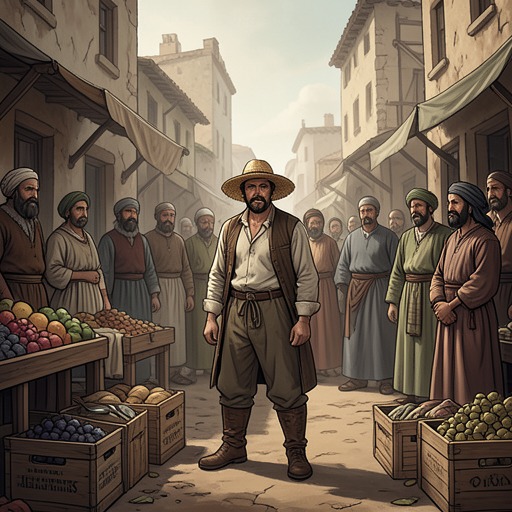
At the Compagnie Pordurière’s warehouses and plantations, the narrator observes both local workers and poor Europeans. The local workers, he says, have to be driven to work with clubs; the Europeans work of their own accord, their education having filled them with hopes of wealth and power. The apparent distinction between forced and voluntary labor therefore conceals a shared dependence on exploitation: one group is compelled directly, while the other is induced to submit by an imagined prospect of advancement.
The narrator’s irony turns the language of civilization against itself. He contrasts the colonial company’s methods with ancient forms of slavery, arguing that modern rule is more efficient because it can address a worker as a gentleman, allow him a vote or a newspaper, and still extract his labor. Military service, too, can redirect people’s impulses into obedience. The point is not that these gestures eliminate coercion, but that a more accommodating surface can make subordination easier to accept.
Production, Taxation, and Colonial Order
The company’s labor process is visible in its warehouse. The narrator learns to number sacks while working between scales amid crowded workers, under the sound of overseers’ clubs. The Director checks that he is mastering both sack-counting and the falsification of weights, making clear that the work serves an extractive commercial system rather than neutral administration.
The Director’s account of colonial change lays out that system’s self-justifying logic. He claims that, before the company’s arrival, local communities lived by hunting, fishing, and conflict; now, he says, the company has replaced those practices with a labor force producing peanuts and rubber. The products are tied directly to taxation: taxes are collected to obtain more rubber and peanuts, and production in turn supplies the basis for those taxes. The Director presents this as progress, but the narrator’s account exposes the coercion beneath the claim. The change is from one imposed order to another, with labor and revenue organized for the company and colonial administration.
The same pattern appears beyond the main trading post. Around Topo, communities suffering from chronic poverty and disease pay a small tax collected with clubs. Some young men are recruited into a twelve-person militia to wield those clubs. Taxation, recruitment, and enforcement thus belong to one arrangement: people are made to pay, and some are enlisted to help enforce the system that extracts payment.
Consent, Discipline, and the Factory
The colonial scenes find a revealing counterpart in the narrator’s employment at the Ford factory. During the hiring examination, a medical assistant dismisses the narrator’s poor health as irrelevant, and a doctor tells him that his education will not help: the job requires him to perform instructed movements, not to think. The factory openly treats workers as interchangeable labor and warns the narrator not to assert his intelligence.
Once inside, the narrator is absorbed into machinery and repetitive tasks. He first passes linchpins to a blind coworker; after doing the job badly for three days, he is transferred to pushing a trolley of washers from machine to machine. This process differs from the clubs used in the colonies, but the result is likewise diminished agency: work is divided into simple motions, and the worker’s time is subordinated to the unbroken demands of production.
The narrator’s reflections distinguish between the systems without treating one as free. In the colonies, violence is visible in the overseer’s club and in taxes collected by force. At Ford, the threat of dismissal and replacement disciplines workers, while the instruction not to think makes obedience part of the job itself. The parallel shows how coercion can be organized through physical force, economic vulnerability, or routine; each makes labor available to an institution while narrowing the worker’s power over its conditions.
Significance
The account connects colonial rule to the broader organization of labor rather than isolating it as a remote abuse. Company production, taxation, military discipline, and factory hiring each offer a different means of securing work and compliance. The colonial Director’s language of improvement disguises a system in which rubber and peanuts serve both commercial production and tax collection, while the factory’s language of efficiency makes intellectual submission an explicit requirement.
The resulting contrast is between direct compulsion and consent shaped by limited choices, not between coercion and freedom. Local workers are driven with clubs; poor Europeans are encouraged by hopes of success; factory hands risk losing their jobs if they resist. By placing these arrangements side by side, the novel shows how institutions can vary their methods while preserving a common outcome: people are treated as labor to be directed, measured, and replaced.