Ford factory
Journey to the End of the NightThe Ford factory is the industrial setting in which Ferdinand Bardamu discovers that employment offers no refuge from insecurity: the factory will hire a sick, educated man, but only on condition that he stop thinking and perform assigned motions. Its immense machinery turns workers into components of a production system, while its ready supply of replacements makes each individual expendable. Bardamu’s brief tenure ends when he cannot return after an absence; the machines continue without him.
Setting and Recruitment
Bardamu first sees the factory as a group of large, squat glass buildings, with men moving inside as if struggling against something impossible. The sound of machinery surrounds the buildings: a heavy, continuous roar of turning, grinding equipment that seems close to breaking down but does not. At a door, a notice announces that men are wanted. The setting thus presents employment as both opportunity and warning before Bardamu enters the hiring process.
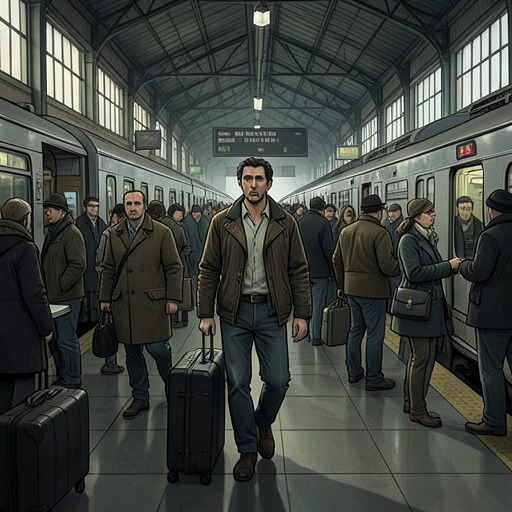
The crowd waiting outside includes an applicant who says he has been standing there for two days and has traveled from Yugoslavia for the job. Many applicants speak little English and watch one another warily. An older Russian former taxi driver advises Bardamu that the factory hires almost anyone, but warns that an employee who becomes difficult can be dismissed quickly and replaced. The prospect of work rests on an imbalance: there are always more desperate applicants waiting than there are secure positions.
The factory’s medical examination makes that indifference explicit. Applicants are stripped for inspection, and an assistant tells Bardamu that he is in terrible condition but that this does not matter. Bardamu worries that his African fevers might disqualify him, yet the factory welcomes weak and physically impaired applicants because their health is irrelevant to the work it intends to assign. The doctor explains that Bardamu’s medical studies are no advantage: the factory needs obedient workers, not people expected to think or use their intelligence. Bardamu takes the warning and resolves to pass as a quiet, compliant laborer.
Labor and Discipline
On entering the building, Bardamu and the other new workers are absorbed into its physical rhythm. The immense structure trembles with the machinery; the vibration reaches the workers’ bodies, and groups gradually disappear from one another’s company as each person is placed at a machine. The production system does not simply direct their work: it overwhelms communication and makes their bodies part of the factory’s continuous motion.
Bardamu is assigned to pass linchpins to a blind worker who has calibrated the same pieces for years. He performs badly and, after three days, is transferred to pushing a small trolley of washers between machines. He leaves inconsistent quantities at each station, and no one speaks to him about the mistakes. His tasks have narrowed from skilled thought to repeated handling and delivery; the unbroken noise, rather than any conversation or personal judgment, governs the workers’ time.
The factory’s internal transport reinforces that hierarchy. A small cart carrying hardware jolts between machines, and workers jump aside to let it pass. It brings materials to people bent over their workstations, while the production process requires them to keep adjusting bolts and other components. The scene presents human labor as organized around the needs of equipment and output: people yield to the moving apparatus, and the routine continues without pause.
Bardamu’s Transformation and Departure
The workday’s end does not immediately restore Bardamu to ordinary life. At six o’clock, the machines stop, but he carries their noise in his head through the night, along with the persistent association of the workplace with oil. After several weeks of renunciation and repetitive labor, he describes himself as becoming a different Ferdinand. His desire to see people returns, but not for the factory workers, whom he experiences as extensions of the machines and their vibrations.
Seeking relief from the factory’s effect, Bardamu spends his wages at a clandestine house, where he finds a form of personal welcome unavailable in the industrial workplace. He becomes a regular customer, and his trust in Molly develops there. This contrast makes the factory’s cost measurable in the narrative: wages earned through mechanized labor are consumed in the effort to recover a sense of human contact. The workplace does not supply a stable life outside its walls; it leaves Bardamu searching for a substitute for the vitality he feels it has drained away.
Bardamu later attempts to return to the factory, but freezes at its gate when he imagines the machinery waiting inside. He stands outside the glass-fronted power plant rather than rejoining the work. An older Russian he recognizes tells him he has already been fired after three weeks of absence and that a machine has taken his place. Bardamu accepts the dismissal as an end to the matter and leaves for town. The episode confirms the warning given during recruitment: the factory’s labor system can replace an absent worker without interrupting production.
Industrial Significance
The Ford factory is linked in the novel to another organized workplace Bardamu has experienced: the Compagnie Pordurière’s warehouse. There, clerks number sacks and falsify weights amid the company’s labor force; at Ford, new hires are examined, assigned simple operations, and expected to follow instructions rather than think. The institutions differ in setting and work, but both reduce labor to tasks serving an employer’s system and treat workers’ bodies as usable resources.
At Ford, this reduction is expressed through the contrast between the workers’ replaceability and the machinery’s relentless continuity. Bardamu’s intelligence and prior medical studies have no value to the hiring doctor, his health is not a reason to refuse him, and his errors lead only to reassignment. Once he cannot endure the routine, his place is filled. The factory therefore becomes more than a backdrop to his employment: it is a concentrated image of industrial modernity in which work absorbs attention and movement while the worker remains disposable.