French Army
Journey to the End of the NightThe French Army is the military institution that draws Ferdinand Bardamu into the war and then subjects him to its routines of command, combat, discipline, and medical observation. In his account, its public language of patriotism and heroism collides with the fear and disposability of ordinary soldiers: a moment of enlistment becomes a passage into what he calls collective murder, while the institutions charged with judging or treating him remain part of the machinery of war.
Recruitment and Entry into Service
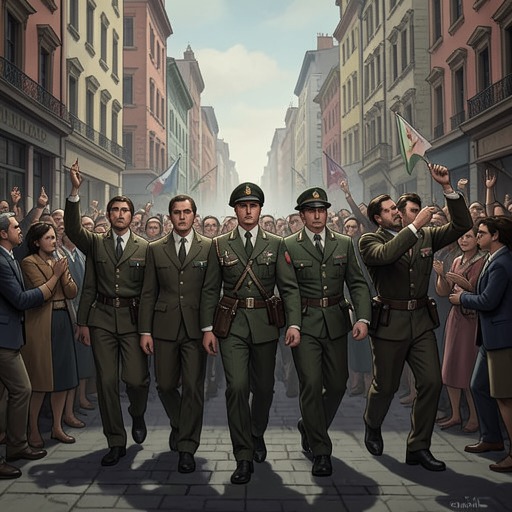
Bardamu enters the French Army after arguing with Arthur Ganate about work, class, and war. He imagines ordinary people below deck in a galley, laboring for nothing while their masters enjoy privilege, then confronts the contradiction between that image and his own actions. When a regiment passes the café, enthusiasm carries him to his feet; he announces that he will find out whether his argument is true and enlists. Arthur calls after him, warning him not to be foolish, but Bardamu falls in with the regiment. The decision is impulsive rather than the result of settled conviction, and its consequence is immediate: once the civilians have joined, the gate closes behind them.
Command and the Experience of War
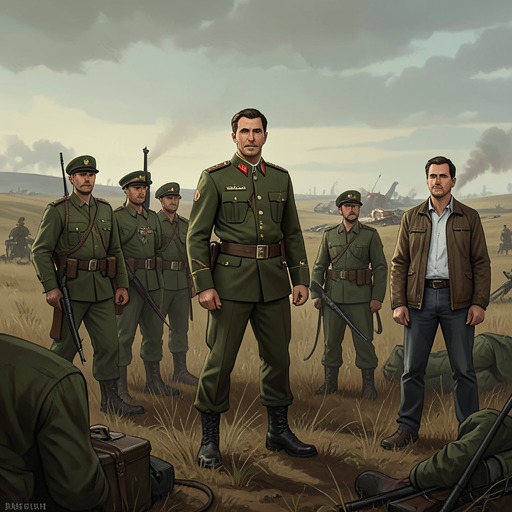
After two months on horseback, Bardamu and the other soldiers are back on foot. He serves beside a colonel, holding the officer’s orderly book as the colonel writes orders, while two German soldiers fire at them from far down the road. Bardamu cannot identify any reason for the shooting and recalls having known Germans from school near Hanover. The gulf between ordinary acquaintance and apparently senseless combat makes the war seem unintelligible to him.
The colonel’s composure sharpens Bardamu’s fear. The officer reads messages from General des Entrayes while bullets pass nearby, and the routine delivery of those messages gives no sign that anyone in command intends to stop the fighting. Bardamu imagines the war continuing because brave men on both sides cannot conceive of their own deaths. His account casts military courage not as reassurance but as a force that sustains collective violence, while his own fear makes him feel isolated among people who accept the danger.
Bardamu’s early doubts do not release him from service. When the colonel is killed, Bardamu brings the news to an advance post and is assigned instead to collect provisions with two other soldiers. Later, he becomes a corporal and is repeatedly sent on liaison duty under General des Entrayes. The general’s demands for a clean bed and a well-equipped kitchen during the retreat reveal a hierarchy in which senior officers’ comfort is protected while troops are made to give way. The chief of staff, despite his own discomfort, has to attend to the general’s requirements; soldiers displaced to make room for headquarters are left to spend the night outside.
Discipline, Injury, and Institutional Judgment
The Army’s power over Bardamu is visible not only at the front but in the punishments he fears. After a dangerous episode, he imagines a hurried court-martial in an abandoned classroom, with noncommissioned officers seated at school desks and himself standing handcuffed before them. He expects execution the following morning. The image joins military justice to an improvised classroom: an institution that claims authority over life appears, in his imagination, both terrifying and makeshift.
After falling ill and becoming delirious, Bardamu is treated as a problem to be classified. Some observers call him an anarchist and want him shot; others regard him as genuinely insane and favor confinement until the war ends. The dispute over his diagnosis exposes how the label of sanity can be governed by nerve and majority opinion rather than reliable judgment. The authorities place him under observation, and his mother and Lola receive permission to visit him only occasionally.
The wounded are housed at a secondary school in Issy-les-Moulineaux, adapted for soldiers whose patriotism is considered impaired or dangerously unwell. Staff monitor them, and after observation men may be sent to an asylum, returned to the front, or, Bardamu says, sent to a firing squad. The arrangement presents treatment and surveillance as adjacent functions: the soldiers are observed not simply as patients but as men whose fitness for the war must be decided.
Patriotism, Heroism, and the Soldier’s Body
The institution’s patriotic language appears in a lesson delivered by a professor, who asks Bardamu to name the concept that can elicit altruism from the elite and answer the prompt himself with patriotism. The professor links patriotism to glory and claims that soldiers abandon self-preservation at their first battle. Bardamu’s agreement is part of the exchange, but the surrounding narrative places this ideal against his fear and his experience of the front. Patriotic doctrine presents the surrender of self-preservation as truth; the story reveals the practical cost of that doctrine in soldiers’ bodies and lives.
In the hospital, a medical authority gives a speech about military service that Bardamu finds more likely to disgust him with dying than to encourage him. The subdued manner of the staff does not dispel the threat of return to the war. Soldiers are tagged when allowed out, asked to sign papers, and made to feel counted and watched among the larger body destined for the front. The contrast is deliberate: civilian and medical personnel can look toward continued life, while the wounded understand that administrative procedure may send them back into danger.
Narrative Significance
The French Army is presented through Bardamu’s changing position within it: first a civilian who enlists in a flash of enthusiasm, then a frightened soldier, a corporal, a patient under observation, and an object of institutional judgment. This episodic movement makes the Army less a single battlefield presence than a sequence of systems that recruit, command, discipline, assess, and potentially return men to combat.
Bardamu’s perspective also unsettles the distinction between heroic conduct and madness. Officers’ composure, patriotic instruction, and administrative order cannot make the fighting meaningful to him; instead, they help sustain it. By setting military ideals against the ordinary soldier’s fear, bodily vulnerability, and uncertain fate, the novel depicts the French Army as both an agent of organized war and a central instrument through which that war’s human costs are imposed.