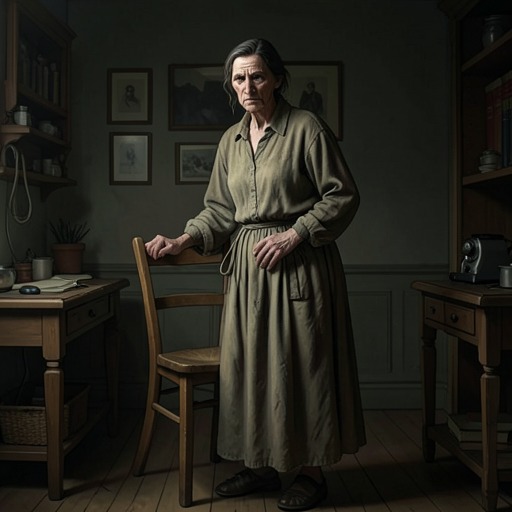
Grandma Henrouille’s death in the crypt
Journey to the End of the NightGrandma Henrouille’s death in the crypt is disclosed as a calculated killing made to look accidental, a revelation that turns the family’s cramped, unstable surroundings into cover for Robinson’s crime. Ferdinand first hears of the death from Abbé Protiste in Toulouse, then privately gets Robinson to reconstruct what happened. The two tellings converge on the same fact: Robinson pushed the old woman down the cellar stairs, and the belief that he was still blind shielded him from suspicion.
The Death Reported in Toulouse
Ferdinand learns of the death during a conversation with Abbé Protiste, who has arrived from Toulouse. The report is not delivered as a straightforward confession. Ferdinand pretends to be astonished and asks when the old woman died; Protiste gradually has to disclose more. He never says outright who pushed her, but he gives Ferdinand enough to infer the answer. The indirectness makes the news a test of what Ferdinand already knows as much as an account of the death itself.
Protiste’s account also fixes the public version of events. The neighborhood takes the death for a tragic accident, judged plausible in light of Grandma Henrouille’s age, the late-afternoon hour, and her presumed tiredness. Most importantly, people believe Robinson is still completely blind. That assumption makes an intentional push seem unlikely to them and allows the accident explanation to stand.
Robinson’s Account of the Killing
Ferdinand later speaks with Robinson in an isolation room at the institution. He has already heard Protiste’s hints and knows Robinson is capable of another attempt; he now invites him to explain the whole scheme. Robinson admits that the old woman had become a persistent source of resentment. As his eyesight improved and he could go out alone, he began to see her again; he describes her presence in the house as constant and oppressive. The household’s small size, with everyone crowded together, supplies the immediate setting for their conflict, but Robinson’s account makes clear that the death was not simply an accident born of that tension.
Ferdinand asks about the cellar stairs, which he had noticed were shaky when he first visited the crypt with Madelon. Robinson agrees that their weakness made the setting practically a setup. He acknowledges that he pushed Grandma Henrouille down them, describing this as his successful second attempt. The compromised stairs helped make the act appear accidental, while his improved but still concealed vision let him act without the neighbors recognizing him as capable of it.
Concealment and the Misreading of Robinson
The murder’s concealment depends on the gap between Robinson’s actual condition and the neighborhood’s belief. Although his eyes had begun to improve enough for him to go out alone and see Grandma Henrouille, the people around him continued to regard him as blind and therefore incapable of the crime. They consequently interpreted the death through familiar circumstances—an elderly woman, a dangerous staircase, and the time of day—rather than suspecting a deliberate act.
Ferdinand and Robinson’s later conversation gives the earlier report a more definite meaning. Protiste had allowed Ferdinand to guess without naming the killer; Robinson’s admission confirms that inference. The scene is thus structured as a staged disclosure: first the death is explained away publicly, then its circumstances are pieced together privately, and finally Robinson supplies the direct acknowledgment that the earlier account withheld.
Narrative Significance
The death turns an apparently ordinary domestic accident into a concealed act of violence. A defective staircase and a shared, crowded house are not incidental background: they provide the conditions under which Robinson can make murder pass for misfortune. The same details that make an accident believable also help expose how easily a community’s assumptions can substitute for investigation.
The revelation is delivered through two conversations rather than through an eyewitness account of the killing. Protiste’s cautious hints invite Ferdinand’s inference; Robinson’s later admission completes it. This delayed confirmation makes the reader follow the same progression from an ambiguous death report to a private explanation, while the gap between Robinson’s improving sight and the neighborhood’s assumption of blindness supplies the decisive concealment. The outcome is not a mystery left unresolved: Robinson’s account identifies him as the person who pushed Grandma Henrouille down the stairs and explains why the act was taken for an accident.