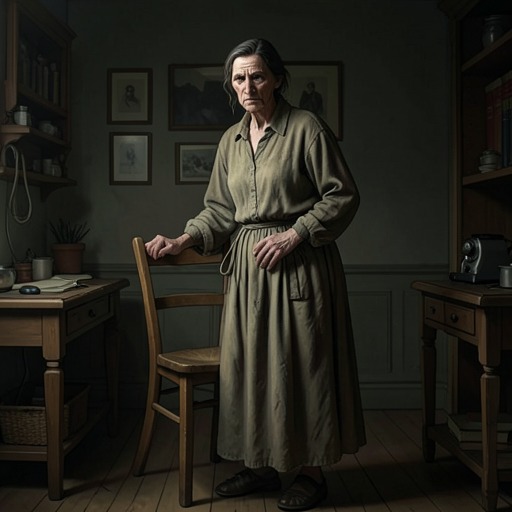
Jules Henrouille
Journey to the End of the NightJules Henrouille is a retired notary’s clerk whose hard-won security does not bring peace: once the house is paid for, fear migrates from money to his body, and his attention fixes on a diagnosis of high blood pressure and the prospect of death. Through his routine, his anxieties, and his silence about his mother, Jules embodies a life organized around saving against disaster, in which each settled worry leaves room for another.
Identity and Background
Jules and his wife have spent decades acquiring their house, saving separately before marriage and then together. When they first moved in, it stood unfinished amid fields; in winter they wore wooden clogs to reach the grocery store, left them there, and continued to Paris by horsecar for two sous a ticket. The distance and daily labor give their eventual ownership its weight: the house is not simply a possession but the result of a lifetime’s discipline.
Their habits preserve that discipline even after the mortgage is settled. A photograph from their wedding hangs above the upstairs bed, and the bedroom furniture has long been paid off. Jules keeps the receipted bills pinned together in the top drawer of the bureau, while the household account book is kept up to date downstairs in the dining room, where the couple never eat. On Saturdays he balances the accounts there; they continue to eat in the kitchen. Their domestic arrangements make accounting a practice woven into daily life rather than a task concluded with the final payment.
The narrator learns the couple’s history gradually, from Jules, his wife, and others. Jules had worked for fifty years as a petty clerk in a notary’s office on Boulevard Sébastopol. His own father’s bankruptcy had prevented him from studying to become a teacher and forced him into clerical work instead. He has therefore encountered financial ruin not as an abstraction but as a family history that shaped his opportunities and his understanding of risk.
Security, Family, and Money
The Henrouilles’ anxieties have long centered on their only son, who works in the feather business. For roughly thirty years, the possibility that he might run into trouble and ask them for a loan has kept his parents awake. They have resolved in advance to refuse: they want to preserve a nest egg and leave him the house as an inheritance. Their concern for him exists alongside a firm boundary against lending him money, justified by the belief that keeping the property intact is itself provision for his future.
That fear is intensified by the instability of the feather trade. When Jules and his wife ask the narrator what he thinks, he agrees with their caution; his own mother’s business had brought his family little beyond hardship. Jules, meanwhile, knows from his father’s bankruptcy how quickly a fortune can collapse. Even after he and his wife own the house outright and owe nothing, the son rarely visits. Since there is nothing left for his parents to lend, he comes only once or twice around New Year’s.
The house does not end the couple’s work of saving. To hasten the final payments, Jules’s wife had sewn buttons onto waistcoats for a department store, complaining of the amount of work required for five francs. After the house is theirs, she suggests that they can afford to buy a newspaper each day. But the thought of Jules’s mother, who lives separately at the far end of the garden, quickly restores the old sense that another expense must be anticipated. The mother-in-law is not discussed openly between the couple or with outsiders, yet her presence becomes a further obligation around which their plans turn.
Illness and the Transfer of Fear
Jules has felt a strange ailment for some time but does not attend to it while the house remains unpaid. Once the final payments are complete, he begins dwelling on dizziness and a whistling sound in both ears. He buys a newspaper for the first time because he can now afford it, sees an advertisement that appears to describe his symptoms, and tries the medicine it recommends. It does not help; the whistling seems worse, perhaps because he is thinking about it more.
The couple eventually go to a dispensary, where the doctor tells Jules that he has high blood pressure. The diagnosis shocks him, but it also supplies a new focus for an anxiety that has persisted for decades. Previously, fear attached itself to the possibility of failing to pay for the house or to a demand for money from their son. Now Jules listens for the beating pressure in his ears, gets out of bed to feel his pulse, and stands motionless beside the bed, attending to the tremor he feels with each heartbeat.
The narrator presents this change as a transfer rather than a cure. Jules has not become more secure in himself; the end of one prolonged financial worry creates a vacancy into which bodily fear moves. He treats the diagnosis as a concrete reason for unhappiness, not merely as information about his health. The doctor gives the pressure a number—twenty-two—and Jules takes that figure as confirmation that his fear has substance. He has, in the narrator’s account, been taught a route toward imagining his own death.
Home Life and the Hidden Obligation
Jules’s symptoms become part of the household’s daily rhythm. His wife has no comparable fear of death: she complains of old age and the cost of living, but does not seem to imagine her own end. Jules, by contrast, listens to the sounds in his ears and worries that they will prevent him from sleeping. He tells himself aloud that he will never be able to sleep, intensifying the very fear that occupies him.
The mother-in-law’s presence compounds the couple’s unease. She lives in a low shed at the far end of the garden, among old brooms, chicken crates, and the shadows cast by surrounding buildings. She seldom comes out and will not admit anyone, even Jules. She says she is afraid of being murdered. Her daughter-in-law considers sending her to St. Vincent’s Convent, where the sisters care for elderly women described as feeble-minded, and tentatively raises the possibility with Jules. He neither agrees nor refuses; at that moment, his attention is absorbed by the whistling in his ears.
The couple’s routines continue to oscillate between calculation and alarm. They return to the market at Saint-Ouen because it is said to be the cheapest nearby, leave in the morning, and spend the day adding figures and discussing which purchases might save them money. After returning home around eleven at night, they are seized again by fear of being murdered, especially Jules’s wife. Jules remains more concerned with the noises in his ears. Their separate fears share the same household: a life built to guard against material loss has not eliminated danger, but made vigilance its permanent form.
Narrative Significance
Jules’s account makes thrift both a source of protection and a structure that cannot deliver lasting calm. The paid-for house stands as the achievement toward which he and his wife have directed their lives; yet its completion does not release them from anxiety. His fear shifts from bills and his son’s possible need for money to dizziness, blood pressure, sleeplessness, and death. The change gives his story its bitter pattern: security settles one concern only for another to occupy its place.
The portrait also turns domestic details into evidence of character and circumstance. Pinned receipts, a carefully maintained account book, the uneaten dining room, the market calculations, and the shed at the garden’s end place financial discipline beside obligations the couple would rather keep unspoken. Jules’s concern for his son is shaped by the family memory of bankruptcy, while the son’s rare visits underline the limits of the inheritance his parents hope to preserve. In this household, care, fear, and money remain entangled, and Jules’s bodily obsession is the latest expression of a life spent searching for a reason to anticipate disaster.