Klise Square
Journey to the End of the NightPlace Clichy is both a starting point and a place of return in Ferdinand Bardamu’s life. There, a conversation with Arthur Ganate about France, progress, and national identity abruptly gives way to Bardamu’s enlistment; years later, after returning from America, he wanders back toward the same square, only to find that its remembered military past has vanished. The place binds together a rash departure, a belated return, and the disquieting sense that history leaves its monuments behind while the living remain stranded in the present.
The Café and the Conversation
Bardamu first meets Arthur Ganate at Place Clichy after breakfast. They go inside from the terrace, which Arthur dismisses as a place for fools, and look out over streets emptied by the heat. The stillness prompts Arthur’s sardonic account of Parisian life: people seem perpetually busy, he says, but in unsuitable weather they disappear indoors to drink. The celebrated century of speed and great change, in his view, has altered little; people simply continue admiring themselves, and even language changes only by small increments. Their conversation begins as an argument about the city’s habits and the hollowness of its claims to modernity.
The talk turns to President Poincaré, who is due to open a puppy show, and to the newspaper Le Temps. Arthur mocks its defense of the French race; Bardamu replies that the race needs defending because it does not exist. The exchange punctures patriotic rhetoric before either man has entered the army. Place Clichy thus first appears as a scene of skeptical talk, where confident public formulas—progress, national character, and the French race—are treated as words that conceal more than they explain.
From Talk to Enlistment
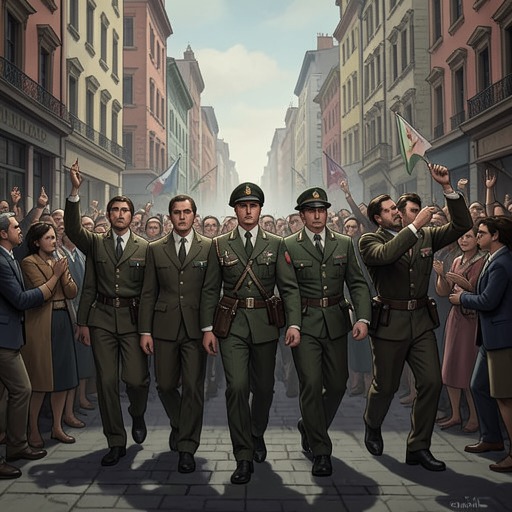
The argument is interrupted when a regiment marches past the café, its colonel riding at the front. The sight lifts Bardamu to his feet. He tells Arthur he will go and see whether the colonel’s example proves their argument, then hurries off to enlist. Arthur calls after him, warning him not to be an ass; Bardamu is hurt by the rebuke, but continues and falls into line. The square is therefore not simply a backdrop to his decision: it is the precise setting in which cynical conversation is converted, almost at once, into participation in the institution they had been discussing.
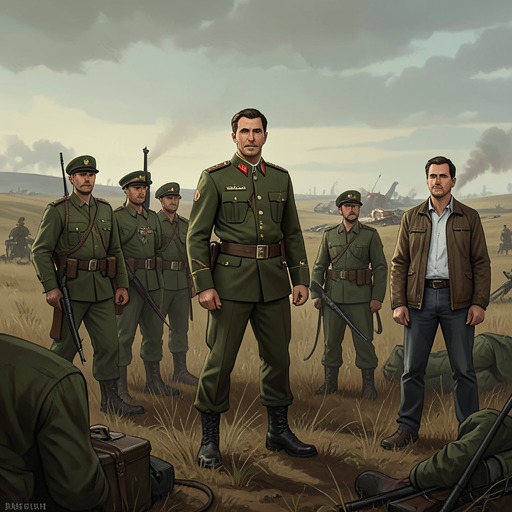
The contrast makes the enlistment feel less like a considered conviction than a sudden surrender to spectacle. A regiment passing through the city gives the abstract subject of patriotism a visible, theatrical form, and Bardamu responds to the colonel’s commanding presence before the consequences of military life have become immediate. Later, amid the mud and bullets of Flanders, he remembers a ceremony in a meadow where the colonel exhorted the regiment with calls to go forward and “Vive la France!” Bardamu’s retrospective judgment is that the colonel could not imagine his own death—or the deaths he was urging others toward. Against that lack of imagination, Bardamu insists on his own wish to die much later, in his own time. The square’s impulsive enlistment thus leads into a war in which the danger he had encountered first as public display becomes intimate and unavoidable.
Return and the Interrupted Past
After leaving America, Bardamu finds no clean new beginning awaiting him. He returns to the Place Clichy and its surroundings, including the Batignolles, and spends weeks and months there doing odd jobs. The work and weather are harsh: rain and, in June, the heat of traffic exhaust him in a way that recalls the heat at Ford’s. In his spare time he watches people going to the theater or the Bois, while remaining more or less alone. The square is again a point of departure, but now it is embedded in precarious routine rather than the apparent decisiveness of enlistment.
On a later night, carrying a small bundle, Bardamu stops to talk with two toll clerks. They joke that he must be going on vacation. Rather than explain himself, he begins speaking off the cuff about the campaign of 1816, when the Cossacks reached the Barrier behind Napoleon. His account is a performance of learning: having impressed the clerks with his supposed culture and sprightly erudition, he feels reassured and sets off down the avenue toward Place Clichy. The route back is shaped by a need to make an impression even as he remains unable to tell the clerks anything genuinely peculiar about his situation.
At the end of the avenue stands the statue of Marshal Moncey, defending Place Clichy since 1816 against memory and oblivion. Bardamu arrives one hundred and twelve years too late for the Russians, the Cossacks, or the battles associated with the site. There are no soldiers; the remaining signs of hardship are three derelicts shivering around a little brazier, with only a ledge of the statue’s pedestal to sit on. Cars race toward the exits. The avenue that leads to a celebrated military monument delivers not a reenactment of history but an empty, cold present, marked by poverty and hurried passage.
A Place Measured by Time
Place Clichy acquires meaning through the gap between its remembered and present-day functions. In Bardamu’s first visit, the square stands at the threshold of a decision that will take him into war. In the later return, its relation to military history is mediated by a statue, a campaign recalled for the toll clerks, and an absence: the battles have passed, and Bardamu arrives after them. The monument’s role as a defender of the square against memory and oblivion gives the location an uneasy double character. It preserves history as an image while the people gathered below it endure a harsher, less monumental reality.
The square also organizes the narrative as a return without restoration. Bardamu comes back to the district from which he first set out, but his return does not recover the earlier moment or furnish a stable homecoming. The months of odd jobs, the remembered heat of Ford’s, the late-night walk, and the derelicts around the brazier make the familiar place register as changed and depleted. Place Clichy links the novel’s large historical movements to the ordinary streets where they begin and end: a passing regiment can redirect a life, while a later walk past a statue can reveal how little remains of the history that once seemed to command it.