La Garenne-Rancy’s Urban Squalor
Journey to the End of the NightLa Garenne-Rancy’s Urban Squalor describes the polluted, impoverished environment in which Ferdinand Bardamu resumes his medical studies, opens a practice, and encounters the daily costs of survival at the edge of Paris. The district’s crowded transport, neglected housing, and hardship-stricken residents make urban poverty an encompassing condition: it shapes work, health, domestic life, and even the doctor’s uncertain ability to earn a living.
Setting and Material Conditions
After returning from America, Bardamu spends weeks and months around Place Clichy and the Batignolles, taking odd jobs before completing his medical examinations. He establishes his practice in La Garenne-Rancy, just beyond Porte Brancion. The location is a choice of necessity rather than prestige: he has little confidence or ambition, and wants above all the chance to breathe and eat somewhat better. Neighbors initially question whether the new practitioner is a genuine doctor, and the concierge predicts that he will not make a living because the area already has too many doctors.
The district’s appearance makes its environmental burden inescapable. Bardamu compares its smoky sky to Detroit’s, describing a haze that hangs over the plain toward Levallois. Buildings seem bogged down in dark muck, and the chimneys rise above them like stakes. His practice occupies a small apartment at the edge of the Fortified Zone, looking toward an embankment. The view connects everyday habitation with the district’s neglected margins rather than separating the clinic from its surroundings.
Work, Transport, and Poverty
At dawn, streetcars carry crowds of residents toward work. Bardamu sees the young laughing and clinging to the running boards, but the apparent cheer stands against the bleakness of the neighborhood and the relentless journey that follows. The passengers are compressed into the streetcar and then swallowed by the Metro, heading to Paris for the employers on whom their livelihoods depend. Their fear of losing work is inseparable from the meager wages they earn and the strain those wages require them to endure.
The commute makes insecurity visible in small, recurring details. Workers remember the economic Slump, the newspapers bought to search for jobs, and the lines at employment offices. Even someone wearing a coat meant for all weather remains vulnerable to dismissal. For the residents Bardamu observes, the journey to work is neither escape from poverty nor secure passage out of it; it is the daily route back to the conditions that sustain it.
In the streetcar, petty disputes and complaints accompany the crowded ride. Passengers may halt the whole line over someone traveling without a ticket, while market-bound women ask about the price of carrots before arriving. Bardamu’s portrait turns these details into evidence of how limited resources organize attention and conflict. The return ticket itself costs as much as two breakfast rolls, so even transport consumes part of a narrow household budget.
Housing and the Fortified Zone
Rancy’s houses give poverty a domestic address. Bardamu describes their facades as flat and their interiors as prison-like, with ownership distant and the landlord represented by an agent. The contrast between a landlord said to be affable and the neglect of the buildings underscores how little personal warmth changes the material arrangement. Residents inhabit cramped and poorly maintained homes while the person with power over the property stays out of sight.
The crowded tenements have courtyards where ordinary domestic life is pressed together. Bardamu lives on the second floor and spends long hours there, watching and listening as the sounds of the surrounding houses rebound through the space. In summer, the court is marked by strong smells and a lack of air; washing hangs from window to window, and the shared surroundings offer little privacy or relief. The concierges’ small privies are grouped together at the dark end, while night-time trips to them bring residents into contact with the garbage cans.
Beyond the housing, the Fortified Zone gathers the consequences of abandonment. Near the Metro entrance and bastions, Bardamu associates the stagnant surroundings with the accumulated aftermath of ruined villages, failed revolutions, and bankrupt businesses. Ragpickers burn damp rubbish in ditches sheltered from the wind. They are themselves physically worn down, and go to the local dispensary rather than resisting the conditions that constrain them. Bardamu’s view of the embankment includes a workman with an arm in a large white bandage, standing without an apparent purpose or the money to buy a drink. The figure makes the consequences of injury and poverty present without turning them into a dramatic exception: they belong to the landscape’s continuing routine.
Household Strain and Everyday Violence
The courtyard’s everyday sounds reveal the strain within poor households. After drinking, adults argue and threaten one another; children bear the consequences of conflicts they cannot control. Bardamu describes family life as an uneven distribution of power, in which those least able to defend themselves, including children and household animals, are especially exposed. The point is not that every family behaves alike, but that crowded domestic conditions repeatedly bring vulnerability and conflict into public earshot.
The pattern extends beyond a single household. Bardamu learns about one family gradually through what he hears and sees in the street: together, its members can appear unremarkable on a walk, while the courtyard around them is marked by recurrent arguments and blows. Even disputes about horse racing may end in violence. This contrast between ordinary public appearances and the sounds of private life gives the district a divided character: the street offers little hint of what the surrounding homes contain, yet their conflicts continually spill into shared space.
Medical Practice and Narrative Significance
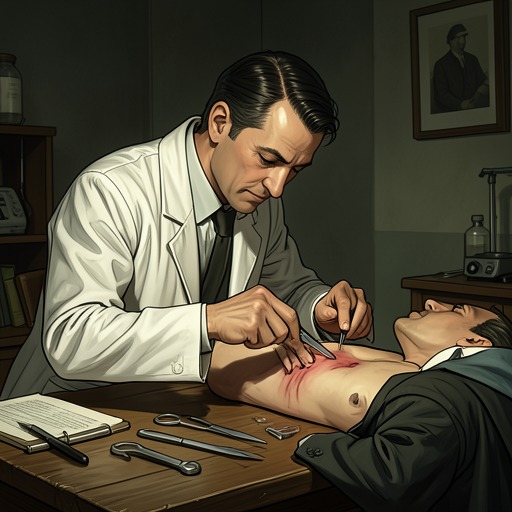
Bardamu’s position as a doctor does not place him above the hardship he observes. He has few patients at first and is himself the main patient in his practice. His own diet consists chiefly of beans and lentils, with eggs only occasionally, and he spends hours waiting at home while those meager meals cook. He later admits that he struggles to charge poor patients for his services: he needs their fees, but feels ashamed to take even a small payment from people who are already wretched and struggling. The conflict makes the practice a point where medical work, need, and poverty meet without an easy resolution.
Bardamu’s account also presents Rancy through a deliberately unstable contrast between motion and entrapment. Each morning, residents pour toward Paris as if fleeing catastrophe, yet the destination is employment that keeps them dependent on the people who control their wages. The crowded streetcars promise movement, while the houses and economic circumstances make departure difficult. The district’s pollution and damaged surroundings operate in the same way: they are not a single incident with a clean ending, but a steady pressure on the bodies and prospects of people with few means to escape them.
This setting develops the novel’s social perspective through Bardamu’s limited but intimate vantage. He is a newcomer who has had to resume his studies and make a living, yet he shares the residents’ material insecurity and sees their lives from inside the district rather than from a position of authority. La Garenne-Rancy’s Urban Squalor is therefore both the subject of his observations and the condition under which he observes: a landscape of work, want, and neglect in which survival takes precedence over comfort, and professional status offers no guarantee of distance from poverty.