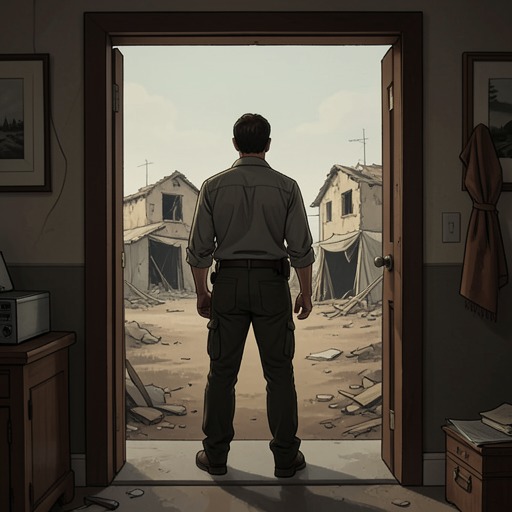
Loneliness in the colonies and the city
Journey to the End of the NightLoneliness in the colonies and the city is not simply being physically alone: it is the failure of human contact to make a person feel recognized, connected, or at home. Across Ferdinand Bardamu’s travels, suspicion aboard a ship, Alcide’s resigned separation from the wider world, an obscure encounter with Robinson, and Bardamu’s isolation in New York show loneliness taking distinct forms while deepening into a conviction of personal insignificance.
Suspicion and Confinement at Sea
On the voyage toward the colonies, Bardamu’s isolation begins among people who have decided what sort of person he must be. Paying passengers without official or military authorization are treated with suspicion, and the other passengers imagine sinister explanations for his presence. The suspicion spreads beyond the officers and women who watch him to the deck hands and stewards, who make caustic remarks behind his back. He becomes, in their collective judgment, the ship’s singular villain, though he has done nothing to earn the role.
The estrangement becomes tangible at the dinner table. Bardamu’s four neighbors, postal officials from Gabon, had initially been friendly; now they say nothing and tacitly regard him as someone to watch. He seldom leaves his cabin and takes precautions when he does. Alone behind a bolted door, he imagines the passengers’ plans against him and reflects that they seem to know him despite having no acquaintance with him. The ship’s confined space turns suspicion into an all-encompassing social reality: Bardamu is surrounded by people, yet separated from them by a story they have imposed on him.
His account enlarges this experience into a grotesque social spectacle. On the Admiral Bragueton, he is cast as the universally recognizable yet elusive “foul and loathsome villain,” a figure whom exceptional circumstances have supposedly made possible to identify and corner. The imagined “moral carnival” gives isolation an ironic collective form: everyone is joined in judging one person, while that person is excluded from the community of ordinary exchange.
Alcide’s Separation in Topo
In Topo, loneliness takes the quieter shape of resignation. Alcide’s hut is also the center of a small, informal trade: he keeps tobacco, brandy, and cotton goods, and much of the colony’s commerce passes through his hands. The twelve militiamen like him despite his frequent scolding and unfair kicks. Their bond rests not on comfort or equality but on a shared recognition of poverty; tobacco, in Bardamu’s observation, creates a tie between them.
That limited fellowship does not reconnect Alcide to the world beyond the settlement. When he tries to read Bardamu’s newspapers, he cannot hold his attention on the news. He explains that after three years in Topo he no longer cares about it. His withdrawal is not presented as a pose or an attempt to impress Bardamu: Bardamu understands it as the result of the world’s sustained indifference to Alcide. The outside world has become as remote to him as another planet.
Bardamu later recognizes Alcide as obliging and generous, but admits that he understood this too late. Alcide’s enormous resignation is the condition that makes poor people easy to kill or leave alive without explanation. They seldom ask why they must endure what happens to them, and their hardship can turn them against one another. Loneliness here is social abandonment made habitual: a person may have neighbors and be useful to them, yet remain cut off from any expectation that the larger world will answer for its treatment of him.
Robinson and the Unrecoverable Past
When Bardamu asks a new acquaintance his name, the answer, Robinson, provokes a search through memory rather than recognition. The conversation concerns the diseases suffered by local people and their inability to trade, but the immediate scene shifts when insects gather so densely around the lamp that it must be extinguished. In the darkness, Bardamu sees Robinson’s face briefly, veiled by the insects, and finds that the image lodges in his memory more sharply than his features had before.
Robinson continues speaking, while Bardamu tries to retrace the past by following the sound of his voice. He cannot discover where they might have met. This failure opens onto a reflection on memory’s losses: people and things in the past have stopped moving, and the living who have been lost to time lie in recollection beside the dead, covered by the same darkness. With age, Bardamu suggests, it becomes difficult to know whom memory might awaken.
The encounter therefore offers no reassurance that a familiar name or a speaking companion will undo isolation. Bardamu hears Robinson but cannot connect him to any recoverable shared history. The voice acts as a possible path into the past, yet that path yields no answer. Loneliness becomes a gap not only between people in the present but also between a person and the relationships his own memory can no longer retrieve.
New York and the Feeling of Nonexistence
In New York, Bardamu finds that urban density intensifies rather than relieves loneliness. He can buy an inexpensive sausage roll from street vendors in poor neighborhoods, but is troubled by his exclusion from the attractive places and people associated with wealth. At the Laugh Calvin, he can at least pretend to look for someone among the women in the lobby. Such small performances do not become companionship; they only help him endure the atmosphere for a while.
Movies provide another temporary distraction. Bardamu takes them in across different streets, but they give him only enough energy for a short walk. He judges his isolation in the American city more crushing than his loneliness in Africa. The contrast does not make the colonial setting benign; it shows that separation follows him across environments and can sharpen amid the crowds and commercial activity of a metropolis.
The city’s unfamiliarity also strips away the habits that had given Bardamu’s life some structure. With no one to speak to him about familiar things, he feels himself disintegrating and comes close to a sense of nonexistence. He has long worried that he is nearly empty and lacks a serious reason to live; New York makes that apprehension feel confirmed. Boredom becomes a sickly, almost irresistible torpor, while amusements and films hold him at a remove from it without resolving it.
Even as his last dollar is nearly gone, Bardamu is too bored to face the urgent steps he ought to take. His dependence on entertainment is therefore both practical and bleak: he clings to the movies because they interrupt the tedium, not because they offer a way out. The city’s main streets, with their endless building fronts, pavements, windows, businesses, and advertisements, become an image of monotonous activity and false promise. The crowded commercial landscape and the isolated observer stand in sharp contrast: everything around him advertises connection and desire, yet nothing supplies the familiar human exchange he lacks.
A Recurring Geography of Isolation
These episodes distinguish several kinds of loneliness without treating any setting as a cure. At sea, Bardamu is socially surrounded but made into an object of collective suspicion. In Topo, Alcide’s everyday usefulness and the militiamen’s affection coexist with his resignation to the wider world’s indifference. In the encounter with Robinson, the possibility of connection is checked by a memory that cannot identify its own past. In New York, crowds, commercial life, and entertainment leave Bardamu feeling more isolated than he did in Africa.
The recurrence turns travel into a test of what a change of place can accomplish. Bardamu moves from colony to city, and from the confinement of a ship to the apparent abundance of metropolitan streets, but physical movement does not guarantee social belonging. Loneliness is thus both circumstantial and inward: imposed by suspicion or neglect, sustained by poverty and separation, and finally felt as a threat to the continuity of the self. The settings change; recognition remains elusive.