Madness
Journey to the End of the NightMadness in the novel names neither a neatly bounded illness nor a simple opposite to sanity. It is a contested condition: military authorities classify fear as impaired patriotism, industrial managers treat independent thought as a defect, and an asylum’s residents reveal how fragile the everyday performance of reason can be. The narrator’s encounters with each system link mental difference to discipline, social judgment, and the effort to maintain an acceptable public self.
Classification and Institutional Control
At a secondary school in Issy-les-Moulineaux, wounded soldiers judged to have dangerously impaired patriotism are held for observation and pressed, by persuasion or force, to confess. The narrator describes the institution’s treatment as not especially harsh, yet its silent male nurses watch constantly. The uncertainty is consequential: after observation, men may be sent to an asylum, back to the front, or, in some cases, before a firing squad. Mental classification sits beside military punishment rather than apart from it.
The narrator sees the same institutional logic in the paperwork and precautions surrounding the men. Tags are placed around their necks and wrists when they are allowed out, and the forms they sign make their possible return to the front feel like a sentence already entered. They are counted and watched as members of a multitude destined for military service. The civilian and medical staff, by contrast, appear to him to inhabit a different future. Observation thus does more than assess an individual state of mind: it sorts bodies and prepares them for the uses the institution has in view.
At Ford’s, classification takes a different form. Applicants are stripped for examination, and the narrator expects his African fevers might disqualify him. Instead, the medical assistant assures him that his poor health does not matter for the work. When the narrator mentions that he studied medicine, the doctor warns him that his education will be useless: the factory needs workers who make the movements assigned to them, not imaginative people who think independently. The narrator resolves to present himself as a quiet drudge. In the factory’s vocabulary, the capacity for thought is unwelcome, while bodily weakness is no obstacle to employment.
The Asylum and the Closed Inner World
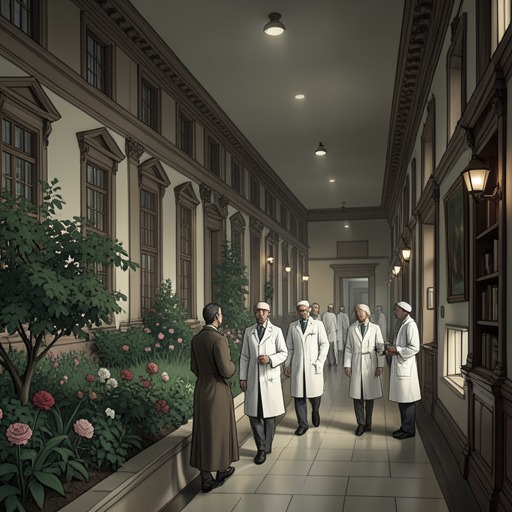
At Vigny-sur-Seine, Baryton’s crowded institution is advertised as a Rest Home, set in a large garden where patients walk on fine days. Their speech and behavior are presented as markedly different from the orderly ideal implied by the prospectus, but the narrator emphasizes the force and privacy of their inner lives: their mental preoccupations are held with such intensity that they will not leave them behind for any external reward. He compares a mind sealed off from the world to a lake without an outlet, stagnant because nothing enters or flows out.
The institution has its rules and methods of management. Baryton admits patients considered manageable, rather than those regarded as overtly homicidal; serious disturbances may be handled with tepid baths and opium extract. At dusk, staff read the roll call and escort residents to their rooms. Before the patients’ families visit on Sunday, staff also monitor them at night so that their behavior will not harm the institution’s reputation. These routines make the asylum’s care inseparable from supervision and the management of appearances.
The narrator’s account nevertheless resists reducing the residents to administrative cases. Patients sometimes gather at the few dining-room windows opening onto the street and frighten the neighborhood with their cries, but most keep their distress to themselves and defend it against therapeutic intervention. Their resistance is described as one of the few sources of vitality in their lives. From this perspective, the institution’s attempt to correct or contain madness does not simply restore a shared reality; the patients’ inner worlds remain powerful, and their withdrawal becomes a challenge to the assumption that normality is self-evidently superior.
Reason as a Social Performance
The narrator’s broader reflection shifts the question from what makes a person mad to what it costs to appear reasonable. He suggests that people spend decades trying not to be fully and unmistakably themselves, conforming instead to a supposedly universal ideal. The pressure to represent oneself as reasonable becomes its own exhausting performance. In that account, the line between sanity and madness is sustained by social expectation, not merely discovered through medical observation.
This tension also shapes the narrator’s own experience as an assistant at Baryton’s. He is kind to the residents, but prolonged conversations can leave him feeling that their ordinary remarks have carried him away from his usual mental ground. He worries that he may be caught within their madness, and describes himself as living on its dangerous edge. His concern is not presented as a diagnosis; it is a narrative measure of how unstable the division between observer and observed becomes when the institution’s supposedly sane employee spends his days among people deemed insane.
War, Insanity, and the Limits of the Boundary
The narrator ultimately places madness beside war as one of the deepest manifestations of human nature. His conclusion grows out of the asylum’s residents, but it also echoes his earlier experience of wartime terror and institutional suspicion. In both settings, the individual encounters forces that exceed ordinary language and social composure. The connection does not make war and mental illness identical; it unsettles the assumption that violence belongs to an exceptional world while sanity securely belongs to everyday life.
The resulting account leaves the boundary unresolved. Institutions can label, observe, treat, or discipline people, but their procedures do not establish a morally reliable division between normality and madness. The frightened soldier, the worker instructed not to think, the residents who guard their inner worlds, and the narrator who fears losing his own footing all expose different pressures behind the category. Madness matters because the novel makes it at once a condition imposed on people and a vulnerability that the performance of reason cannot wholly conceal.