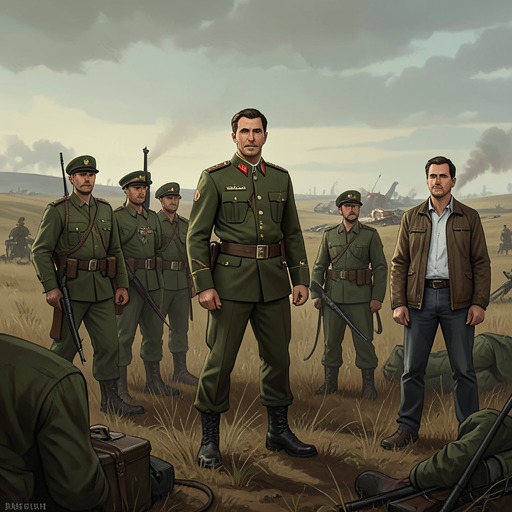
Major Pinçon
Journey to the End of the NightMajor Pinçon is an officer in the French Army whose nightly commands turn the search for a regiment into a recurring danger for the liaison men under his authority. Through Ferdinand Bardamu’s recollection, Pinçon’s authority is defined less by strategy than by the casual exposure of subordinates to exhaustion and possible death. His episodes also establish a pattern that recurs elsewhere in Bardamu’s life: institutions claim to manage or care for people while demanding obedience from vulnerable bodies.
Identity and Military Role
Pinçon serves as a major attached to the general staff under General des Entrayes. His responsibilities include directing liaison men and carrying out the staff’s arrangements as it moves between villages. The general’s comfort takes precedence: villages are reserved for the staff, its horses, its provisions, and its luggage, while troops already lodged there can be displaced. Pinçon belongs to this hierarchy and helps enforce its demands.
Bardamu presents him as a man with authority over the movements of tired soldiers, but not as a reliable guide to their destination. When Pinçon orders them to return to their regiments, he names Barbigny; the men ask where it is, and his directions point into darkness. Bardamu later suggests that even Pinçon’s own understanding of the regiment’s location is guesswork. The disparity between the certainty of the order and the uncertainty of its destination makes command itself a source of danger.
Nightly Orders and Their Consequences
The liaison men have already spent the day running errands for the general. Pinçon summons them in the evening, reprimands them, and sends them out again. His shouted dismissal is followed by the order to return to their regiments “on the double.” When they ask where the regiment is, his answer is simply “At Barbigny.” The men are left to find a place whose position they cannot establish from his directions.
At night, the group sometimes reaches the regiment by accident. Sentries may fire before recognizing them; once admitted, the men can be made to carry oats and water and perform further duties, despite their fatigue. More often, they fail to find it and circle among unfamiliar routes, avoiding evacuated villages and thickets because of German patrols. Their immediate objective is not victory or even the completion of a meaningful mission, but finding somewhere in the dark to wait and survive.
Bardamu describes the repeated expeditions as an ordeal sustained by a diminishing hope of coming back alive. The men cannot safely confront Pinçon: Bardamu imagines that accusing him openly would give him the excuse to have them shot by the military-police captain accompanying him. Their limited resistance consists of pretending not to understand and trying to remain in their billet. Once darkness falls and the general’s dinner is ready, Pinçon orders them out again.
The Staff’s Comfort and the Soldiers’ Exposure
The contrast between the general’s table and the liaison men’s nights gives Pinçon’s conduct its institutional setting. General des Entrayes waits in a specially requisitioned house, with the table and lamp prepared. The general is entitled to forty rations, while the men are sent back into the darkness. Sometimes the cook slips them a bite before they leave, a small concession within a system otherwise organized around the staff’s comfort.
Pinçon’s final summons in this sequence makes the priorities explicit: he shakes his lantern at the men and orders them away because the staff is sitting down to table. Bardamu associates the officer’s excitement with the prospect of sending them to their deaths. The scene’s force comes from its juxtaposition of ordinary domestic routine and perilous military orders: the meal proceeds in shelter while the exhausted subordinates are dispatched into uncertain country.
Bardamu’s Memory and Judgment
Bardamu does not present Pinçon as an abstract emblem detached from concrete detail. He recalls a uniformed officer marked by his field glasses, map, decorations, mustache, and bony knees, and asks why a man with a map is so intent on sending others, who have none, toward danger. Pinçon’s appearance and equipment sharpen the imbalance between the authority to command and the lack of dependable guidance given to those who must obey.
The memory expands into a judgment about human viciousness. Bardamu insists that the worst experiences must not be forgotten or softened, and treats remembering them accurately as work in itself. Pinçon becomes one of the people through whom that lesson is learned: a man who looks like anyone else, yet whose power over others makes him, in Bardamu’s account, more dangerous than an animal predator. The recollection does not excuse the system by blaming one officer alone; it shows how military hierarchy gives a particular person the means to make other people bear its risks.
Institutional Echoes and Narrative Significance
Pinçon’s episode anticipates the novel’s later scenes of institutional supervision. At a secondary school used to observe wounded soldiers whose patriotism is judged impaired, Bardamu describes staff watching the men and authorities deciding whether to send them to an asylum, back to the front, or to a firing squad. At the factory, an examining doctor tells Bardamu that health and education do not matter for the work: employees are expected to make the movements they are told to make, while the machinery’s rhythm overwhelms individual thought. Later, in a rest home, Bardamu helps conduct evening roll calls and rounds under rules designed to regulate residents and protect the establishment’s reputation.
These settings are not identical, and the evidence does not make Pinçon responsible for the later institutions. Their juxtaposition instead reveals a recurring structure in Bardamu’s experience: institutions classify, watch, and direct people, while presenting obedience as necessary and individual judgment as inconvenient. In Pinçon’s case, the consequence is especially stark. His authority sends men into darkness toward a destination they may not find; Bardamu’s enduring response is to preserve the memory of that exposure rather than let its ordinariness erase its cruelty.