Sergeant Branledore
Journey to the End of the NightSergeant Branledore is a re-enlisted soldier in a military hospital, an experienced patient who understands that attention and sympathy can be won through carefully staged patriotism. As Ferdinand Bardamu’s roommate, he teaches the wounded men to perform confidence they do not feel; later, his jealousy of Bardamu’s celebrated war story turns their shared act into a contest for public acclaim. Branledore’s importance lies in making heroism appear less like an inner virtue than a role rehearsed for nurses, visitors, and spectators.
Identity and Hospital Life
In the new hospital, Branledore shares a room with Bardamu. He is described as an old hand at hospitalization, a re-enlisted man who has already spent months moving through four different hospitals. His own condition is serious, but experience has taught him how to manage the attention of the staff: he can adapt his manner to whoever happens to be passing and present himself as an unshakably patriotic soldier.
Branledore’s civilian occupation was lace salesman. The contrast between that ordinary trade and his skill at military theatrics underscores how thoroughly his hospital persona is learned. He is not introduced as a battlefield hero. He is a practiced performer in a ward where survival, reputation, and treatment depend partly on how one appears to others.
Teaching the Wounded to Perform
Between episodes of difficulty breathing, Branledore calls out or murmurs, “Victory! Victory! Victory will be ours!” He varies the force of the declaration to suit his physical state and the attention available, turning a familiar patriotic refrain into a calculated display. Nurses who have seen severe illness may not be impressed by suffering alone; Branledore’s dramatic optimism gives them a recognizable image of courage to respond to.
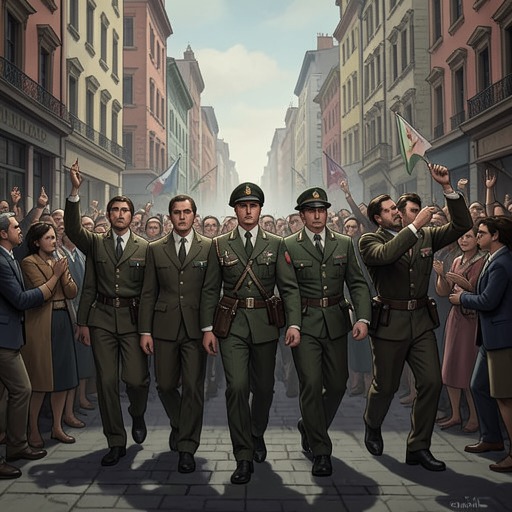
After a week in the hospital, Bardamu and the other patients understand that they must change the image they present. On arrival, they had been frightened, avoided attention, and remained haunted by memories of slaughter. Following Branledore’s example, they remake themselves as bold, combative figures, adopting energetic and increasingly obscene speech as part of their act. The transformation is collective: the same men who had arrived in terror now imitate the swagger expected of soldiers.
The new persona does not come naturally or immediately. Bardamu says it takes a week, and in fact nearer two, of intensive rehearsal before the patients’ patriotic performance becomes convincing. That duration matters: their apparent change in morale is not evidence that fear has disappeared, but that they have learned how to conceal it. Branledore’s method gives them a script suited to an institution and a public that reward visible confidence.
Public Acclaim and Rivalry with Bardamu
The hospital’s performance soon attracts visitors and prestige. Once the patients appear presentable and cease to be treated as moral outcasts, socialites and political figures begin visiting. The ward acquires a reputation as a center of patriotic fervor, and ceremonies turn the wounded into public symbols. Branledore is part of the original transformation that makes this spectacle possible, but his own place in it shifts when Bardamu’s invented exploits receive special attention.
A celebrated actress recites a heroic account based on Bardamu’s fabricated military story, and a poet magnifies it into a public performance. The injured men attend the recital at the Comédie-Française. Branledore, whose imagination has been surpassed by Bardamu’s story and whose own role is absent from the photograph associated with the hospital event, becomes intensely jealous. He answers by inventing new stories of his own, each more extravagant than the last, and the rivalry spreads through the ward as the patients compete to compose increasingly brilliant versions of their military histories.
At the recital’s climax, the actress gestures toward the wounded men as the poem presents Bardamu’s supposed act of bravery. Branledore deliberately takes up the whole front row of the box, using his bandages to obscure Bardamu and the others. Two comrades climb onto chairs behind him so that the audience can see them over his shoulders, and their appearance wins a strong response. Bardamu recognizes that Branledore has engineered the moment and considers protesting, but avoids a public quarrel. Branledore takes the applause for himself, turning a collective fiction into a personal victory.
Performance, Fear, and Narrative Significance
Branledore’s influence reveals the social mechanics behind the hospital’s image of morale. The patients learn that courage is not merely expected; it must be legible, voiced, and staged. Their bold language and heroic stories win attention, while their unperformed fear would leave them isolated. The ward’s public reputation and the wounded men’s rival performances show how institutional approval and popular appetite reinforce one another: the audience wants heroes, and the patients learn to supply them.
The rivalry also complicates Bardamu’s position. Although he has helped construct the collective performance, he wants recognition when his own story becomes the centerpiece. Branledore understands that public acclaim is scarce and acts decisively to claim it, while Bardamu’s resentment exposes how readily the performance reproduces ordinary competition beneath its patriotic surface. Neither man’s theatrical success removes the terror that the story associates with the patients’ arrival; it changes only what they can show.
Branledore therefore serves as both model and rival: he teaches the men how to inhabit a heroic image, then demonstrates that such an image can become a contest for visibility. His role gives the novel a concrete example of heroism as performance, with bandages, slogans, stories, and applause standing in for inward certainty. The hospital’s spectacle does not resolve the soldiers’ fear; it gives that fear a socially acceptable costume.