The ethical dilemma of treating the poor
Journey to the End of the NightThe ethical dilemma of treating the poor shapes Ferdinand Bardamu’s early medical practice in La Garenne-Rancy: he sees patients who cannot readily pay, treats many without charge, and nevertheless needs their fees to live. His account refuses a clean distinction between altruism and self-interest. Compassion leaves him financially exposed; the effort to earn a living makes him feel that he is exploiting people already in distress. In the clinic, poverty is not a backdrop to medical ethics but a force that narrows the choices available to doctor and patient alike.
Practice and the poverty of the neighborhood
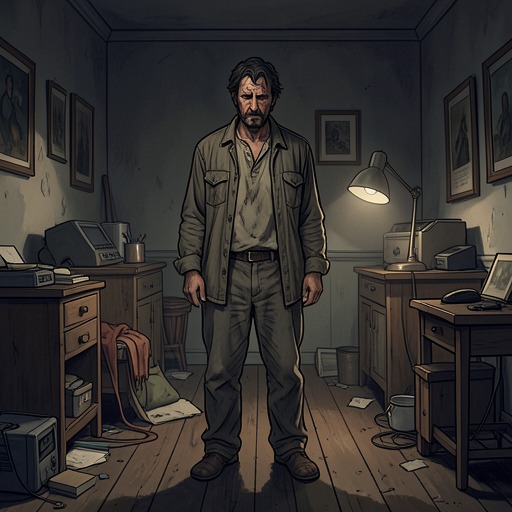
Bardamu sets up in a small apartment near the Fortified Zone, looking out over the embankment. He describes a neighborhood where people are so poor and distrustful that they hesitate to summon even an inexpensive doctor before dark. For months he borrows money from one person to another and crosses unlit courtyards at night for fees of ten or fifteen francs. The work brings him into contact with people, he reflects, but that greater knowledge does not supply the means to live or make the neighborhood’s hardship easier to treat.
At first, his patients are mostly himself. He has few paying cases, and the wait for a practice to become established is no comfort when rent and daily expenses continue. He treats people without charge, he says, largely out of curiosity, and lets patients dictate the terms of their encounters. Bébert’s aunt, for example, asks him to write a prescription intended to stop the boy from masturbating. Bardamu complies, then recognizes that his supposed disinterestedness has invited others to impose on him. He feels that patients exploit his free care and that he has become subject to their demands. The relationship is not a simple opposition between a generous doctor and ungrateful patients: he wants access to their hidden lives, while resenting the dependence and exposure that come with that access.
Fees, conscience, and survival
Bardamu describes the economics of practice as a trap with no morally comfortable exit. Payment from the rich makes him feel like a servant; payment from the poor makes him feel like a thief. He asks how a doctor can charge people who cannot afford food or a movie, especially when they are gravely ill. His response is often to let payment go, but this softness threatens the practice itself. The doctor’s professional duty to provide care collides with the material fact that he, too, has to eat and pay rent.
The strain becomes concrete when rent falls due in January. Bardamu sells his sideboard, pretending that he needs the room for physical-culture classes. In February, he sells his bicycle and the phonograph Molly gave him as a parting gift; its record, “No More Worries,” remains in his memory after the instrument is gone. To appear more prosperous, he tells people he plans to buy a car when the weather warms and says he is taking in money in preparation. The display of confidence masks a doctor who is liquidating his possessions to meet ordinary expenses.
Collecting a fee is difficult for him even when he knows he needs the money. After advising a family and writing a prescription, he prolongs his departure by talking about other subjects, delaying the moment when payment might be requested. He imagines that some patients, poor and disagreeable as he sees them, may resent the twenty francs owed enough to harm him. His colleagues’ insistence on fees does not resolve the moral discomfort: to Bardamu, the word does not make the transaction innocent. He insists that taking even five francs from the poor and the wicked leaves the doctor compromised, and admits that he regards himself as no less morally compromised than anyone else. The landlord’s claim on his earnings explains the pressure, but, in Bardamu’s own judgment, does not excuse the act of taking money.
Clinical limits and responsibility
The case of Bébert tests Bardamu’s sense of responsibility beyond the question of payment. The boy becomes gravely ill, loses weight, and continues to run a high fever. Bardamu tries baths, serum, dietary measures, and vaccines, but none turns the illness around. Bébert remains lucid for a time, and Bardamu is struck by how much more urgently he wants to save a child than an adult: a child still represents a future that cannot be dismissed as readily. That feeling makes the failure of treatment more painful, not less.
Bébert’s aunt moves from repeated talk and advice to grief as the boy worsens. Bardamu watches her sorrow recur over weeks and doubts that the illness will end well. Other people urge her to replace him with a more impressive doctor, and a previous scandal involving a girl under his care has circulated through the neighborhood. Yet other physicians show little eagerness to take the case once they learn it is typhoid, and Bardamu remains responsible for Bébert. His determination to do what he can is real, but it cannot overcome the limits of the treatment available or the neighborhood’s precarious access to care.
Around the seventeenth day, Bardamu goes to the Joseph Bioduret Institute seeking advice or a vaccine recommendation. He wants to be able to say that he tried every possible avenue if Bébert dies. There he eventually finds Serge Parapine, an old medical-school instructor who is willing to help. But Parapine’s years of exposure to changing and contradictory claims about typhoid have left him unable to offer a clear position on its treatment. The visit exposes a second limit alongside poverty: institutional scientific authority does not necessarily deliver certainty or a decisive remedy. Bardamu’s search is driven partly by the child’s danger and partly by the fear that, if he has not exhausted every possibility, he will feel guilty for the rest of his life.
Emergency care under competing pressures
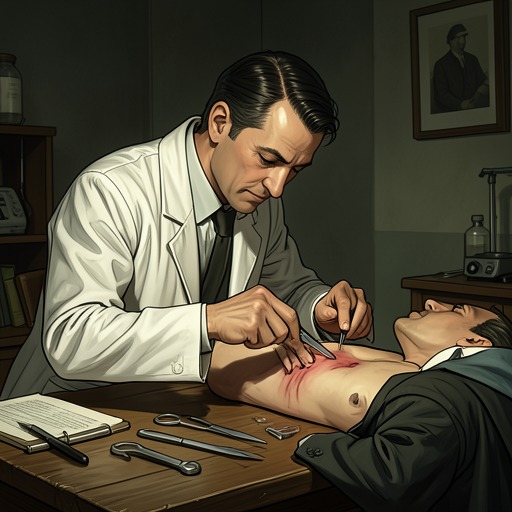
A separate emergency shows how financial necessity can intrude directly into urgent clinical judgment. Bardamu is called to a household where a young woman is bleeding heavily after a miscarriage. Her mother is preoccupied with shame and neighborhood opinion; Bardamu is unsure what to do, and a midwife disputes his judgment. Meanwhile, a cancer patient in the same building is dying. The two cases draw the household and its visitors into a chaotic vigil, while Bardamu moves between the patients.
When the dying patient’s regular doctor arrives, he rebukes Bardamu and takes the twenty francs associated with the visit. Bardamu returns to the woman, whose bleeding continues, and argues with the midwife while trying to hold his ground. He also calculates that the case could be worth a hundred francs if he manages it successfully. That calculation does not erase the medical urgency, but it makes visible how fees and professional rivalry enter his thinking at a moment when the patient’s condition demands attention. Exhausted and faced with the prospect of performing a risky intervention in front of the gathered family, he eventually decides to leave rather than attempt it. He later describes the hundred francs as lost and recognizes that his fatigue and reluctance to undertake surgery were part of the decision.
The scene does not offer a simple verdict on Bardamu. He is responsible for care, but he is working within poverty, exhaustion, disputed authority, and the limits of his confidence. His account makes the practical meaning of medical duty unstable: a doctor may feel obligated to act, afraid of causing harm, and acutely aware that an unpaid or unsuccessful case will not cover the next bill.
Ethical significance
Bardamu’s practice makes care inseparable from material survival. His willingness to treat patients without payment expresses concern and curiosity, but it also leaves him vulnerable to debt and resentment. When he tries to collect, he experiences the fee as an injury to people already disadvantaged; when he does not, he sells his belongings and falls further into financial trouble. Neither professional convention nor personal kindness dissolves the conflict.
The cases also distinguish effort from outcome. Bardamu persists with Bébert and seeks help at the institute, yet the child’s illness defeats his attempts and leaves him with guilt rather than mastery. In the miscarriage emergency, by contrast, the prospect of a substantial fee appears beside uncertainty, fatigue, and the refusal to undertake a risky procedure. Taken together, these episodes portray poor medical practice not as a simple test of the doctor’s virtue but as a condition in which ethical intentions are repeatedly bent by inadequate means, vulnerable patients, and the physician’s own need to survive.