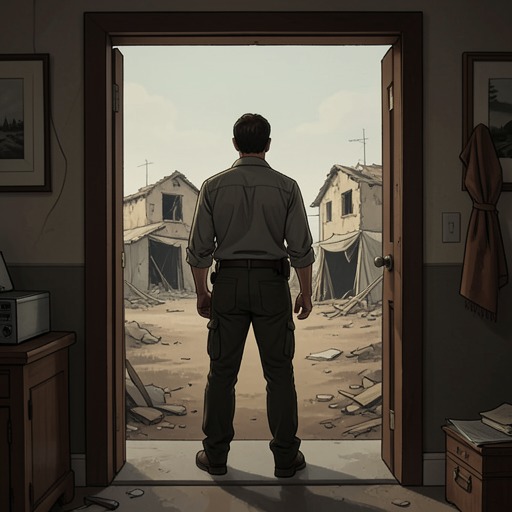
The ravages of poverty
Journey to the End of the NightThe ravages of poverty in Journey to the End of the Night are physical, social, and moral. Poverty does not merely deny Ferdinand Bardamu comfort: it shapes what he can imagine, the work he must accept, the medical care he can offer, and the degree of compassion he feels able to preserve. Across colonial trade, industrial labor in Detroit, and his struggling practice in Rancy, the novel presents deprivation as a pressure that makes people vulnerable while also drawing them into systems that exploit others.
Desire and the Poor
In New York, Bardamu watches his last three dollars in Times Square before entering a cheap public restaurant. The orderly meal service—tray, queue, and food dispensed in sequence—stands against the disorder of his inner life. He imagines that wealth would make social contact effortless and transform a hostile world into a docile one. The fantasy exposes the specific deprivation at stake: people without resources are caught between rebuff and desire, while possession seems to promise release. Bardamu, however, has accumulated and abandoned so many dreams that his mind feels fractured and disordered. His poverty is not only the absence of money but the repeated experience of wanting what remains inaccessible.
Labor as Economic Compulsion
In the colonial warehouse of Compagnie Pordurière, the economic order is visible in the work itself. Bardamu learns to number sacks and falsify weights among exhausted laborers, while overseers strike workers who endure the blows without protest. The Director presents the transformation of people into a labor force, taxed into producing peanuts and rubber, as the achievement of colonial rule. His account makes clear that the company’s prosperity depends on coercion and on recasting exploitation as orderly work. The workers’ suffering and Bardamu’s assignment belong to the same commercial machinery, though their positions within it are unequal.
Detroit offers a modern industrial version of that reduction. When Bardamu mentions his medical studies, a factory official tells him that intelligence is unwanted: management requires obedient workers who will perform prescribed movements. Bardamu learns to conceal his education and pass as a quiet drudge. Inside the plant, vibration and noise seem to absorb the workers’ bodies; speech becomes difficult, and each worker is placed at a machine. The factory’s scale makes labor appear impersonal, but the cost is intimate: the men are treated as replaceable extensions of equipment.
Bardamu’s tasks show how this system strips work of judgment and agency. He first passes linpins to a blind coworker who has calibrated the same pieces for years. After three days, having done the job badly, Bardamu is moved to pushing a trolley of washers from machine to machine. He leaves different quantities at different stations, with no one speaking to him. At the end of the shift the machinery stops, but its noise follows him through the night. The wage buys subsistence at the cost of time, attention, and a sense of human presence.
The Suburbs and the Threat of Unemployment
Back in Rancy, Bardamu describes an industrial landscape of smoky skies, buildings sunk in black muck, and chimneys rising over the plain. The setting is not a backdrop to poverty but one of its conditions: crowded housing and polluted surroundings frame daily movement between home and work. Each dawn, workers travel by streetcar toward Paris, then enter the Metro in search of the employer on whom their food depends. Their commute is driven not by confidence in employment but by fear of losing it.
The memory of the Slump gives that fear a history. Workers remember buying newspapers for job advertisements, waiting in lines at employment offices, and being unable to find work. Even a coat that appears protective cannot shield a person from the memory of unemployment. The threat of dismissal reaches backward into past hardship and forward into every working day, keeping people dependent on employers who make them labor for a pittance.
Bardamu sees Rancy’s residents gradually lose the desire to want anything. Scrimping and going without become ordinary enough to dull aspiration itself. His own medical practice reproduces this economic precarity in a different form: he borrows money repeatedly and crosses dark courtyards at night to collect fees of ten or fifteen francs. His patients are so poor and wary that they hesitate to call even a doctor who charges little. The labor of caring for them brings no dependable livelihood, and their reluctance reflects not indifference but the danger of spending money they cannot spare.
The Ethics and Economics of Care
Bardamu’s practice places him between patients who cannot afford treatment and the need to pay his own bills. He describes medicine as thankless: fees from wealthy patients make a doctor feel like a servant, while collecting from the poor makes him feel like a thief. When patients are hungry or near death, asking for payment feels especially hard to justify. His softness toward them, however, contributes to his financial failure; compassion does not remove the rent or other costs of maintaining a practice.
That conflict becomes concrete in his efforts to raise money. When rent falls due in January, he sells his sideboard, telling neighbors that he needs the space for physical-culture classes. In February he sells his bicycle and the phonograph Molly gave him when he left America, to pay taxes. He tells people he plans to buy a car and needs cash, using an appearance of prosperity to disguise his circumstances. After offering advice and writing a prescription, he delays asking for payment by talking about other subjects. He needs the money but feels ashamed to demand it from patients who are already destitute; he concludes that calling the charge a fee does not make taking money from the poor morally innocent.
The pressure of poverty extends beyond the immediate transaction. Bardamu’s diet is largely beans and lentils, and the cold, rain, and deprivation leave him thinking he looks tubercular. His account connects economic hardship to bodily decline without presenting illness as an isolated misfortune: the lack of food and pleasure is part of the same narrowing that leaves him unable to live comfortably or practice medicine without compromise.
Unequal Burdens and Diminished Compassion
The novel also shows economic hardship through the people who provide care for others. Alcide reveals that he supports Ginette, his orphaned niece, who is being raised by Sisters in Bordeaux. He worries about the expense of her schooling and wants her to receive piano and English lessons. Bardamu understands that Alcide has saved from meager wages and small clandestine business over months and years in Topo. The disclosure changes Bardamu’s view of a man he had kept at a distance: Alcide’s modest means have not prevented him from accepting a sustained responsibility for a child’s future.
Bébert’s illness brings poverty and care into the same room. His aunt grieves through weeks of helplessness, while Bardamu’s treatments fail to stop the illness. Neighbors urge her to dismiss him for a more imposing doctor, and the suspicion surrounding his earlier conduct circulates through the community. The episode shows how little authority a low-cost doctor possesses among patients who need care but cannot confidently trust what they can afford. The aunt’s distress is not merely an emotion observed from outside; it is part of the exhausting work of tending to a sick child when neither family nor doctor can secure the outcome they want.
Later, Bardamu’s response to the dying Léon Robinson measures the damage poverty has done to his own capacity for pity. Robinson is gravely ill, and Bardamu stays beside him, but he feels unable to offer the kind of comfort Robinson seems to seek. He attributes that failure to a life spent becoming poor and hard, in which concern for others has been pushed aside in favor of everyday survival. Poverty in this account is not a moral excuse that absolves the narrator; it is a force that helps explain how he and others become guarded, calculating, and diminished. The book’s bleakest implication is that deprivation takes more than money: it consumes possibility, strains care, and leaves compassion difficult to summon precisely when another person needs it most.