Kalervo's people
KalevalaKalervo's people are the family and tribal community endangered by the feud between Kalervo and his brother Untamo. Their story moves from escalating trouble to an assault that appears to erase the group, then turns on a later disclosure that Kalervo's family has survived. The people are significant not as a separately described political institution, but as the kin group whose apparent destruction shapes Kullervo's sense of loss and whose continued existence changes what he understands about his origins.
Identity and Kinship
The account defines the group through family ties: they are Kalervo's people, also described as his tribe and kindred, and Untamo is identified as his brother. Untamo's threat is directed against his brother's people, making the feud a conflict within a family as well as an attack on a community. The narrative offers no separate account of the group's laws, leadership, or customs; its collective identity is conveyed through those bonds of kinship and the shared homes and settlements put at risk.
A barley-sowing episode appears amid the troubles between the brothers. The narrative marks it as a second trouble and places Kalervo's sowing on the second and third days, but does not clearly explain how the act caused or developed the feud. Its position nevertheless helps establish that the group's later danger follows a sequence of conflict rather than arriving without warning. The available account does not support a more specific claim about the dispute's origin.
Threat and Destruction
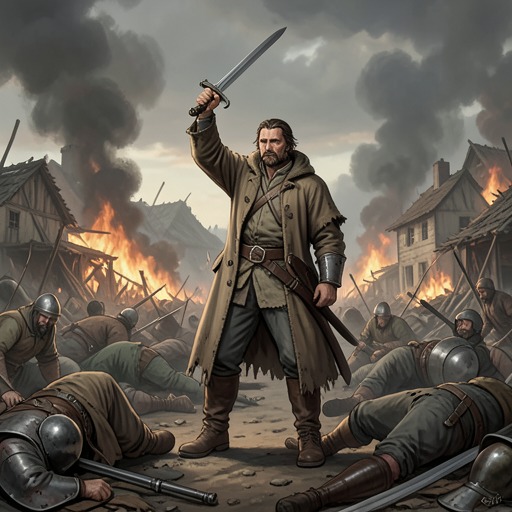
Untamo threatens to annihilate Kalervo's people and exterminate his tribe-folk, young and old alike. The language presents the danger as collective: the threatened object is not only Kalervo himself, but everyone connected to him. The threat is followed by action. Untamo's warriors attack, kill the people of Kalervo, and burn many dwellings, while other courts and cabins are levelled. The violence therefore reaches both the kin group and the places where its members live.
The report of the aftermath makes the loss seem nearly complete. Kalervo's daughter, carrying an unborn child, is identified as the sole survivor of the slaughter. This survival gives the threatened lineage a narrow point of continuity: although the community is described as destroyed, a child of Kalervo's family may yet be born. The passage does not say that the rest of the group escaped, nor does it explain the fate of the daughter and child at this moment; its emphasis is on the apparent scale of the loss and the exceptional survival of one branch of the family.
Survival and Recognition
A later encounter unsettles that account of extinction. A gray-haired woman tells Kullervo that his tribe has never perished and that his mother is still living with his father in the Northland. This disclosure directly counters the earlier impression that only Kalervo's daughter and her unborn child survived. It does not describe how the family endured the attack, or account for every member of the people; instead, it establishes that Kullervo's parents are alive and that the family he believed lost remains part of his story.
The revelation changes the group's narrative function. At first, Kalervo's people appear chiefly as the victims of Untamo's threat and assault, with their survival reduced to a daughter and an unborn descendant. Later, the news of Kullervo's living parents turns that apparent finality into a discovery of surviving kin. The group thus stands at the intersection of family destruction and recognition: its near-erasure gives weight to Kullervo's separation, while the surviving household makes reunion possible. The account preserves both the devastation of the attack and the later correction to what seemed to be its outcome, rather than supplying a detailed explanation that reconciles them.