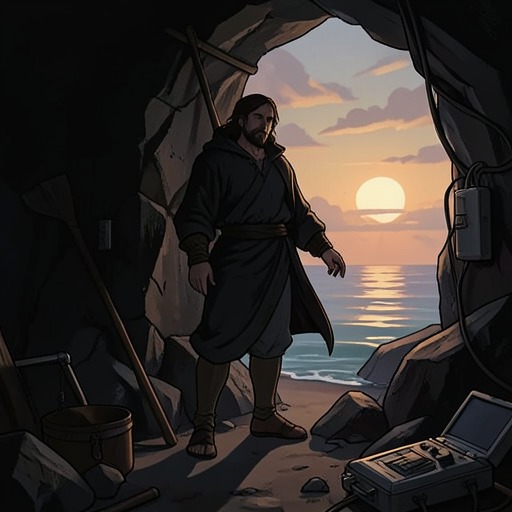
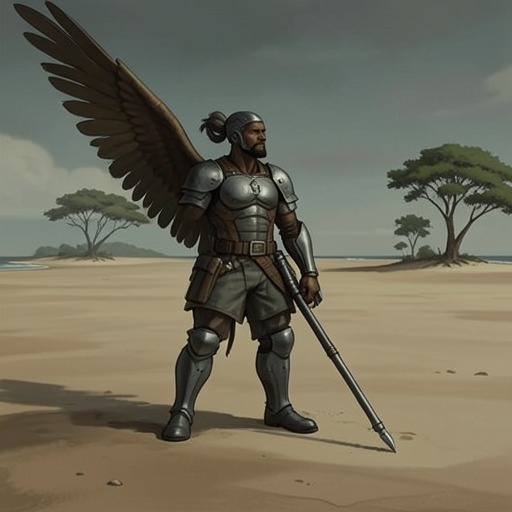
Event 1
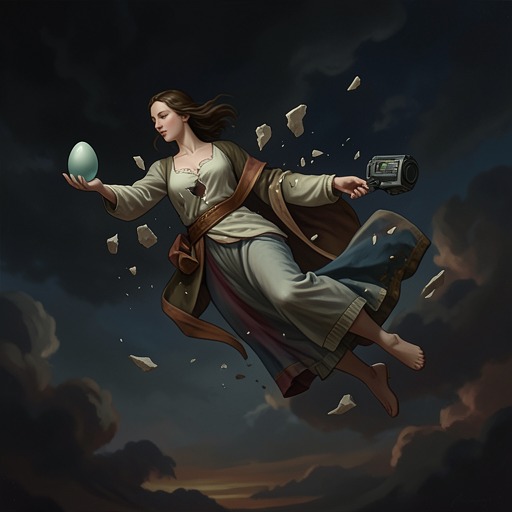
Creation of the World from the Cosmic Egg
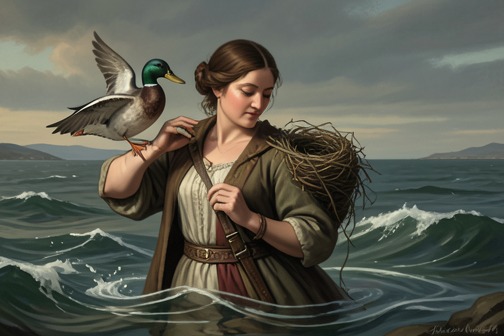
The [Creation of the World from the Cosmic Egg](entity:event-recall-event-creation-of-the-world-f-a32641510b15) presents the world as emerging through a sequence of natural actions: a duck seeks a place to nest on [Ilmatar](entity:character-recall-character-ilmatar-9f50eba80e7e), its eggs break into the ocean, and their fragments become part of the ordered world. Creation here is neither a single command nor a finished act. It proceeds through nesting, incubation, breakage, and the continuing movement of the water-mother, making living creatures and the sea active participants in the formation of the landscape.
## The [Duck](entity:creature-recall-creature-duck-3f0d924e3a1d) Finds a Nesting Place
After Ilmatar’s supplications, a duck descends and flies about the water-mother. Its arrival gives the scene a practical, creaturely beginning: the bird is searching for somewhere to build a dwelling and raise its young. Ilmatar provides a safe nesting place, and the duck slowly circles, looking until it notices her shoulders. The body of the water-mother thus becomes the ground on which the first nest can be made.
The exchange is small in scale but decisive in consequence. The duck does not arrive as an announced maker of the world; it seeks shelter for its eggs. Ilmatar’s body, meanwhile, is at once part of the oceanic setting and a place where life can take hold. The episode makes the emerging world feel inhabited from its beginning: its first construction is a nest, made by an animal, on the body of a living being.
## Seven Eggs and Their Rupture
On Ilmatar’s shoulders, the duck builds its nest and lays six golden eggs, followed by a seventh of iron. It then sits upon them to hatch them. The detail gives the nest an ordered inventory before anything has yet been made from it: six eggs share one material description, while the seventh differs. The scene does not explain that contrast, so its importance lies in the particular composition it records rather than in an assigned symbolism.
The turning point comes when the duck shakes its body in succession. The nest is shaken from its foundation, and the eggs fall into the ocean, where they dash to pieces on the bottom of the deep waters. The change is abrupt: what had been a protected place of incubation becomes a scattered mass at the sea floor. Yet the breaking is not merely the end of the duck’s attempt to hatch its eggs. The narrative immediately makes the fragments consequential, changing an accident into the material beginning of a world.
## From Broken Egg to Ordered World
The account distinguishes an upper and a lower half, equal to one another, and identifies the lower half as the source of the nether vault of Terra. It also associates the shining of the new sun and the lighting of the full moon with the emerging world. The language therefore turns the egg’s division into an ordering principle: a single broken form supplies contrasting parts and gives the cosmos its vertical arrangement.
This creation depends on transformation rather than preservation. The eggs do not remain intact, and the nest does not survive its displacement. Their destruction opens the way for the world’s formation. The event’s sequence makes the reversal plain: the duck’s effort to keep its eggs safe ends in their shattering, but that shattering supplies the beginnings of a larger structure. The ocean is both the place where the nest is lost and the depth in which the pieces become the basis of creation.
## Ilmatar Continues to Shape the Sea
The making of the world does not end with the eggs. Ilmatar remains in the sea as the water-mother, with the waters spread before her. Wherever she turns her hand, a fertile hillock rises; where she rests her foot, the water also receives a formed place. Islands are created, rocks are fastened in the ocean, and pillars of the sky are planted. The account thus moves from the accidental breaking of the eggs to a continuing process in which Ilmatar’s gestures give the sea durable features.
The two modes of creation remain distinct. The egg’s fragments provide the first divisions and beginnings, while Ilmatar’s movement shapes particular places within the watery expanse. Neither the duck nor the water-mother is reduced to a passive backdrop: the duck’s nesting and the eggs’ fall initiate the transformation, and Ilmatar’s actions continue it. The world emerges through relationships among body, animal, egg, and ocean, with the sea serving not as empty space but as the medium in which creation takes form.
Event 2
Birth of Wainamoinen
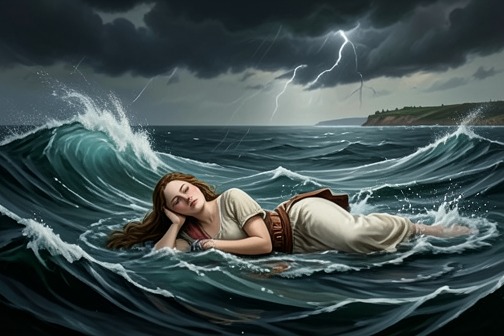
The birth of [Wainamoinen](entity:character-recall-character-wainamoinen-d8e4019ef0c6) is a prolonged passage from cosmic gestation to oceanic emergence. His mother, [Ilmatar](entity:character-recall-character-ilmatar-9f50eba80e7e), bears him through centuries of labor, and he himself remains undelivered long after the surrounding world has begun to take shape. When he finally breaks out of his confinement, birth does not bring immediate arrival on land: he enters the water and spends years there. The episode gives its hero an origin measured in vast durations and successive thresholds, linking his emergence to both his mother’s endurance and the still-forming world around him.
## Cosmic Conception and Prolonged Labor
The account places Wainamoinen’s beginning in a union described as one of force and beauty. The salt-sea’s storm winds, which had played upon the lone maiden, sink into slumber; overburdened by conception, she can no longer rise above the surface. The image makes the sea not simply a setting but the medium in which pregnancy and the world’s earliest transformations take place.
Ilmatar’s labor stretches across seven hundred years. During that time she wanders and swims back and forth across the ocean, unable to rise above its waters and conscious only of her travail. The narration also measures this duration as nine ages of human existence, setting human time against a scale so immense that it makes ordinary measures seem inadequate. Yet the span has a definite outcome: after seven hundred years of labor, her first-born is delivered. Wainamoinen’s birth therefore begins not with a brief crisis but with an endurance that has occupied an age of the world.
## The Undelivered Son
Delivery does not at once end Wainamoinen’s confinement. After the surrounding rocks have become established and the world has begun to acquire solid form, he still has not seen sunshine or the moonlight. He remains within what the poem calls a dark fortress, a maternal enclosure figured as a dungeon. The contrast is striking: the world outside has advanced toward solidity and light, while its future singer remains withheld from both.
The poem marks this continuing delay in more than one measure. Wainamoinen has spent thirty summers in the dungeon, a human seasonal count nested within the much longer chronology of Ilmatar’s labor. His confinement thus extends the birth episode beyond his mother’s travail: the mother’s centuries of pregnancy and labor and the son’s years of undelivered waiting are distinct stages in the same long emergence. He is already identified as the singer and as old and trusty, qualities that give his origin a legendary scale even before he has entered the open world.
## Breaking the Enclosure
As his existence grows weary and life becomes an annoyance, Wainamoinen acts to end his confinement. He bursts the outer portals of the dark fortress with a strong but unnamed finger. The detail gives the escape a physical agent without supplying a named implement or a more elaborate struggle: the threshold is broken by his own strength. His movement out of the enclosure is the decisive change in the episode, turning prolonged waiting into an active passage toward the world beyond.
The escape is not followed by an immediate landing. Wainamoinen reaches the water and swims eastward and westward, studying his new surroundings. The poem says that he rests five years in the ocean, then continues for six long years and even seven. These successive spans extend the uncertainty of his arrival: he has crossed out of his mother’s confinement, but the sea remains the space through which he must orient himself. His birth is therefore presented as a sequence—labor, enclosure, escape, and continued passage—rather than as a single point in time.
## Emergence and Significance
The narrative finally names the outcome plainly: Wainamoinen is delivered from his mother, Ilmatar, the Ether’s daughter. The naming of mother and son closes the movement from the vast, impersonal conditions of sea and conception to a specific relationship. At the same time, the preceding years prevent delivery from appearing effortless or instantaneous. The child’s arrival is bound to Ilmatar’s prolonged labor and to his own forceful departure from the fortress.
The episode’s scale makes birth an origin story for a figure whose life begins in sustained contact with elemental space. Sea, storm, darkness, rock, sunlight, and moonlight define successive conditions of existence: the storm winds subside around the pregnant maiden; solid ground takes form while her son remains unseen; and the imprisoned Wainamoinen moves at last into the ocean. The narrative’s repeated changes of boundary give the event its shape. Wainamoinen is born not simply when he leaves his mother, but through a drawn-out crossing from enclosure into a world he must first encounter and study.
Event 3
Wainamoinen's Sowing of Barley
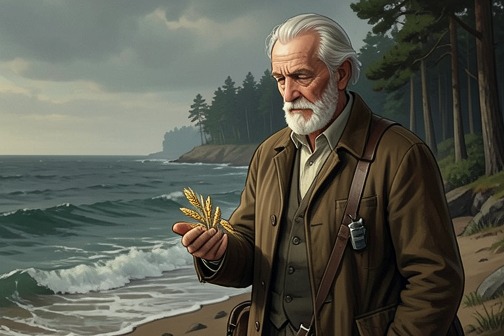
[Wainamoinen's Sowing of Barley](entity:event-recall-event-wainamoinen-s-sowing-of-cd80811bcc89) recounts how [Wainamoinen](entity:character-recall-character-wainamoinen-d8e4019ef0c6) establishes a barley crop where vegetation has appeared but barley will not grow. The episode makes cultivation a hard-won beginning: seeds must be found, the forest prepared, and the grain entrusted to the ground through both human work and an appeal to [Ukko](entity:character-recall-character-ukko-316a9dd36b1c). Its clearing of the land is not absolute, however. A birch remains for the birds, and the resulting crop marks the transformation of a wild, unproductive place into a source of food.
## The Need for a Crop
The episode begins with a problem rather than a harvest. Many kinds of vegetation are present, but barley is not growing. Wainamoinen, described as old and trusty, goes away to consider what must be done. The poem thus distinguishes the abundance of untended plant life from the particular success of a cultivated grain: the presence of vegetation alone does not provide the crop he seeks.
His search brings him to the borders of the waters and the ocean's sandy margin. There he finds six seeds of golden barley, then specifies seven ripened kernels on the shore of upper [Northland](entity:location-recall-location-northland-8351eb6a39dd). The verse preserves both numbers in its account, presenting the discovery as a small, precious stock of seed rather than an already flourishing supply. The shoreline is where the means of cultivation become available, but finding grain does not yet make the land ready to receive it.
## Preparing the Forest
Wainamoinen's next task is to clear the ground. He considers the need for the forest to be levelled and its branches burned to ashes, makes himself an axe, and begins felling trees. The work is described broadly: he cuts trees of different kinds, making human labor the immediate means by which a field can be opened. The axe is a practical tool, and its appearance marks the shift from deliberation to sustained physical action.
The clearing has a limit. Wainamoinen leaves the birch standing so that birds will have a place to rest and sing. In the poem's sequence, this exception is a concrete feature of the new field's preparation, not an incidental detail: the work of making space for barley does not require removing every tree. The [Cuckoo](entity:creature-recall-creature-cuckoo-eefb35ee3a9f)'s song is associated with the birch as a place of rest, giving the spared tree a continuing use amid the cleared ground.
A bird from heaven then kindles fire among the branches, and north winds fan the flames. The fire burns the cut wood to dust and ashes, while the birch remains standing. The sequence joins Wainamoinen's axe-work to fire and wind: clearing is accomplished through a combination of his deliberate preparation and forces that carry it further. At the end of the burning, the land is not wholly bare; the single spared tree remains the visible exception to the destruction of the branches.
## Sowing and Appeal to Ukko
With the ground prepared, Wainamoinen brings out his magic grains of barley and scatters the seed. He calls them seeds of life and describes sowing through his open fingers, connecting the act to the hand of his Creator. The image makes planting both a bodily action and an act placed within a larger sacred order. The grains are handled and dispersed by Wainamoinen, but their growth is not represented as his achievement alone.
He addresses Ukko as the God above and Father of the heavens. His words also recognize his own contribution: he speaks of the crop in relation to his plowing and sowing, and to his skilled and honest labor. The appeal therefore does not erase work or substitute prayer for it. Human effort has prepared the ground and scattered the grain; the invocation asks for the conditions in which that work can come to fruition. Ukko holds counsel in the cloud-space, and the seeds then grow, unfolding from germ into blades and richly colored ears.
## Harvest and Significance
Wainamoinen returns to see how his plowing, sowing, and labors have turned out. He finds barley growing, its blades triple-knotted and its ears six-sided. The crop's distinctive forms provide the visible answer to the opening failure: barley, previously absent among the vegetation, now stands as the result of the entire sequence. The poem records not merely that seed was placed in earth, but that it matured into a harvest with described characteristics.
The episode's structure gives cultivation several necessary parts. The seeds must be discovered; trees must be felled and burned; one birch is deliberately left for the birds; and the grain must be sown through human labor and accompanied by an appeal to Ukko. Its significance lies in this linked account of practical work, the powers of the natural world, and divine assistance. The opening contrast between plentiful vegetation and absent barley is answered not by effortless abundance but by a process of preparation and care.
That account also suits the [Kalevala](entity:location-recall-location-kalevala-1532cc3f896a)'s presentation of the mysteries of nature and the origins of things. The epic was transmitted unwritten through generations by song-men, and its songs preserve knowledge and experience alongside mythic narrative. In this episode, the origins of a cultivated crop are rendered memorable through a sequence of vivid particulars: seven ripened kernels on a northern shore, the axe in the forest, the birch reserved for birds, fire driven by the north winds, and barley returning in a formed harvest. Cultivation begins not with mastery of every part of nature, but with labor shaped by attention to what should remain.
Event 4
Felling of the Great Oak
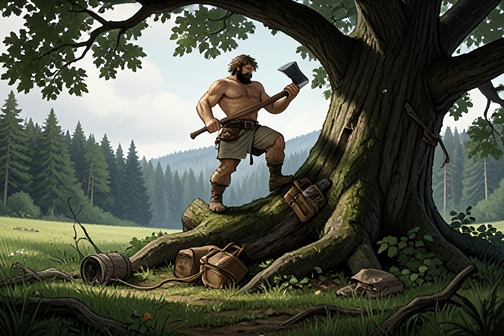
The [Felling of the Great Oak](entity:event-recall-event-felling-of-the-great-oa-25f0a4ebe048) transforms an unchecked force of growth into a renewed, open sky. After [Wainamoinen](entity:character-recall-character-wainamoinen-d8e4019ef0c6) discovers that the oak has outgrown the surrounding forest and shut out the light, he calls for help; a being rises from the ocean, grows from a pigmy into a giant, and brings the tree down with an axe. The fall is both a violent rupture in the newly flourishing landscape and the condition that lets the sun and moon shine again.
## The Oak Outgrows the Forest
The episode begins in a landscape already responding to planting. Wainamoinen looks over the growing seeds and sees young trees spreading thickly and the forest rising in beauty. Yet one tree has not joined this growth: the oak remains inside its acorn. Its delayed emergence marks it as a problem not because it is lifeless, but because its eventual growth will exceed the order around it.
The story gives that growth a sudden, almost elemental beginning. [Water-maidens](entity:creature-recall-creature-water-maidens-308f026e0e55) rake the cut grasses into a windrow in a meadow, and [Tursas](entity:character-recall-character-tursas-b370b59f55f1) rises from the ocean. He presses the grasses together, leaving ashes where they had been gathered; in those ashes he places tender leaves and plants an acorn. The oak therefore takes root in a changed ground, one made fertile by the burning and prepared by the water-maidens’ work. The account ties the tree’s extraordinary rise to a specific sequence of transformation rather than presenting it as an ordinary forest sapling.
From this planting, the oak spreads branches and forms a broad crown, lifting itself above the storm clouds. Its scale changes the whole visible world: its leaves dim the moonbeams, and the starlight dies from the sky. The forest’s earlier beauty has become a different kind of abundance, one so excessive that it suppresses other forms of light. The danger is not simply that the oak is large; it is that its growth has made the sky inaccessible.
## Wainamoinen Calls for Help
Wainamoinen considers how the mighty oak can be killed. The problem is presented as a practical one—how to bring down a tree with a hundred branches—but its consequences reach beyond the task itself. With the moonlight and stars obscured, the landscape has lost the light by which its natural order can be seen. The felling must restore room for the sky as well as clear the tree from the land.
He calls upon his ancient mother and helper, asking for assistance in bringing down the oak so that sunlight can shine again and the moon can once more gleam. The appeal places the coming act within a relationship of dependence: Wainamoinen, though the hero who recognizes the danger, does not accomplish the task alone. Immediately after he has finished speaking, a form rises from the ocean. The sequence makes the answer to his appeal visible as an arrival from the water, joining the episode’s earlier emergence of Tursas from the same realm.
At first the new figure is not among the largest. The apparent mismatch between the scale of the task and the size of its prospective agent holds only briefly: scarcely has Wainamoinen finished speaking or moved his eyelids before the pigmy unfolds and becomes a mighty giant. The scene’s rapid enlargement reverses the oak’s slow, overwhelming expansion. The tree’s power had accumulated until it blocked the heavens; the helper’s power is revealed in a moment, as if the answer to excessive growth were a force that can suddenly meet it on equal terms.
## The Giant Brings Down the Tree
The giant prepares an axe by using six hard blocks of sandstone and seven softer whetstones. This concrete preparation gives the felling a deliberate, worked quality: the tree’s extraordinary strength is answered not by an unexplained blow, but by a tool made ready for the purpose. Once armed, the giant turns toward the oak and stalks to it in long, roomy clothing.
He strikes once, then a second time. As the blade descends a third time, sparks fly upward from the axe, and fire shoots out from the oak. Before a fourth blow can fall, the tree gives way. The sequence makes the felling feel measured, while the sparks and fire make the third stroke a visible escalation. The oak does not merely topple at an unspecified moment; its resistance culminates in an eruption of sparks and then ends in a fall that shakes earth and heaven.
The tree’s defeat answers the problem created by its own scale. It had extended its crown above the storm clouds and extinguished the visible signs of the night sky; its fall is correspondingly vast, with the shaking of earth and heaven registering the force of the reversal. The giant’s blows do not restore balance by reducing the forest to emptiness. They remove the one tree whose growth had come to dominate the conditions of light.
## Light Returns to the North
The episode explicitly links the oak’s fall with the return of illumination. Once the mighty tree has fallen and lost its hundred branches, the North can see sunshine and the gentle gleam of moonlight again. The clouds, too, can keep their courses. These are related but distinct consequences: daylight and moonlight become visible, while the sky’s moving weather is no longer obstructed by the tree’s immense crown.
The movement from acorn to world-shaking tree and from darkness to open sky gives the event its larger significance. Growth first appears as a sign of flourishing: the forest spreads, and the oak rises with it. But the oak’s exceptional size turns fertility into obstruction, making the recovery of light depend on cutting back what has become overwhelming. The felling is therefore not a rejection of growth as such; it is a violent correction that restores distinction between forest, sky, and the lights above them. Wainamoinen identifies the danger and asks for aid, while the giant supplies the strength to complete the task. The result is measured not only by the tree’s fall but by what becomes possible afterward: the North can see the sun and moon once more.
Event 5
Contest of Wainamoinen and Youkahainen
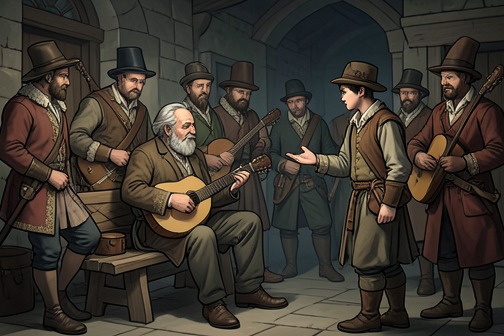
The [Contest of Wainamoinen and Youkahainen](entity:event-recall-event-contest-of-wainamoinen-495dea4c3fe0) begins as a challenge between two singers but becomes a struggle over wisdom, bodily freedom, and the power to shape the world through song. The young minstrel’s defeat is not merely a loss of artistic standing: [Wainamoinen](entity:character-recall-character-wainamoinen-d8e4019ef0c6)’s singing enchants the landscape and imprisons him, until he offers his sister [Aino](entity:character-recall-character-aino-a07502581ca8) as ransom. The encounter thus establishes both the unequal standing of the rivals and the human cost of turning a contest into coercion.
## Background and Challenge
Wainamoinen is introduced as an ancient minstrel who has passed his years in contentment. His reputation travels beyond his own country: echoes of his renown are heard to the south, and the story reaches all of [Northland](entity:location-recall-location-northland-8351eb6a39dd). There, [Youkahainen](entity:character-recall-character-youkahainen-cf9fba2d3249) lives as a young and reckless minstrel of [Lapland](entity:location-recall-location-lapland-34769692e172). The contrast between the settled, celebrated elder and the ambitious young singer sets up a contest in which reputation and age matter less than knowledge and skill.
The report of Wainamoinen’s superiority provokes Youkahainen. Envy rises in him, and he resolves to go and face the older minstrel, challenging him to sing in a contest—a bardic battle rather than a physical duel. The decision follows counsel but finally belongs to Youkahainen himself: the passage weighs a mother’s advice against the value of choosing for oneself. His independence is real, but he directs it toward a contest whose stakes he has misjudged.
## Song Becomes Enchantment
The rivals’ dispute concerns who stands higher in wisdom, possesses greater knowledge, and sings more sweetly. Youkahainen resists the judgment that he is the lesser minstrel, and his anger sharpens the exchange. Wainamoinen, in turn, grows angry; his response is not simply another claim of superiority. He sings, and the contest shifts from argument into an exercise of supernatural power.
Wainamoinen’s song reaches beyond the two singers. Copper-bearing mountains and flinty rocks enter the scene as part of the world his singing commands. The transformation is especially stark when Youkahainen’s jeweled belt is sung into twinkling stars, while Youkahainen himself is sung down into quicksand. The same vocal art that can alter what surrounds the rivals can act directly upon a rival’s body. A contest over knowledge has become an ordeal in which the older singer controls the terms of survival.
The entrapment proceeds by degrees. Youkahainen sinks deeper into mud and water, and his effort to move his left foot ends with it turned to flint. The details make his loss physical and cumulative: first he is caught in the mire, then movement itself becomes impossible. His proud challenge has left him not merely out-sung but immobilized, dependent on the person he came to oppose.
## Aino Offered as Ransom
From this desperate position, Youkahainen begs to be lifted from the suffocating torment and freed from the sand and water. He offers increasingly personal compensation, promising Wainamoinen his sister Aino, described as his mother’s fairest daughter and offered as a bride forever. The demand for rescue therefore draws a family relationship into the contest: Youkahainen makes his sister the price of his own freedom.
The bargain is made more concrete by the domestic pledges attached to it. Youkahainen promises golden covers for Wainamoinen’s bed and honey-biscuit. These offerings cannot match the gravity of the central promise, but they show how his plea shifts from boasting to negotiation: a singer who came to challenge an elder now offers both a bride and material comforts in exchange for release. Wainamoinen, characterized as old and truthful, finds at last the ransom he wants in Lapland’s young and fairest daughter.
## Release and Narrative Consequences
Once the ransom has been found, the enchantment is broken. Youkahainen, sorrowful but wiser, drags his feet out of the quicksand. His release reverses the immediate movement of the scene—from sinking, helplessness, and stone-stiffened movement toward escape—but it does not erase the price he has promised. The ending therefore gives him back physical freedom while leaving the contest’s most consequential pledge in place.
The episode establishes a lasting imbalance between the singers. Youkahainen’s challenge tests Wainamoinen’s standing, but the answer demonstrates that Wainamoinen’s song can impose consequences on the material world, not merely win an argument. At the same time, Youkahainen’s offer brings Aino into the story as the object of an agreement made under duress. The scene’s decisive reversal is accordingly double: the challenger becomes a captive, and his attempt to save himself binds another person to the victor’s claim.
## Significance of the Contest
The contest joins artistic rivalry to action. Song first serves as a measure of wisdom and skill, then becomes an instrument that alters the surroundings, transforms a jeweled belt, and confines a human opponent. The movement from verbal challenge to physical helplessness makes the story’s conception of singing unmistakably consequential: mastery in song carries power over bodies and circumstances.
The episode also complicates the idea of personal choice introduced before the challenge. Youkahainen chooses to face Wainamoinen, but once trapped he bargains with Aino’s future to regain his own freedom. His decision to enter the contest is voluntary; the promise he makes under enchantment is a different kind of choice, shaped by desperation and unequal power. The encounter thus establishes the conflict’s central tension between individual agency and the consequences imposed by stronger forces, while making the promised marriage a direct outcome of a singing contest.
Event 6
Fate of Aino
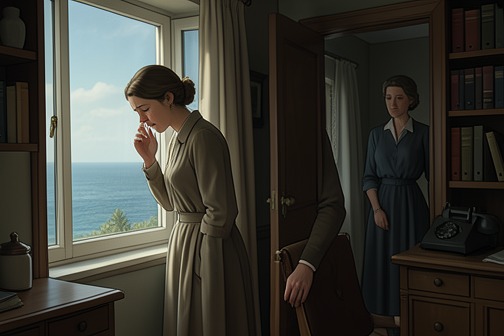
[Fate of Aino](entity:event-recall-event-fate-of-aino-c422bd49055f) is the tragedy of a young woman treated as the object of a family promise who answers that promise with grief, departure, and disappearance. In Rune IV, [Youkahainen](entity:character-recall-character-youkahainen-cf9fba2d3249) declares that he will give his sister [Aino](entity:character-recall-character-aino-a07502581ca8) to [Wainamoinen](entity:character-recall-character-wainamoinen-d8e4019ef0c6). The episode follows the consequences not as a settled marriage but as a separation: Aino’s tears and farewell give way to a journey from home to the sea, where she vanishes. Her mother’s mourning then carries the private loss beyond the household, addressing mothers as a group.
## The Offer and Aino’s Response
The episode begins with Youkahainen’s offer of his sister. Its compact phrasing makes the family relationship central: Aino is identified first as the sister he will give, while the decision is voiced by her brother. The next emphasis is on Aino herself, described as fair and lovely, and on her tearful reply. The contrast between the confident offer and the maiden’s distress establishes that the promise does not amount to her willing acceptance.
Aino’s response is presented through grief rather than through a negotiated change in the arrangement. The repeated attention to tears and weeping makes her opposition unmistakable, even though the surviving lines do not preserve the substance of every exchange. Her mother answers her, and Aino later speaks again in sorrow, recalling that she has been given away. The movement between mother and daughter keeps the cost of the promise within the family: the arrangement affects not only the person offered but also the bond between Aino and the parent she is about to leave.
## Farewell and Departure
Aino’s parting is marked as an act of separation. She ends her exchange with her mother and leaves, after which the narration gives her a mournful song. The song belongs to the threshold between home and what follows: Aino is no longer simply replying to her mother, but voicing grief as she moves away from her family. The episode thus gives her departure its own emotional beat instead of treating it as an incidental step in the plot.
After leaving, Aino wanders throughout the day. That duration makes her movement feel extended rather than immediate: the narrative follows her away from the household and toward the coast. It then places her a good distance out at sea. The sequence narrows from the whole day of wandering to this distant maritime setting, where the account introduces a sudden swaying and a stone of rainbow colors before stating that the weeping maiden has vanished. The text records the disappearance, not a witnessed recovery or return.
## The Vanishing at Sea
The sea marks the decisive break in Aino’s story. Before reaching it, the episode has shown her in relation to her brother’s offer and her mother’s response; at sea, those domestic relationships can no longer provide the scene’s setting. The distance from shore and the suddenness of the disappearance turn her departure into an unresolved loss. The rainbow-colored stone is the episode’s distinctive concrete image at this turning point, set beside the moment of vanishing rather than explained as an ordinary object or given a stated origin.
The narration emphasizes the disappearance more than once. Aino first vanishes in the immediate sea scene, and a later line again marks that the maiden has vanished. This repetition gives the event a finality in the telling while leaving its physical circumstances unclear. The account does not describe a body, a rescue, or a return to her family. Its focus remains on the fact that Aino is lost after going out to sea, and on the grief that this absence produces.
## The Mother’s Lament and the Episode’s Significance
After Aino’s disappearance, the focus returns to her mother, now mourning the loss. Her grief answers the earlier exchange between mother and daughter: the departure that had been anticipated in sorrow has become an absence. The mother’s lament does not undo the event or restore Aino; it gives the surviving family member the final voice in the episode.
That voice expands from personal mourning into direct address. The mother calls on all mothers to listen, making Aino’s fate more than a private calamity within one household. The shift from daughter and mother to mothers collectively frames the story as a warning carried by grief. Formally, the episode moves from an offer made by a brother, through the distressed daughter’s farewell and solitary wandering, to a mother whose loss becomes public speech. Aino’s disappearance at sea is therefore both the ending of her narrated journey and the cause of the lament that preserves her fate.
Event 7
Wainamoinen's Failed Fishing for Aino
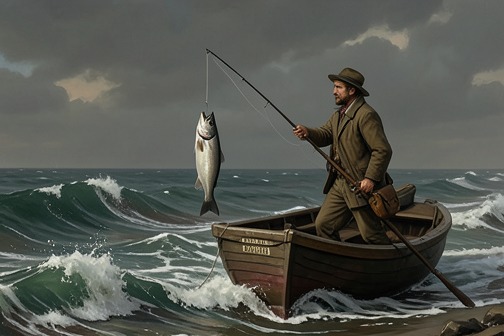
[Wainamoinen's Failed Fishing for Aino](entity:event-recall-event-wainamoinen-s-failed-fi-21957b7c68ef) turns a fishing expedition into a failed attempt to recover a lost beloved. After many days of angling, [Wainamoinen](entity:character-recall-character-wainamoinen-d8e4019ef0c6) hooks a magical fish; when he reaches for it with his silver knife, it escapes his grasp and reveals itself as [Aino](entity:character-recall-character-aino-a07502581ca8). Her recognition of him does not restore their relationship: she rebukes him, dives away, and remains beyond his reach despite his renewed search. The event moves from apparent capture to revelation, refusal, and an ultimately fruitless pursuit.
## The fishing expedition
Wainamoinen hastens to a boat-house on the sea-shore and examines his fishing hooks. The pursuit then unfolds over time rather than in a single cast: he angles at noontide and continues for many days and nights. At last, one sunny morning, a fish of magical powers strikes his line and plays like a salmon. The ordinary pattern of fishing has produced an extraordinary catch, and Wainamoinen treats it as food, imagining a meal rather than recognizing the being on his hook.
The detail of his silver knife marks the point at which the catch seems about to become possession. Wainamoinen wears the knife sheathed in his belt and draws it to cut the fish, apparently preparing to make supper. But as soon as he touches the fish with the blade, it leaps back into the water. It raises its head beyond the reach of the fishing tackle and addresses him. The intended meal has become a speaking presence, and the action shifts from capture to confrontation before he can claim the fish.
## Aino's recognition and refusal
The fish identifies herself as Aino, [Youkahainen](entity:character-recall-character-youkahainen-cf9fba2d3249)'s youngest sister. She describes herself as a young maiden and friend and sister of the fishes, not a salmon or whiting. The revelation makes the catch a person whom Wainamoinen already loves, rather than an unknown creature he might take for food. Her identity also binds this encounter to Youkahainen through kinship: the figure on the line is his sister, now speaking for herself.
Aino's address overturns the balance of the scene. Wainamoinen has approached as the angler with control of the line, but she speaks as the one who understands what has happened and judges his conduct. She contrasts his former reputation as a wise-tongued hero with his present foolishness and lack of judgment. The fish's escape is thus not merely a lucky break in the struggle between angler and catch; it is joined to a verbal rebuke that makes Wainamoinen's failure a failure of insight as well as possession.
Wainamoinen answers with sorrow and regret. Once he learns that she is Youkahainen's sister, he asks the beautiful Aino to come back to him. Her response closes off the reunion he seeks: she says that Aino's spirit will never again fly to him and be ill-treated. She then dives from the surface of the billow toward the many-colored pebbles below. The sequence gives her refusal an unmistakable physical consequence. Wainamoinen's request cannot reverse her decision, and the disappearing figure passes beyond the reach of his fishing gear.
## The search after the escape
After Aino's disappearance, Wainamoinen reflects anew on how to live, work, and win her. He draws his silken fish-net carefully and sweeps it back and forth through foam and billow, bays and winding channels. The search extends across the seas of [Kalevala](entity:location-recall-location-kalevala-1532cc3f896a), enlarging the pursuit from the single fish that escaped him to the waters where he hopes to find Aino again.
The net brings up many fish and creatures of many forms, but quantity does not bring the desired result. Wainamoinen catches neither the sea-maid nor [Wellamo](entity:character-recall-character-wellamo-7fd34302205a)'s water-maiden, identified as the fairest daughter of the [Northland](entity:location-recall-location-northland-8351eb6a39dd). That contrast keeps the search's failure precise: he is not unable to catch anything; he cannot catch the particular being he seeks. The waters yield abundant life while withholding Aino, so the repeated labor of casting and drawing the net sharpens rather than resolves his loss.
## An empty-handed return
The event ends not with a recovered beloved but with Wainamoinen's departure. Depressed and discouraged, he gives up the attempt to find Aino and heads back to his country. He leaves empty-handed and heavy-hearted. The contrast with the opening is decisive: he began by expecting to turn a catch into supper, then discovered that the catch was Aino, and finally returns without either the fish or the reunion he hoped to gain.
The failed fishing is structured around successive changes in what the water seems to offer. First it supplies a magical fish; then that fish becomes Aino, whose speech exposes Wainamoinen's mistaken understanding; finally the wider sea supplies other fish but not her. Each change renews his hope only to limit it. The episode's conclusion therefore rests on the distance between seeking and possessing: Wainamoinen can pursue Aino, recognize her, ask her to return, and search the waters afterward, but none of those actions undoes her refusal or brings her back.
Event 8
Youkahainen Shoots Wainamoinen
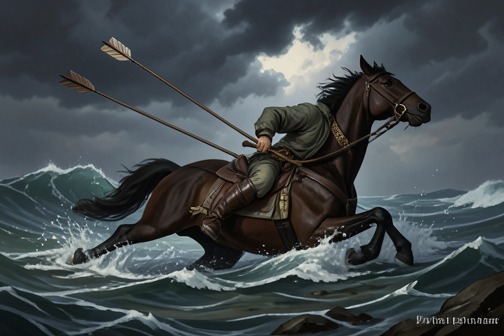
[Youkahainen Shoots Wainamoinen](entity:event-recall-event-youkahainen-shoots-wain-1f0f1dffb618) turns a minstrel’s envy into an ambush, and a journey toward the sea into a fall from the saddle and an uncertain fate on the waves. [Youkahainen](entity:character-recall-character-youkahainen-cf9fba2d3249)’s arrows do not kill [Wainamoinen](entity:character-recall-character-wainamoinen-d8e4019ef0c6) in the scene; they knock him into the water, where a storm wind carries him away. The event shifts the story from rivalry in song to physical danger, while the boast that follows exposes the gap between what Youkahainen believes he has done and what the narration actually establishes.
## Causes and Preparation
The episode opens as Wainamoinen arranges a journey. He is described as old and truthful, and his route takes him to the blue sea’s margin without wetting his horse’s hooves. The approach to the shore gives the attack a clear threshold: Wainamoinen is travelling onward when a rival who has been waiting for him makes the journey dangerous.
Youkahainen’s motive is stated as a grudge nourished in his heart: envy of Wainamoinen, the wonderful enchanter. The account presents the attack not as a sudden accident but as the consequence of this sustained resentment. Youkahainen prepares a cruel crossbow made of steel and other metals, paints it in many colors, and has his arrows ready. The weapon’s careful preparation contrasts with the abrupt violence of the final shot; this is a planned attempt against a rival, not a chance encounter.
The waiting gives the plan its shape. Youkahainen remains ready with the strung bow, waiting a long time without growing weary. At daybreak he is near a holy stream and whirlpool, by a sacred river’s waterfall. These landmarks place the encounter at moving water before the action carries Wainamoinen out into the sea. Youkahainen is identified as the [Lapland](entity:location-recall-location-lapland-34769692e172) minstrel and as being of [Pohyola](entity:location-recall-location-pohyola-86563c228405), while Wainamoinen approaches along his own journey; the meeting is arranged by the ambusher’s patience, not by a declared contest between the two men.
## The Three Shots
When Youkahainen bends the bow, he braces the weapon on his left knee and plants his right foot firmly. The first arrow flies over Wainamoinen’s head and scatters the flock of lamb-clouds. Its passage into the sky makes the miss visible on a scale beyond the two men: the shot travels upward through the clouds, but leaves Wainamoinen untouched.
Youkahainen is not discouraged by that failure. He selects and adjusts quickly, then shoots again. The next arrow pierces toward the lower regions and splits old Sand Mountain in two. The account thus gives the second shot a forceful consequence, but it still does not strike Wainamoinen. The repeated misses prolong the danger: Youkahainen keeps recalibrating, and each attempt changes the surroundings without yet reaching his target.
The third arrow finally strikes the steed. It hits near the golden girdle and passes through the shoulder of the racer. The distinction matters: the shot does not directly wound Wainamoinen in the described action. It disables the horse beneath him, breaking the security of the ride and precipitating the fall. After two arrows have gone elsewhere, the third succeeds by bringing down the mount that carries the traveller.
## Fall and Aftermath
Wainamoinen goes headlong into the waters, plunging beneath the rolling billows as he falls from the saddle of his dappled magic steed. The movement is sudden and complete: the mounted journey ends not on shore but in the sea. A mighty storm wind then rises, roars over the water, and bears him away across the high, rolling waves and the broad expanse. The immediate consequence is displacement and danger, rather than a confirmed death.
Youkahainen boasts after the storm has carried Wainamoinen off, believing him dead and buried. That belief belongs to Youkahainen; the narrative does not confirm that Wainamoinen has died. The difference between assumption and established outcome keeps the attack from resolving as a simple victory. Youkahainen has achieved the fall and lost sight of his rival, but the sea and storm have taken control of what happens next.
The mother’s answer supplies the episode’s sharpest judgment of the violence: she laments the action as bringing woe to earth and declaring joy and singing gone forever. The response connects the physical attack to what Wainamoinen represents in the narrative: not only a body that can be thrown from a horse, but a figure associated with song. The scene therefore moves from envy, to patient preparation, to repeated shots, and finally to a consequence whose full meaning exceeds Youkahainen’s boast. Its reversal is stark: the archer can strike the steed, but cannot determine Wainamoinen’s fate once the waves take him.
Event 9
Rescue of Wainamoinen by the Eagle
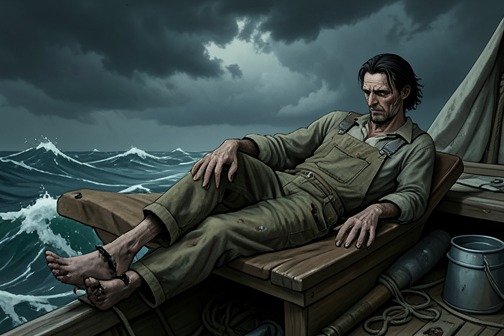
The rescue of [Wainamoinen](entity:character-recall-character-wainamoinen-d8e4019ef0c6) by the [Eagle](entity:creature-recall-creature-eagle-98c7b5b4b2f8) turns a desperate passage at sea into an unexpected arrival in [Pohyola](entity:location-recall-location-pohyola-86563c228405). Wainamoinen, stranded and near physical collapse, is borne to the [Northland](entity:location-recall-location-northland-8351eb6a39dd) by a bird from Pohyola; once there, however, he is not immediately safe or at home. The Eagle’s intervention saves him from the water, while [Louhi](entity:character-recall-character-louhi-6ccf075fe1c4)’s later response brings him into shelter. Together, the two rescues change the direction of his journey without erasing its costs: he reaches land exhausted, grieving, and dependent on people whose country is not his own.
## From endurance to crisis
The episode presents Wainamoinen as having swum through the deep sea for days. By the evening of the eighth day, his endurance has given way to bodily distress: his toenails have been lost, and his fingers are described as dead and dying. The details make his peril physical rather than abstract. He is not merely uncertain of his route; prolonged exposure has begun to disable him, and the sea offers no obvious place to rest or build a home. His lament registers a crisis in which survival itself, not the completion of a chosen journey, has become the immediate question.
That exhaustion shapes the terms of the rescue. Wainamoinen is an old and truthful hero and an ancient minstrel, but those identities do not protect him from bodily weakness. The narrative places the renowned singer at the surface of the ocean, unable to command a safe landing by himself. The contrast matters: this is a moment when his accustomed heroic stature cannot overcome the environment, and help must come from outside his own powers.
## The Eagle’s intervention
A bird arrives from far Pohyola: an Eagle from the west, explicitly noted as not among the largest of its kind. It flies over the waves, strikes its beak against the sea-cliffs, circles, and finally perches. From there it sees Wainamoinen on the ocean and addresses him. The encounter begins not with a display of force but with recognition: the bird notices the stranded hero and asks why he is swimming in the deep billows. That attention interrupts Wainamoinen’s isolation and opens a means of escape.
The Eagle tells Wainamoinen not to lose heart and invites him to place himself between its shoulders. Wainamoinen rises above the water and seats himself on the bird’s feathered back. The scale of the action reverses the earlier picture of helplessness: the exhausted swimmer is carried aloft, along the path of the breezes, instead of struggling through the water under his own strength. The bird’s size is striking precisely because it is not described as exceptional among eagles; its significance lies in what it does, not in a claim that it is the greatest or most powerful bird.
The flight takes Wainamoinen to the distant shore of the Northland, identified with Pohyola. The Eagle sets down its burden and flies away to join its fellows. Its help is decisive but limited: it delivers Wainamoinen from the sea, yet does not remain to guide him, comfort him, or arrange his return. The landing ends one immediate danger while leaving the hero alone in an unfamiliar place.
## A landing without refuge
After the Eagle departs, Wainamoinen weeps and moans. His hair and beard have been disordered by the surging waves, and the narrative gives this distress a measurable duration: he weeps through three days and as many nights. He does not know which way to travel. The rescue has therefore not restored him to his former security. Land is safer than open water, but arrival in the Northland leaves him disoriented, without a clear route onward, and visibly marked by the ordeal.
The contrast between aerial deliverance and prolonged grief keeps the event from becoming a simple triumph. Wainamoinen has been saved from drowning, but the Eagle’s departure means that salvation does not immediately amount to care. The three days and nights also separate the bird’s action from Louhi’s: the first rescuer carries him to shore, while the next stage begins only when someone hears him. His lament, previously a private expression of distress, becomes the sound that makes a further intervention possible.
## Louhi brings him to shelter
The [Maiden of Pohyola](entity:character-recall-character-maiden-of-pohyola-00d4357f8cf2) hears weeping from the seashore and recognizes it as the lament of a hero. She hastens home to tell her mother, Louhi, hostess of Pohyola. Louhi goes out from her dwelling and court-yard, hears the crying herself, and identifies it as the anguish of a bearded hero. The rescue thus shifts from an encounter between Wainamoinen and a bird to a human response prompted by listening: the Maiden carries the news, and Louhi acts on what she hears.
Louhi pushes a boat into the water and rows swiftly to the shore. She finds Wainamoinen with his face trembling and his locks disheveled, and addresses him. She then takes the hapless hero from his place of sorrow, seats him safely in her boat, and brings him to her home by the sea, to the dwellings of Pohyola. There she feeds him, gives him warmth and shelter, and allows him to rest. The scene completes what the Eagle’s flight could not: Wainamoinen is no longer merely deposited on foreign land but received into a household and provided for.
The episode’s decisive turn is therefore a sequence of limited acts of aid. The Eagle saves Wainamoinen from the sea and carries him to the Northland, but leaves him on the shore; the Maiden hears his grief and informs Louhi; Louhi comes by boat and gives him food, warmth, and shelter. His arrival in Pohyola follows from this chain of recognition and assistance. The rescue preserves the vulnerability established by his long swim while changing his immediate condition from exposed survivor to guest under Louhi’s care.
Event 10
Louhi's Bargain for the Sampo
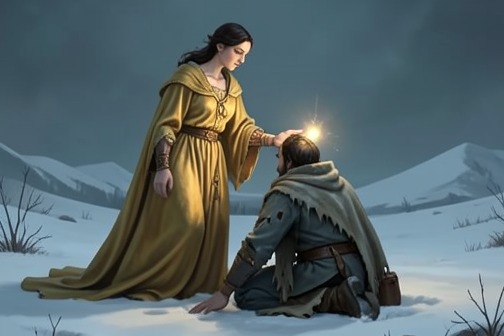
[Louhi's Bargain for the Sampo](entity:event-recall-event-louhi-s-bargain-for-the-57c6699b02d3) turns [Wainamoinen](entity:character-recall-character-wainamoinen-d8e4019ef0c6)'s desire to return from [Pohyola](entity:location-recall-location-pohyola-86563c228405) into a demand for a wondrous object: [Louhi](entity:character-recall-character-louhi-6ccf075fe1c4) will help him go home, but the price is a [Sampo](entity:object-recall-object-sampo-fa7a38a9f0fa). The exchange also binds that task to marriage, making the journey home dependent on a feat Wainamoinen says he cannot perform.
## The wish to return
Louhi, the hostess of Pohyola, has given the stranded Wainamoinen warmth, food, and shelter. Once he recovers, she questions the ancient singer about why he is in this unfamiliar, cold country. His answer centers on home: he asks [Ukko](entity:character-recall-character-ukko-316a9dd36b1c) to let him visit his people again, and contrasts the pleasures of his own table and home with the rare drink offered in strangers’ golden bowls. The longing is not for a new reward but for return to [Wainola](entity:location-recall-location-wainola-4a84a3e73606) and the plains of [Kalevala](entity:location-recall-location-kalevala-1532cc3f896a).
Louhi asks what he would give as payment if she took him back. Wainamoinen offers golden treasures and the finest silver, treating wealth as a possible recompense for safe passage. Louhi rejects that scale of payment: gold and silver, she says, are only trinkets. Her counteroffer changes the negotiation from a simple exchange of transport for treasure into a task with consequences beyond the journey itself.
## The price of passage
Louhi demands that Wainamoinen forge the Sampo, including its many-colored lid. Her request describes its making through an extraordinary collection of materials: the tips of white-swan feathers, the milk of a barren cow, one grain of barley, and the finest lamb’s wool. The specificity makes the Sampo’s creation the test at the heart of the bargain, rather than a payment that can be settled with ordinary riches.
She offers her daughter as a reward and promises to take Wainamoinen to his beloved homeland. Wainamoinen, however, says he cannot forge the Sampo. His refusal is accompanied by the observation that there are no traces of a hammer or tongs, underscoring the absence of the craftwork that such a task would require. The bargain therefore reaches its central impasse: the return he wants is offered, but its stated price exceeds what he claims he can make.
## Marriage made conditional
Louhi answers that she will give her daughter only to the person who can forge the Sampo. The marriage promise is thus not a separate gift available to Wainamoinen regardless of the outcome; it is conditional on completing the same difficult work demanded for the bargain. Louhi links passage home and the prospect of marriage to the Sampo’s creation, while Wainamoinen has already declared himself unable to produce it.
After setting out that condition, Louhi harnesses a dappled horse to her birch-wood sledge. The preparation gives the negotiation a practical next movement, following the exchange of wishes, payment, and terms. The episode establishes the Sampo as the price attached to return from Pohyola and makes Louhi’s daughter part of that price’s promise, even though Wainamoinen has not agreed that he can fulfill the demand.
Event 11
Wainamoinen's Failed Boat-Building and Wound
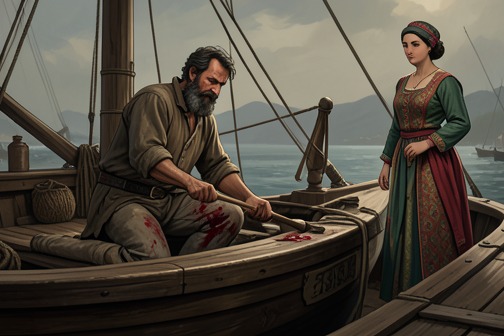
[Wainamoinen's Failed Boat-Building and Wound](entity:event-recall-event-wainamoinen-s-failed-bo-8e22f9b5e60b) is the turning point in his encounter with the [Maiden of the Rainbow](entity:character-recall-character-622ef58ec52a): a courtship challenge that brings the ancient singer from magical words and determined craftsmanship to an abruptly interrupted task and a serious wound. In Rune VIII, the boat he undertakes to build is to be made from fragments of the maiden’s distaff. His work advances for several days, but on the evening of the third, an axe turns aside under [Lempo](entity:character-recall-character-lempo-43bd3fae8159)’s influence and cuts his knee. The boat remains unfinished, and the episode’s direction changes from wooing to the consequences of injury.
## Courtship and the Challenge
The episode begins in the setting of [Wainamoinen](entity:character-recall-character-wainamoinen-d8e4019ef0c6)’s pursuit of the Maiden of the Rainbow. The rune presents him as an ancient minstrel, skilled and truthful, but his age and reputation do not settle the question of whether the maiden will join him. He addresses her with an invitation to come to his snow-sledge; her answer, and then a further answer, keep the exchange in the form of a negotiation rather than a completed union. The scene thus places his request beside the maiden’s own response, instead of treating his desire as sufficient to decide the outcome.
The distaff fragments give that negotiation a practical test. Wainamoinen takes them up and turns toward making a boat, an undertaking that converts the courtship encounter into a demonstration of skill. The task is not simply another song: the fragments must be worked into a vessel, and the following action is described through the hammer and the work itself. The challenge therefore joins the episode’s romantic aim to material labor. Wainamoinen has to make something before the courtship can advance, and the narrative makes that effort—not a declaration alone—the center of the scene.
## The Work and Its Interruption
Wainamoinen applies himself eagerly to the task. The account marks the passage of time: he continues working until the evening of the third day. That duration distinguishes the undertaking from an instantaneous display of magic. Though the maker is also a true magician, the scene gives attention to repeated effort and to the tools in his hands. The hammer, distaff fragments, and axe make the attempted boat a concrete piece of work, while the several days of labor establish how far the project has progressed before it is broken off.
The decisive reversal comes as the axe turns aside. The account names Lempo as the force guiding the sharpened hatchet, making the accident more than an ordinary mishap without diminishing its physical consequence. A stream of blood follows, and the wound is identified with Wainamoinen’s knee. The change is sudden: a tool being used in the service of a courtship task becomes the means by which that task is stopped. The third-day marker gives the turn a clear point in the episode’s sequence—work has continued, the blow falls, and the boat-building can no longer proceed as before.
## Consequences and Narrative Significance
The wound redirects the episode from making toward the need for care. The evidence associated with the scene presents Wainamoinen again as the ancient or wise minstrel after the injury, but his titles do not prevent him from being vulnerable to what happens during the work. His magical identity and his practical effort coexist with an accident that neither his reputation nor his purpose averts. The result is a marked contrast between command and exposure: he undertakes the task with zeal, yet the axe’s deflection brings his labor to a halt.
The unfinished boat also leaves the courtship challenge unresolved within this episode. The maiden’s invitation or refusal is not replaced by a completed vessel; instead, the work is interrupted before its intended purpose can be fulfilled. That structure keeps the wound connected to the proposal without claiming that the injury itself decides the relationship. The scene’s consequence is first a change in Wainamoinen’s immediate course: from building for the Maiden of the Rainbow to confronting the wound and the need for healing.
The episode’s force lies in that change of register. It begins with an exchange between an experienced suitor and a maiden who answers him, moves into a prolonged act of making from humble fragments, and ends with the sudden failure of the work through Lempo’s intervention. The object being built and the wound that prevents its completion are tightly linked: the axe belongs to the labor, but its diverted stroke turns the maker’s effort against him. Wainamoinen’s courtship is therefore defined not by a successful demonstration but by an interruption that exposes the limits of skill and magical authority. The unfinished task leads the narrative away from wooing and toward the subsequent concern with his injury.
Event 12
The Origin of Iron and Steel
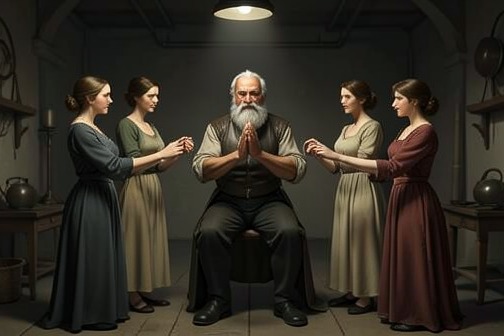
[The Origin of Iron and Steel](entity:event-recall-event-the-origin-of-iron-and-33356ea1d6fd) presents metal as both a product of a heavenly beginning and a material transformed by the smith’s labor. [Ukko](entity:character-recall-character-ukko-316a9dd36b1c) initiates iron’s origin, three maidens become its mothers, and [Ilmarinen](entity:character-recall-character-ilmarinen-eeb892d7bfb2) works the metal through fire and water. The account’s decisive turn comes when the process of making iron useful also makes it dangerous: the finished explanation connects iron and pale-blue steel with wounds that draw blood.
## Heavenly Origins and the Three Mothers
The account places iron’s birth near the beginning of the ordering of the world. Ukko, described as maker of the heavens, cuts apart air and water; the narration then declares that iron had not yet been born. The sequence gives metal a place among the things brought forth as the world takes shape, rather than treating it as an ordinary material whose origin needs no explanation.
Ukko’s next action is physical and generative. He rubs his hands together and presses them firmly against his kneecap. From that gesture arise three lovely maidens, also described as three beautiful daughters, who become the mothers of iron. The account thus gives iron a maternal lineage: its origin is not attributed solely to a later human craft, even though smithing will determine what the material can do. The movement from air and water, to Ukko’s bodily gesture, to the maidens establishes a creation sequence before the narrative turns to the furnace.
## Ilmarinen and the Fear of Fire
Ilmarinen enters the account as the smith who comes to earth to work metal. His origin is associated with the Coal-mount, a place-name that connects his arrival with the material and heat of his craft. Where Ukko’s actions bring iron into being, Ilmarinen’s work subjects it to a process of change. The two roles are distinct: the heavenly maker belongs to iron’s first emergence, while the blacksmith handles the metal as something to be worked.
That work is not presented as effortless. Ilmarinen raises the prospect of placing iron in a furnace so that it may become free and useful; iron responds with fear and distress at the mention of Fire. The episode gives the metal a fearful response at the very point when smithing promises to make it serviceable. Fire is therefore both a necessary part of the transformation and a threat from iron’s perspective. The account does not make usefulness a simple gift: it begins with a frightening passage through heat.
Ilmarinen starts the bellows and gives the handle three motions. Iron then flows in streamlets. The specific count and the flowing image make the transformation visible as a sequence of deliberate acts: the smith works the bellows, and the rigid material becomes fluid enough to move. The passage shifts from iron’s fear of the furnace to the smith’s control of the process, but it does not suggest that control removes danger from what is being made.
## The [Hornet](entity:creature-recall-creature-774186bfa72d) and the Poisoned Water
The making of steel introduces a second danger after the furnace. While Ilmarinen speaks of helping water produce steel from iron, the evil hornet of [Hisi](entity:character-recall-character-hisi-d32032d13353) hears him from the cottage gable. The detail fixes the hornet at the edge of the smith’s workspace, listening as the work proceeds. The account singles it out not as a neutral insect but as an evil creature associated with Hisi, and places its overhearing immediately before the later mention of poison.
Ilmarinen, identified as a skilled and ancient blacksmith, thinks that the bee has brought something to help him. The contrast between the bee he supposes to be assisting and the evil hornet already noted in the scene makes the episode turn on mistaken attribution. The text then describes Ilmarinen dipping the iron into water mixed with many poisons. The supplied sequence links the hornet’s overhearing, the smith’s belief in the bee’s aid, and the poisoned water, without detailing every step between them. What is explicit is the result: the finished account of iron’s origin also explains how wounds came to make blood flow in streams from human beings and heroes.
## From Material to Consequence
The narration closes by naming its subject directly: the origin of iron and of steel of light blue color. That conclusion gathers the earlier stages into one account—Ukko’s generation of iron, the three mothers, Ilmarinen’s work with the furnace, and the tempering of metal in poisoned water. Steel is distinguished by its pale-blue color, while the process is tied to the bodily consequence of wounds and flowing blood.
The event’s significance lies in this double explanation. Iron is born through a creation story, but its later character is shaped by craft and by the dangers surrounding that craft. Ilmarinen’s labor turns iron into something useful, yet the outcome is not purely beneficial: the account associates the metal’s origin with injuries suffered by people and heroes. The closing reference to blood makes the process more than a technical transformation. It explains metal’s place in the world by connecting the smith’s work to the harm metal can inflict.
Event 13
Väinämöinen’s Wound and Healing
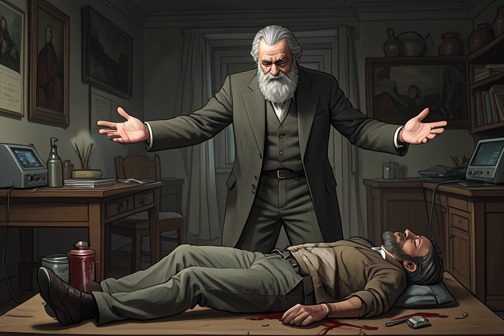
[Väinämöinen’s Wound and Healing](entity:event-recall-event-v-in-m-inen-s-wound-and-30fd0eb856a0) turns a dangerous wound into a two-part act of restoration: a gray-bearded healer first arrests [Wainamoinen](entity:character-recall-character-wainamoinen-d8e4019ef0c6)’s bleeding with words, then treats him with a balsam made by the healer’s son. The episode moves from knowledge of iron’s origins to practical healing, and ends with Wainamoinen restored and conscious of the help of magic and [Ukko](entity:character-recall-character-ukko-316a9dd36b1c).
## From knowledge to intervention
The scene begins with the gray-bearded man rising from the hearth and answering after the account of iron’s origin. His appearance marks a change in the episode’s direction: knowledge that has been presented as an explanation now leads into an effort to save Wainamoinen. The danger is addressed directly through a spoken remedy aimed at the blood flowing from Wainamoinen’s wounds.
The healer’s words command the crimson stream and the blood of ages to stop their course. The passage presents the spell as an action, not merely a description of healing: when the words have been spoken, the blood-stream ends. That immediate result establishes the healer’s speech as the first stage of the rescue, while leaving a further remedy to be prepared.
## The balsam and its application
After the bleeding stops, the gray-bearded man rejoices and sends his young son to the smithy to make a healing balsam. The sequence gives the recovery both a verbal and a material means: the spell checks the immediate flow of blood, and the salve is prepared as a remedy for the wounds. The son’s task extends the healer’s intervention beyond his own words and brings the smithy into the work of restoring Wainamoinen.
Before the balsam is applied, the old man tests it and finds the remedy effective. The text thus distinguishes its preparation from its use: the son makes the salve, the healer tests it, and only then is it put to work. When the wounds have been anointed and the magic salve has touched them, Wainamoinen recovers. The account presents the treatment as a sequence of deliberate steps rather than as a single unexplained reversal.
## Recovery and significance
The episode’s outcome is secured in stages. First the spoken words stop the blood; then the tested balsam is applied; finally, Wainamoinen feels the aid of magic and the help of gracious Ukko. The ending therefore joins the healer’s practical actions to a larger source of protection acknowledged by the recovered hero. The account does not reduce the restoration to either spell or salve alone: each has its place in the progression from danger to recovery.
The scene also links knowledge, speech, and skilled making. The gray-bearded man’s response follows the account of iron’s source; his words then alter the immediate crisis, while his direction sends his son to the smithy for the next part of the cure. Wainamoinen’s healing is consequently framed as both an act of magic and a purposeful process involving the healer, his son, and the prepared remedy.
Event 14
Ilmarinen Forges the Sampo
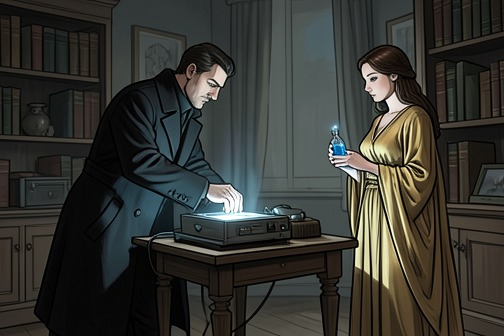
[Ilmarinen Forges the Sampo](entity:event-recall-event-ilmarinen-forges-the-sa-4e9e3005f8ee) turns a marriage bargain into a feat of supernatural craftsmanship, then exposes the gap between fulfilling a condition and winning its promised reward. [Wainamoinen](entity:character-recall-character-wainamoinen-d8e4019ef0c6) enlists the master smith to make the [Sampo](entity:object-recall-object-sampo-fa7a38a9f0fa) for the sake of a maiden of [Pohyola](entity:location-recall-location-pohyola-86563c228405); [Ilmarinen](entity:character-recall-character-ilmarinen-eeb892d7bfb2) succeeds, and [Louhi](entity:character-recall-character-louhi-6ccf075fe1c4) takes the finished marvel away. Yet the smith’s request for the maiden’s willing answer remains unresolved, leaving the episode’s achievement divided between an object secured and a bride not obtained.
## The bargain and the summons
The undertaking is framed as an exchange. Wainamoinen points to a maiden seated on the rainbow and walking upon purple clouds, then names the Sampo as the work to be made and the virgin as its reward. The promised bride gives the commission its personal stakes: this is not simply a demonstration of Ilmarinen’s skill, but labor undertaken in expectation of marriage.
Wainamoinen’s own magic marks the movement toward that commission. After speaking of what might be taken from him, he sings again in magical accents and sings a storm-wind into the heavens. The narrative then turns to his direct appeal to Ilmarinen, addressing him as a master of the forge and asking him to make the Sampo and its many-colored lid. The sequence places the smith’s specialized craft alongside Wainamoinen’s song-magic: the work requires Ilmarinen’s forging, but the events leading to the request are shaped by Wainamoinen’s powers and purposes.
## The work at the forge
The forging proceeds through a measured sequence. On the next day Ilmarinen lays his bellows; on the third he builds his furnace and begins to forge the Sampo. The song identifies him both as an ancient blacksmith and as the eternal magic artist, joining long-established mastery to a creation that exceeds ordinary smithing. The delay matters: the Sampo does not appear instantly at the request, but emerges through the preparation of tools and furnace and the labor that follows.
When Ilmarinen bends down to inspect the metals at the bottom of the furnace, he sees the Sampo rising and sees its lid in many colors. That moment makes the object visible as the product of his work: first it is promised, then forged, and finally discerned within the materials of the furnace. The colored lid links the completed marvel to the repeated description in the commission, so that the finished object answers to the design set before the smith.
## What the Sampo does
The completed Sampo is described through its rhythmic operation. Its lid rocks to and fro as it grinds: one measure at daybreak, a second for the market, and a third for the storehouse. The account emphasizes repeated production and distinct uses, rather than merely naming the Sampo as a treasure. Its value lies in what it continually yields and in the way its output reaches both the day’s beginning and the needs of exchange and storage. The separate measure associated with money further establishes that its abundance includes wealth as well as provisions.
This working rhythm also gives the marvel a particular form in the song. The Sampo is neither only a beautiful object nor only a prize in a marriage bargain: it is a machine whose rocking lid and grinding action make its extraordinary abundance legible. The repeated measures turn magical plenty into an ordered process, and the compact pattern of daybreak, market, and storehouse makes the result sound regular and dependable.
## Possession and the unfulfilled reward
Louhi, hostess of Pohyola, takes away the magic Sampo joyfully. Her taking marks the transfer from the smith who made it to the figure who carries it off; the account thus distinguishes the maker’s labor from control of its product. Ilmarinen’s part in the bargain has produced the object, but does not by itself secure the bride.
After the Sampo has been taken, Ilmarinen modestly pleads for the maiden’s willing answer. The emphasis on willingness sharpens the contrast with the earlier promise: the maiden is not simply another possession delivered alongside the machine. The episode closes its account of the bargain with the imbalance still in view. Louhi has the wondrous Sampo; Ilmarinen has not the Bride of Beauty. The forging is completed, but its promised human reward remains unsettled, making the episode’s success real and incomplete at once.
Event 15
Lemminkäinen Abducts and Marries Kyllikki
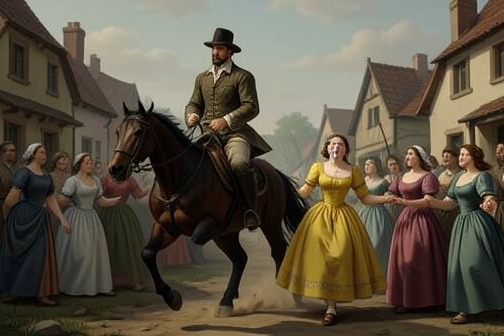
[Lemminkainen](entity:character-recall-character-lemminkainen-ee8fbdcc2336) Abducts and Marries [Kyllikki](entity:character-recall-character-kyllikki-3a018cebe0a4) turns a forced removal into a marriage marked by grief and reciprocal vows. Kyllikki, celebrated as [Sahri](entity:location-recall-location-sahri-312b3d669a94)’s pride and beauty, is taken from the place where maidens gather to dance and brought to Lemminkainen’s mother’s cottage. The movement from public gathering to the hero’s family home makes the episode’s central tension visible: marriage joins households, but here that joining begins with Kyllikki’s loss of freedom and her tearful resistance.
## Background and the meeting at the dance
The episode follows a warning against spending time wooing Sahri’s favored maiden. Little time passes—scarcely a month—before the narrative turns to a merry evening and the gathering of maidens for dancing. The contrast is pointed: the warning imagines courtship as something to avoid, while the scene presents Kyllikki among her companions in a social space of her own. Her beauty and standing are emphasized before Lemminkainen arrives, so the reader encounters her first as the celebrated object of others’ attention and then as a person whose wishes will become impossible to ignore.
Lemminkainen comes on a stallion described as the fleetest racer of the [Northland](entity:location-recall-location-northland-8351eb6a39dd). He drives beyond the meadow to the place where the maidens meet, and the poem’s quick verbs compress his approach and seizure: he snatches Kyllikki, seats her, and draws a leather cover. The horse and hurried action give the abduction a public, forceful character; this is not a private agreement reached through an extended courtship. The scene’s briefness also sharpens the change in Kyllikki’s circumstances. She moves in moments from the company of the dancers to the control of the man who has carried her away.
## Abduction and protest
The poem does not let the speed of the seizure erase its cost. Kyllikki’s wailing and weeping are presented directly after the abduction, and her pleading becomes a distinct part of the encounter rather than a detail absorbed into Lemminkainen’s success. Her grief marks the gap between his action and her consent. The narrative thus holds two facts together: he has physically removed her, yet her response makes clear that the removal is not an uncomplicated romantic elopement.
The exchange that follows sustains the conflict through speech. Kyllikki addresses Lemminkainen as a cruel fighter, while he answers and addresses her as the fair Kyllikki. His language is associated with the broadsword and spear, bringing martial identity into a scene ostensibly concerned with marriage. The contrast matters: his means of acquiring a bride are continuous with the force and combat associated with his heroic persona, while her words register the human opposition that such force encounters. The scene does not describe a battle between them; instead, it lets the tension surface in her accusation, her pleading, and his reply.
## Vows and conditions
The relationship changes through an oath rather than through any account of Kyllikki’s sudden affection. The two make vows together, register them in heaven, and swear before [Ukko](entity:character-recall-character-ukko-316a9dd36b1c). That heavenly witness gives their promises a solemn authority beyond the immediate encounter, while the fact that both take part distinguishes the vows from the unilateral act of abduction that preceded them. The marriage’s terms are therefore presented as something to be bound by mutual undertaking, even though the episode has already shown how unequal the circumstances of their meeting are.
Dancing and warfare give the promises their concrete stakes. Kyllikki is associated with the village dances, and the exchange makes her visits to them a subject of the oath; Lemminkainen’s broadsword and spear, in turn, make his life as a fighter part of the negotiation. The episode links domestic union to the restraint of activities that define each figure in the scene. Its vows do not erase the coercive beginning, but they introduce an obligation that can later be measured against conduct: the promise is not simply a declaration of marriage, but a rule whose breach can have consequences.
## Arrival and significance
After the vows, the pair reach Lemminkainen’s home and birthplace and enter his mother’s cottage. The destination is more than a change of scenery: Kyllikki is transferred from the gathering of maidens at Sahri into the household of her husband’s family. The movement brings the episode from the public setting of dancing to the domestic space in which the marriage will be lived. The mother’s cottage also makes the union a matter of household incorporation, not merely a private bond between two individuals.
The poem’s sequence refuses to make that incorporation look effortless. A warning against wooing leads to a meeting at the dance; the meeting becomes a seizure; Kyllikki’s distress leads into a spoken exchange; the exchange is followed by vows; and only then does the couple enter the family home. Each transition changes the form of the conflict without making its earlier stages disappear. The episode is therefore both a marriage story and a narrative of contested choice: Kyllikki’s protests remain part of the account even as the oath and the arrival establish a shared domestic future. Its decisive tension lies in that unresolved conjunction, between the force that brings her to Lemminkainen’s home and the promises that are meant to govern their life together.
Event 16
Kyllikki Breaks Her Vow
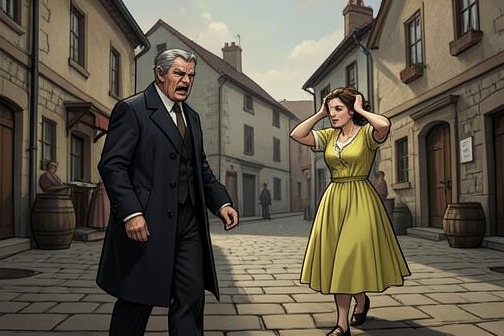
[Kyllikki Breaks Her Vow](entity:event-recall-event-kyllikki-breaks-her-vow-d262ebcac133) marks the collapse of a reciprocal agreement between [Kyllikki](entity:character-recall-character-kyllikki-3a018cebe0a4) and [Lemminkainen](entity:character-recall-character-lemminkainen-ee8fbdcc2336). Her visit to a village dance is reported to her husband, who turns from hurt and anger toward a northern campaign. The breach therefore does more than expose a broken promise: it becomes the immediate occasion for Lemminkainen’s departure, while his mother’s warnings make that departure ominous.
## The Reciprocal Oath
The preceding agreement binds each spouse to a different restraint. Kyllikki is not to go to village dances, while Lemminkainen is not to go to war. Their promises are presented as mutual, not as a demand imposed on one spouse alone: the two make an oath together and register their vows in heaven, swearing before [Ukko](entity:character-recall-character-ukko-316a9dd36b1c). The divine witness gives the private bargain a solemn, public-facing weight, even though the evidence of its force ultimately rests on the spouses keeping it.
The conditions also place two distinct kinds of freedom in tension. Kyllikki’s promise concerns village dances, a social gathering; Lemminkainen’s concerns combat and the dangers of a northern expedition. The arrangement links domestic trust to the prospect of violence beyond the household. Once one condition is broken, the other becomes vulnerable too: the oath does not preserve peace when the partners cease to honor it.
## The Breach Comes to Light
On an evening when Lemminkainen is away from home, Kyllikki goes to a village dance among the maidens. The account gives the act plainly, without supplying a further motive for her choice. Its significance comes from the promise it violates: the dance is not merely an outing but the specific conduct she had agreed to forgo.
[Annikki](entity:character-recall-character-annikki-331e996fc58d), identified as Lemminkainen’s sister, carries the news to him. Her role turns an absence into a disclosure. Kyllikki’s action takes place away from her husband, but it does not remain hidden; the news reaches him through his own family. The narrative thus makes the report, as well as the broken promise itself, the hinge between the domestic agreement and the next movement of the story.
## From Hurt to Anger
When he hears, Lemminkainen is dejected and broken-hearted, but anger rises alongside his distress. He speaks of Kyllikki going to the village dances and, in effect, says she may continue to go. That response does not restore the couple’s agreement. Instead, his words register its failure and turn attention toward his own abandoned restraint.
He declares his intention to hasten to combat, to the campfires of [Northland](entity:location-recall-location-northland-8351eb6a39dd) and the battlefields of [Lapland](entity:location-recall-location-lapland-34769692e172). The sequence makes the broken oath a turning point: the prospect of war, which Lemminkainen had promised to avoid, returns as his chosen course. The text presents the movement from marital grievance to military purpose directly, without suggesting that the dance itself explains everything about his decision or absolves him of responsibility for it.
## His Mother’s Warning
Lemminkainen’s mother tries to restrain him and continues to plead with him as he prepares to go. Her appeal is set against his urgency: she is not simply reacting after he has left, but attempting to stop the departure while it can still be prevented. The conflict therefore extends beyond the spouses, bringing a mother’s protective counsel into opposition with her son’s resolve.
Her warning is attached to a concrete sign: the bloodied hairbrush. She tells him to watch for blood flowing from the brush, making it an omen connected with the danger ahead. The brush gives the warning a material form that can be recognized later, rather than leaving it as a general fear. Even so, Lemminkainen heeds neither his mother’s warning nor her efforts to hold him back.
## Departure and Narrative Consequence
The rune closes this turn with Lemminkainen going to Lapland, described as a place of battle and as no welcoming destination. His departure fulfills the very impulse his vow was meant to restrain, while Kyllikki’s broken promise has already ended the shared discipline on which that restraint depended. The account does not resolve the couple’s breach here; instead, it carries the consequences outward, from the dance and the sister’s report to the northern expedition.
The episode’s structure rests on a sharp reversal. A vow witnessed by Ukko had paired Kyllikki’s social conduct with Lemminkainen’s avoidance of war; a single reported breach is followed by his decision to take up the path of combat. His mother’s plea and the ominous hairbrush deepen the cost of that choice without changing it. The broken agreement thus serves both as a marital rupture and as the threshold to the dangers of the next adventure.
Event 17
Lemminkäinen’s Trials for Louhi’s Daughter
[Lemminkäinen’s Trials for Louhi’s Daughter](entity:event-recall-event-lemmink-inen-s-trials-f-8c6b80453f65) makes courtship a test of deeds: [Louhi](entity:character-recall-character-louhi-6ccf075fe1c4)’s daughter is promised not freely, but conditionally, as [Lemminkäinen](entity:character-recall-character-lemmink-inen-bdc945d92935) is sent from one dangerous task to the next. The surviving sequence records his claim to have caught the wild moose, his return as a victor to [Pohyola](entity:location-recall-location-pohyola-86563c228405), and Louhi’s demand that he kill a swan in the [River of Tuoni](entity:location-recall-location-river-of-tuoni-019836737925) with a single arrow. The passage ends as he accepts this third test, leaving its outcome beyond the scene presented here.
## Marriage Made Conditional
The trial sequence is framed by Lemminkäinen’s desire to marry Louhi’s daughter. The wild moose is not an incidental quarry: the condition attached to bringing it back is a chance to woo the maiden. The demand makes a personal relationship depend on the suitor’s completion of tasks set by her mother, and turns the pursuit of marriage into a public measure of his capability.
After the hunt, Lemminkäinen goes as a victor to the dwellings of Pohyola and addresses Louhi. He asks her for her fairest virgin as his future bride. Louhi, identified as hostess of the [Northland](entity:location-recall-location-northland-8351eb6a39dd) and of Pohyola, does not grant his request on the strength of his success. Instead, she sets a further condition. The exchange therefore renews the obstacle at the moment Lemminkäinen expects his achievement to count: completing one demand earns him an audience and a new demand, not the bride.
## The Tests in Sequence
The moose hunt is the first clearly established achievement in the supplied sequence. Lemminkäinen later tells Louhi that he has caught the moose of [Lempo](entity:character-recall-character-lempo-43bd3fae8159) and done what she required. His statement connects the boast of a successful hunt to the condition that began the wooing, and presents the completed task as grounds for asking again for her daughter. The narrative thus gives the episode a repeated pattern: a demand, a claimed accomplishment, and a renewed request for marriage.
A second test lies between that first success and the audience in Louhi’s court. The narration calls what follows Louhi’s second test of heroes, and Lemminkäinen hastens forward to accomplish it, undaunted. The larger sequence identifies this trial with the fiery horse, but the quoted portion supplies no account of how he completes it. What it does establish is the escalation’s structure: his progress has already required more than the moose, and the second task has not ended his pursuit. He rides over the snow-capped hills of [Lapland](entity:location-recall-location-lapland-34769692e172) to Sariola, dismounts, and enters Louhi’s court to make his claim.
## The Third Demand and Its Stakes
Louhi responds to the request for her daughter by naming another task: Lemminkäinen must kill the swan in the River of Tuoni, where it swims in the black death-river. The setting and the required act distinguish this demand from the earlier hunt. The suitor is not merely asked to bring back another animal; he must attempt a killing in a river explicitly associated with death.
Louhi also sharply limits his means. He may try with only one crossbow and one arrow from his quiver. That restriction concentrates the danger into a single attempt and denies him the security of repeated shots. The trial’s terms make success uncertain even before the action begins, while the river’s name and description give the task a grave setting. Lemminkäinen is called reckless as he takes up this third test, a characterization that signals the risk in his persistence without resolving what happens next.
## Narrative Function and Limit
The episode advances by withholding the marriage while registering each step as an achievement or fresh obstacle. Lemminkäinen’s return as a victor and his claim that he has fulfilled Louhi’s demand create a brief expectation that the earlier work may secure the bride; Louhi’s next condition immediately redirects the action. The sequence makes the suitor’s determination inseparable from the danger imposed by the tests.
The available passage closes at the threshold of the swan challenge: Lemminkäinen has accepted it, but no result is given here. The scene therefore leaves both the task and the marriage unresolved. Its decisive movement is not a final victory but the transition from two prior tests to a third, more tightly constrained demand.
Event 18
Lemminkäinen’s Death and Restoration
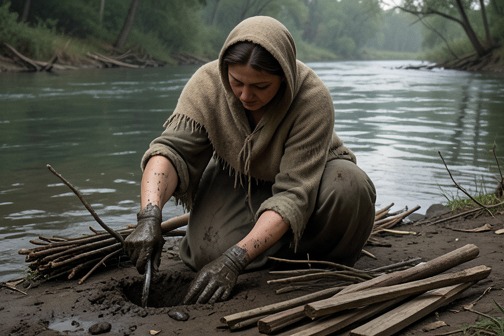
[Lemminkäinen’s Death and Restoration](entity:event-recall-event-lemmink-inen-s-death-an-95fc423d357d) turns a death associated with [Nasshut](entity:character-recall-character-nasshut-0b1ca9f2f03d), [Northland](entity:location-recall-location-northland-8351eb6a39dd)’s old shepherd, into a return made possible by a mother’s persistence. Its decisive movement is from fragments to a re-formed body and from stillness to waking: [Lemminkäinen](entity:character-recall-character-lemmink-inen-bdc945d92935)’s mother does not abandon her son to death, but gathers and restores him.
## The Death and Its Naming
The episode’s opening traces name the wretched shepherd Nasshut and describe Lemminkäinen as the blood-stained son of death-land. These compressed phrases establish the death as the crisis from which the rest of the episode must work its way back. The shepherd’s name anchors the event in a human encounter, while the death-land epithet gives the loss a larger, mythic register.
The narrative then names Lemminkäinen directly as hero. That designation matters to the episode’s shape: the figure presented as lost is not replaced by another protagonist. The restoration will return this same son, and its emotional center is the bond between him and his mother.
## The Mother’s Search and Work
Lemminkäinen’s mother is called faithful, a description borne out by the labor attributed to her. She draws the rake for a third time, making persistence part of the scene’s action rather than merely a quality assigned to her. The repeated effort culminates in recovery: she finds the pieces of her son and shapes him from the fragments.
Reassembling him is distinct from waking him. The poem first describes the mother making her son whole, then turns to the further act of care by which life returns. This sequence gives the restoration a careful progression: recovery, shaping, anointing, and awakening. The mother is not simply present at the return; her actions make it possible.
## Anointing and Return to Life
After shaping her son from the fragments, the mother anoints him. The account then moves slowly toward his waking, preserving a pause between the work of restoration and its result. Lemminkäinen does not spring instantly from death into action. His return is presented as a gradual change, with the mother’s care continuing through the moment when he begins to wake.
The episode thus gives the mother’s work both a practical and a relational meaning. She retrieves and reconstitutes her son, but the careful order of the actions also makes her devotion the force that carries the narrative across the boundary between death and life. The hero’s restoration is an achievement of maternal persistence rather than a solitary feat by the hero himself.
## Narrative Significance
The episode’s structure rests on a stark reversal: the named hero is associated with death, yet his mother’s repeated labor brings him back. The contrast between the fragments and the shaped son makes restoration visible as a process, while the third drawing of the rake gives that process a measure of persistence and time.
The mother’s role also changes the terms of heroic action. Lemminkäinen is the figure restored, but he is not the agent of his own return; his mother searches, gathers, shapes, and anoints. The ending’s slow awakening keeps attention on that care and completes the movement from loss to renewed life.
Event 19
Väinämöinen’s Search for the Lost Words
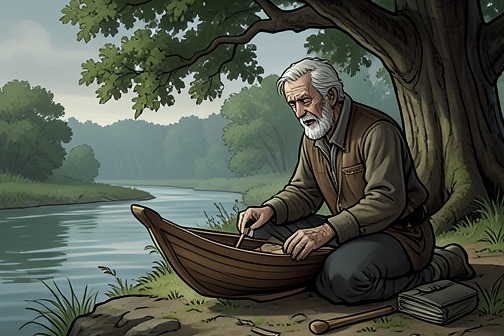
[Väinämöinen’s Search for the Lost Words](entity:event-recall-event-v-in-m-inen-s-search-fo-f223c56c6bf1) is the episode in which an unfinished oak vessel sends its builder in search of ancient knowledge. [Väinämöinen](entity:character-recall-character-v-in-m-inen-de75453bbc03) can shape the boat through enchantment and song, but three missing words halt the work; only after seeking wisdom first in [Tuoni](entity:character-recall-character-tuoni-e881ffaf3b02)’s realm and then from [Wipunen](entity:character-recall-character-wipunen-bbfd203b4318) can he return to the vessel. The episode makes a craft’s completion depend not on further labor alone but on recovering knowledge that song preserves and carries forward.
## The vessel and the missing words
Väinämöinen is introduced as old, skilful, and an “eternal wonder-worker.” He builds a vessel from oak timber, using its posts, planks, and flooring as the material frame. The construction proceeds by song: with one song he joins the framework, with a second he sets the siding, and with a third he places the row-locks. The sequence presents enchantment as practical work. Song does not merely accompany the building; it fastens and arranges the boat’s parts.
The structure is nearly complete when the obstacle appears. Its ribs are firmly fastened and its sides tightly jointed, but three words are wanting: Väinämöinen has lost the master-magic words for fastening the ledges. The interruption is precise. He has not forgotten how to make the whole vessel, nor does the text describe a general failure of skill; a particular part of the building cannot proceed without a particular piece of knowledge. The missing words expose a limit within the singer’s considerable power: the boat’s frame can be formed, yet the work remains unfinished until its lost verbal knowledge is recovered.
## The search in Tuoni’s realm
Väinämöinen first journeys to the kingdom of Tuoni to find ancient wisdom. His destination places the search in a realm associated with the dead, but the immediate aim is practical: he needs the sayings that will complete his vessel. When questioned about why he has come to Manala, he tells the maiden a falsehood, claiming that fire brought him there. The deception gives the encounter a wary, indirect quality; he does not initially disclose that he has come to learn magic sayings.
The hostess, [Tuonetar](entity:character-recall-character-tuonetar-176863f7931c), answers plainly when the purpose is eventually stated. Mana does not give these sayings, she says, and they cannot be learned from Tuoni. Her refusal closes off the hoped-for source of knowledge rather than supplying the words Väinämöinen needs. The episode therefore distinguishes between entering a place of ancient power and actually gaining access to its wisdom. A journey to Tuoni’s kingdom is not enough to retrieve the lost words.
## Wipunen’s store of knowledge
The search turns to Wipunen, described as a wisdom-singer, ancient bard, and great magician. The encounter is presented through images of age and stored knowledge: Wipunen is an ancient prophet filled with power, and his store of knowledge opens. The contrast with the failed visit to Tuoni’s realm is consequential. Where Tuonetar says the sayings cannot be learned there, Wipunen’s knowledge becomes available to the seeker.
The passage gives that recovery a scale beyond the immediate boat-building problem. As Väinämöinen learns the magic sayings, ancient songs, and legends, even Jordan is said to cease flowing and the Wuoksen to stop and listen. The pause in the rivers makes the act of transmission seem momentous: the world itself is figured as attentive to the recovered lore. Wipunen’s knowledge is not only a missing instruction for one craft but part of a body of songs and legends whose preservation matters beyond the lives of their keepers.
That concern is stated directly in the warning that the earth must never lose this wisdom, even if the wisdom-singers perish. Wipunen’s role thus joins the figure of the powerful magician to that of a keeper of cultural memory. The episode does not treat knowledge as secure merely because an ancient singer possesses it. Its continuation depends on its being opened, learned, and carried onward by another singer.
## Return to the work
Once he has learned the sayings, Väinämöinen hastens back to the firesides of [Wainola](entity:location-recall-location-wainola-4a84a3e73606) and the plains of [Kalevala](entity:location-recall-location-kalevala-1532cc3f896a). He goes straight to the smithy of his brother, [Ilmarinen](entity:character-recall-character-ilmarinen-eeb892d7bfb2), and greets him with the news that he has found the keys of secret doctrine and the lost words of the Master. The return links the distant search to a familiar working place and to a relationship: the recovered knowledge is brought back among companions and into the world of craft.
Väinämöinen then goes directly to his vessel, returning to the spot of magical labor. The sequence closes by bringing the seeker back to the task that began the episode. The boat’s unfinished state has led him outward, first to a realm that cannot provide the sayings and then to Wipunen’s opened store; the return restores the construction as the immediate purpose of the quest. The supplied account establishes that Väinämöinen has recovered what was lost and resumed his approach to the vessel, while the broader significance lies in the connection between recovered words, working craft, and the survival of old songs.
## Narrative significance
The episode turns a shortfall in technical work into a search through different kinds of authority. Väinämöinen’s own songs can join the frame, set the siding, and place the row-locks, but they cannot supply the three words he has lost. Tuoni’s realm proves unable to give them; Wipunen’s knowledge can. This progression makes the quest’s outcome depend on recognizing that mastery includes seeking knowledge beyond oneself.
The song-form reinforces that idea by presenting knowledge as something spoken and learned rather than stored as an abstract instruction. The missing words interrupt the building; the recovered sayings, songs, and legends restore a path forward. At the same time, the warning about wisdom-singers’ mortality gives the recovery a wider urgency. The words matter to Väinämöinen’s vessel, but the episode also insists that wisdom must outlast the individual singers who carry it. The boat and the lore are linked as works that require continuity: one must be completed through inherited knowledge, and the other must be kept alive through transmission.
Event 20
Ilmarinen and Wainamoinen compete to woo the Maiden of the Rainbow
The competition between [Wainamoinen](entity:character-recall-character-wainamoinen-d8e4019ef0c6) and [Ilmarinen](entity:character-recall-character-ilmarinen-eeb892d7bfb2) turns a courtship in [Northland](entity:location-recall-location-northland-8351eb6a39dd) into a test of precedence, reputation, and the maiden’s freedom to choose. Ilmarinen has been wooing the [Maiden of the Rainbow](entity:character-recall-character-622ef58ec52a) for three years when Wainamoinen sails north to seek her too. Ilmarinen’s pursuit of his rival ends not in violence but in an agreement to let the maiden decide; her rejection of a sea-born hero then makes clear that Wainamoinen’s gifts and arrival cannot command her consent.
## The Rival Courtship
The episode begins with Wainamoinen bound for the dismal Sariola, another name used here for the Northland to which Ilmarinen has been wooing. Wainamoinen is described as the cleverer suitor who sails ahead to court the bride Ilmarinen has sought for three long years. The contrast is pointed: Ilmarinen’s courtship has endured, but Wainamoinen’s arrival unsettles its apparent claim. The maiden is not simply a distant prize at the end of a journey; her decision has become the stake between two established heroes.
Wainamoinen’s approach is marked by the vessel itself. He sails on the waters, seated at a copper helm, carrying costly presents and priceless gems from [Kalevala](entity:location-recall-location-kalevala-1532cc3f896a). His voyage therefore combines movement toward the Northland with a display of wealth and standing. Yet the narrative does not treat the gifts as a guarantee of success. The question of who may marry the maiden will be answered by her choice, not settled by which suitor arrives first or bears the richest offerings.
## Ilmarinen Gives Chase
When Ilmarinen hears the story of Wainamoinen’s voyage, he stands motionless, and silent grief settles over him. The stillness makes the news register as a personal blow: the blacksmith who has spent years courting the maiden now learns that a rival is sailing to claim her attention. His response is not to abandon the courtship. He travels north for a day, then another, and continues through the following day until he catches Wainamoinen on the third.
Ilmarinen intercepts Wainamoinen by bringing his own magic vessel alongside the other boat. This meeting converts a rivalry that had unfolded across distance into a direct negotiation. Ilmarinen proposes that the maiden be allowed to wed the man she chooses and follow the one she selects. Wainamoinen agrees, and the two resolve to court her in peace. Their pact changes the terms of the contest: neither man will settle the matter by force or by claiming that prior pursuit entitles him to her.
## The Maiden’s Judgment
The Maiden of the Rainbow’s responses distinguish her judgment from the suitors’ competition. She speaks after the presentation of costly gifts and gems from Kalevala, but the scene does not show those offerings deciding her. Her mother’s advice also enters the exchange. The hostess of [Pohyola](entity:location-recall-location-pohyola-86563c228405) rebukes her daughter for choosing the ancient blacksmith, invoking Ilmarinen’s identity as the maker of the wondrous [Sampo](entity:object-recall-object-sampo-fa7a38a9f0fa) and the craftsman who hammered its colored lid. The Sampo thus functions as more than a valuable object in the episode: its making is the evidence of Ilmarinen’s exceptional skill and a reason his name carries weight in the marriage discussion.
Wainamoinen lands before Ilmarinen and draws out his gaily covered vessel, placing his arrival and display against the blacksmith’s pursuit. But when the maiden answers her suitor, she refuses the sea-born hero. Her words make Wainamoinen’s maritime identity a limit rather than an advantage: the gifts, vessel, and journey that announce his courtship cannot override her preference. The contrast with her mother’s appeal to Ilmarinen’s work makes the direction of the choice legible, even as the episode’s emphasis falls on the maiden’s right to decide.
## Significance of the Contest
The event gives the courtship a clear ethical structure. Wainamoinen and Ilmarinen may compete, but the agreement between them places the decision with the person whose marriage is at issue. Their peaceable resolution matters because the scene has already made the stakes emotionally sharp: Ilmarinen’s grief follows the news of his rival’s approach, and his three-day pursuit brings the two suitors face to face. The answer is not to erase that rivalry but to set a boundary around it.
The episode also contrasts different grounds for a suitor’s claim. Wainamoinen arrives by sea with precious gifts; Ilmarinen is associated with a three-year courtship and the extraordinary craft that produced the Sampo. Neither history nor display is presented as ownership of the maiden. Her refusal of Wainamoinen supplies the decisive turn, while her mother’s rebuke shows that even familial counsel may conflict with the choice she makes. The contest therefore ends its immediate question not with a victory won by speed or force, but with the maiden’s judgment exerting the final authority.
Event 21
Ilmarinen plows the serpent-field of Hisi
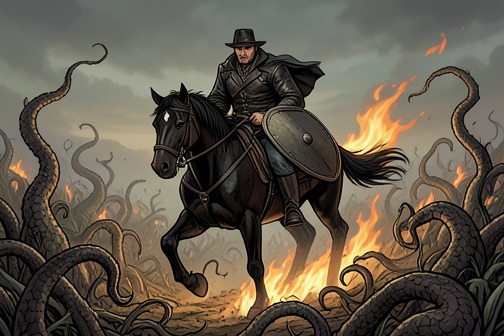
[Ilmarinen](entity:character-recall-character-ilmarinen-eeb892d7bfb2)’s plowing of the serpent-field of [Hisi](entity:character-recall-character-hisi-d32032d13353) turns the [Maiden of the Rainbow](entity:character-recall-character-622ef58ec52a)’s marriage condition into a trial of practical skill and supernatural danger. Faced with a land no hero has cultivated, the blacksmith makes protective equipment, rides a horse of fire into the field, and buries its venomous inhabitants beneath the furrows. He completes the task and returns to report it to the hostess of [Pohyola](entity:location-recall-location-pohyola-86563c228405); the feat establishes that he has met this particular condition for wooing the maiden, though the episode does not itself conclude the marriage.
## The Condition for Courtship
The trial belongs to Ilmarinen’s effort to win the Maiden of the Rainbow. Her affianced status does not mean she is ready to marry: the song stresses that she is not yet prepared, and makes wooing or winning her conditional on accomplishing a task by magical aid. The demand thus places a boundary between desire and success. Ilmarinen cannot claim the maiden simply by arriving as a suitor; he must answer a requirement attached to the courtship.
The task is to bring a particular field into cultivation. The maiden presents it as an achievement beyond the reach of earlier heroes: none, she says, has ever cultivated it. The field is therefore more than an ordinary piece of land awaiting a plow. Its reputation defines the scale of the challenge, making the work a test whose completion can distinguish Ilmarinen from those who tried, or might try, before him.
## Making Ready for the Field
Ilmarinen hastens to the Maiden of the Rainbow’s chamber and identifies himself through his craft, addressing the challenge as a blacksmith. Rather than meet the danger unprepared, he builds a forge and smithy and places gold in the furnace. The episode gives making and doing separate stages: first he prepares the means of protection, then he undertakes the work that protection makes possible.
He equips himself with safeguards for his limbs and body, and selects a horse of fire, harnessing the flaming stallion. These preparations answer the field’s particular hazards. Ilmarinen does not simply drive an ordinary team into hostile ground; forged protection and a fiery mount accompany him into a place where cultivation has been beyond heroic reach. The sequence makes his blacksmithing part of the action itself, not merely a title: the smith’s ability to shape materials becomes essential to carrying out the trial.
## Plowing the [Serpent](entity:creature-recall-creature-serpent-113ecb300b7d)-Field
The field contains countless vipers and serpents of every species. They crawl, writhe, hiss, and sting, turning the soil into an active threat to the plowman and his horse. The song’s accumulation of different kinds of serpents enlarges the danger: this is not a single creature to defeat but a field crowded with venomous life, encountered across the ground Ilmarinen must work.
Ilmarinen nevertheless plows safely. The account associates his success with magic, and describes the serpents being lifted by the plow and buried beneath the furrow. Their dangerous presence is not erased before the work begins; it is overcome through the act of cultivation itself. As the field is turned, its inhabitants are displaced and made harmless against his magic. The trial’s solution is therefore both protective and agricultural: he does not abandon the field or merely escape its serpents, but makes the ground workable by plowing through them.
## Completion and Significance
Once the task is complete, Ilmarinen returns quickly and addresses the hostess of Pohyola. He reports that he has plowed Hisi’s field, stilled and banished its serpents. The report closes the practical sequence begun by the courtship condition: preparation leads to dangerous labor, and labor to a claim of completion before the household that set the test.
The episode establishes a limited but decisive success. The Maiden of the Rainbow’s condition has required magical assistance, the field was said to defeat every earlier hero, and Ilmarinen can now present the completed work as his answer. Yet the accomplishment is not itself a wedding or proof that every obstacle in the courtship has ended. Its narrative force lies in converting an apparently impossible demand into a finished deed, while showing the specific combination of craft, preparation, and magic by which Ilmarinen meets it.
Event 22
Ilmarinen muzzles the bear of Tuoni
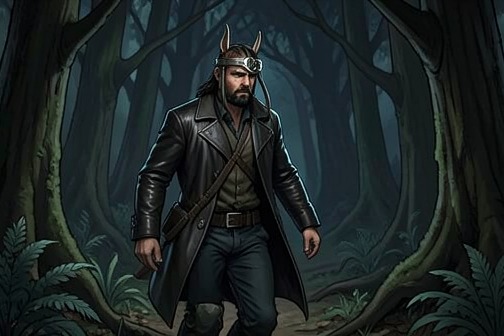
[Ilmarinen muzzles the bear of Tuoni](entity:event-recall-event-ilmarinen-muzzles-the-b-e2c30d095fc5) in a courtship ordeal that makes the bride-price a test of both craft and controlled action: he must enter the Death-land forests, take a beast associated with the fate of failed suitors, and return with it alive and restrained. Rather than meet the bear in open combat, he combines a forged magic bridle with a prayer for concealment, then promptly returns to [Louhi](entity:character-recall-character-louhi-6ccf075fe1c4) when the task is done.
## The Ordeal and Its Stakes
The episode begins in the aftermath of [Ilmarinen](entity:character-recall-character-ilmarinen-eeb892d7bfb2)’s appeal to Louhi for her daughter, the fairest maiden of the [Northland](entity:location-recall-location-northland-8351eb6a39dd). Speaking as hostess of [Pohyola](entity:location-recall-location-pohyola-86563c228405), Louhi refuses to grant or give her daughter. The refusal is set against the record of earlier attempts: no one has yet succeeded, and all have perished in Manala. That warning gives the bear-task its grave stakes. This is not merely a demonstration of metalworking; the suitor is being sent into the domain from which previous challengers have not returned.
Ilmarinen hurries to the maiden’s chamber, where she is identified as his affianced and gives him the course of action. He must bring the bear from the Death-land forests, from [Tuoni](entity:character-recall-character-tuoni-e881ffaf3b02)’s grove and empire. She specifies the task as taking the bear of Tuoni from those forests, turning Louhi’s general refusal into a dangerous, concrete test. Her advice directs Ilmarinen toward a way of succeeding without simply overpowering the beast.
## Craft and Concealment
Ilmarinen first makes a tool suited to the danger: a magic bridle forged of steel. The detail joins his identity as an artist and eternal metal-worker to the ordeal’s practical demands. His craft does not remove the risk of entering the bear’s territory, but it equips him to restrain the animal once he can approach it.
In the forests of the Death-land, Ilmarinen also asks Terhenetar, the ether-maiden and daughter of fog and snowflake, to settle fog and snow so that the bear cannot see his coming or hear his stealthy footsteps. Terhenetar hears his prayer and makes the fog and snow settle over the wild beasts’ coverts. Concealment is therefore not incidental atmosphere: it answers Ilmarinen’s specific request and allows the approach the bridle alone could not guarantee.
## The [Bear](entity:creature-recall-creature-bear-5145fc8bf870) Is Taken
With the coverts obscured, Ilmarinen safely bridles the bear. He then fetters it in magic chains in the forests of Tuoni, in the blue groves of Manala. The sequence is precise: the prayer brings concealment, the bridle secures the beast, and the chains hold it fast. The bear is not reported killed; the deed is presented as capture and restraint, fulfilling the instruction to lead it out of the Death-land forests.
The successful capture answers the earlier report that all previous challengers perished. The scene does not describe a contest of strength or a wound suffered by Ilmarinen. Instead, its decisive action depends on preparation, stealth, and the effective combination of forged equipment and supernatural assistance.
## Return to Louhi
Once the task is completed, Ilmarinen returns quickly and addresses the ancient Louhi again, asking her to give him her daughter and the bride already promised to him. His return connects the dangerous expedition directly to its courtship purpose: completing the bear-task gives him grounds to renew his claim after Louhi’s refusal. The episode’s resolution is thus a successful return with proof of accomplishment, not a report of what Louhi decides next.
The ordeal makes Ilmarinen’s metalworking consequential beyond the forge. Steel becomes a means of safely mastering a perilous creature, while the fog summoned by Terhenetar makes that mastery possible. The bear’s restraint, rather than its destruction, marks the form of success the maiden prescribed and brings Ilmarinen back to the marriage negotiation alive.
Event 23
Ilmarinen catches the pike of Mana
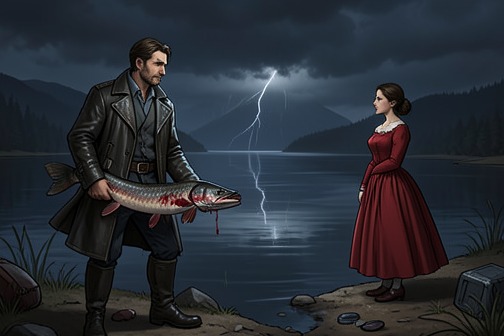
[Ilmarinen catches the pike of Mana](entity:event-recall-event-ilmarinen-catches-the-p-c719bebbc541) as the third of [Louhi](entity:character-recall-character-louhi-6ccf075fe1c4)’s courtship trials, a dangerous undertaking in the waters of [Tuoni](entity:character-recall-character-tuoni-e881ffaf3b02) that brings his suitor’s ordeal to its promised conclusion. A magic eagle helps him confront the monster and secure the pike, but the triumph is disputed: Louhi objects that the fish has been torn apart and its body eaten. [Ilmarinen](entity:character-recall-character-ilmarinen-eeb892d7bfb2) answers that the greatest victories carry the greatest losses; Louhi nevertheless agrees to give him the [Maiden of the Rainbow](entity:character-recall-character-622ef58ec52a).
## The Final Courtship Trial
The catch follows two earlier tests in Ilmarinen’s effort to win Louhi’s daughter. Louhi has already heard that he brought the bear of Mana from Tuoni’s fields and forests; the pike is the remaining demand, and its setting makes clear that this is no ordinary fishing task. The hostess of [Pohyola](entity:location-recall-location-pohyola-86563c228405) warns that the dangers of the deathly waters have already killed those who attempted the feat. The trial therefore sets the suitor’s desire against a stated likelihood of death, making the demand a test of survival as well as strength.
Ilmarinen is disheartened by the prospect and hurries to the Maiden of the Rainbow’s chamber. Her response changes the immediate shape of the challenge: rather than leaving him to face it without help, she gives him advice and urges him not to be discouraged. Her counsel is part of the action, not merely reassurance. Ilmarinen goes on to forge an eagle in the furnace, preparing a creature capable of reaching the dangerous waters where the pike is found. The final trial thus depends on the smith’s craft and the maiden’s guidance as well as on his own endurance.
## Descent to the Waters of Tuoni
The demand is to seize the mighty fish of Mana from the death-stream of Tuoni. Ilmarinen’s answer is to send the magic eagle toward the [River of Tuoni](entity:location-recall-location-river-of-tuoni-019836737925), where it hunts and fishes. Yet the place proves dangerous before the pike itself is secured: a monster rises from the river, grasps Ilmarinen, and tries to drag him toward its sea-cave. The suitor is not safely removed from the encounter by sending the eagle ahead. The trial draws him into immediate peril, while the bird serves as a means of confronting the threat.
A pike then rises from the dark river. The poem identifies it as the pike of Mana but also distinguishes it from the largest of the pikes, resisting any simple equation between size and the whole difficulty of the task. The eagle attacks the monster; the account marks the wounds on its body and gives the bird a repeated course of assault. It soars again, circles, and swoops once more. Only on its third attempt does it bring success from earlier failures and catch the fish. That sequence makes persistence, rather than an effortless display of power, the decisive action: the capture comes after the danger has resisted the eagle’s efforts.
## The Disputed Trophy
After the encounter, Ilmarinen takes the pike’s head to the hostess of Pohyola. He presents the catch as the evidence of his triumph and reminds her that he has done what she demanded, counting his achievements in the land of death. His return converts a perilous encounter into a matter of proof: he has not simply survived the journey but brought back a visible token to support his claim.
Louhi rejects that proof as inadequate. In her judgment, the task has been badly accomplished: Ilmarinen has torn the pike to pieces, its body has been eaten, and the head he brings is a worthless relic. The dispute turns on the difference between accomplishing the dangerous act and presenting the result in the form the judge will accept. Ilmarinen does not deny the damage; instead, he answers that the greatest victory brings the greatest losses. His reply makes the trial’s outcome both successful and imperfect: the pike has been caught, but its remains cannot satisfy Louhi’s standard without argument.
## Promise and Narrative Significance
Despite her criticism of the trophy, Louhi finally says she will give Ilmarinen her daughter and prepare the maiden for him. The pike trial therefore completes the sequence of demanded feats and secures a promise of marriage. It does not, by itself, depict the wedding or settle every later consequence of that promise. Its immediate outcome is the hostess’s agreement after the final test, despite her insistence that the victory has been poorly presented.
The episode gives the courtship ordeal a pointed conclusion: success is not only a matter of defeating danger, but also of satisfying the person who set the task. Ilmarinen meets the demand in the deathly waters, and the eagle’s repeated attacks make the achievement hard-won; Louhi then judges the damaged remains rather than accepting the feat without qualification. The trophy dispute preserves the cost of the trial inside its apparent success. The final concession follows not a flawless return, but an accomplishment that the suitor must defend in words.
Event 24
The slaughter of the great ox of Suomi
[The slaughter of the great ox of Suomi](entity:event-recall-event-the-slaughter-of-the-gr-5bc65e6a05ba) turns a wedding-feast provision into a test of scale and strength: the animal defeats the butchers of [Northland](entity:location-recall-location-northland-8351eb6a39dd) until a hero comes from the sea to kill it, yielding enough food for the banquet at [Pohyola](entity:location-recall-location-pohyola-86563c228405). The episode moves from a practical need to an impossible-seeming task, then resolves the impasse through a stranger whose power matches the ox’s immensity.
## A feast that required a giant
The ox is first associated with the feeding of the poor and the people’s entertainment, and its origins cross the lands named in the account: it grew in far [Karjala](entity:location-recall-location-karjala-64e2ae80ea44) and is also described as an ox of [Suomi](entity:location-recall-location-suomi-8ffb66e2a563). Though initially called neither the largest nor the smallest, it becomes a creature of overwhelming proportions as the scene unfolds. Its shoulders rise to the clouds and its horns reach the highest heaven; even the passage of the Moon does not suffice for a butcher to reach its horn-tip. The contrast between the animal’s unassuming introduction and its later, almost cosmic dimensions delays the slaughter and makes the feast’s preparation the episode’s central obstacle. In Sariola, no butcher can be found among either the younger generation or the older hosts who can kill the ox for [Louhi](entity:character-recall-character-louhi-6ccf075fe1c4).
## The failed attempts and the sea-born butcher
When [Wirokannas](entity:character-recall-character-wirokannas-0d5a923b10d8), the gray-bearded hero from Karelen, sets out to slaughter the ox, the attempt quickly confirms that the problem is not merely a shortage of ordinary skill. Palwoinen swings his war-club, but the would-be slayers retreat into a thicket; Wirokannas hides there too. The scene turns the search for a butcher into a public impasse: throughout Karelen, people seek someone able to kill the ox, yet the animal’s immense size has made the task seem beyond reach. The concealment of the first challengers gives the ox’s scale a practical consequence, not just a marvelous description.
The answer comes from outside the land. A hero rises out of the sea-waves, appearing on the ocean’s blue back amid the far-stretching pastures. He carries a golden cleaver with a copper handle, an extraordinary tool suited to the extraordinary task. At last, the people have found both a butcher and a slayer for the magic ox. The episode’s reversal is compact: after local strength fails and the search spreads across the country, a figure from the waters arrives equipped to master what no one nearby could overcome.
The sea-god sees his quarry, rushes upon it, and hurls it to its knees. He fells both the calf of Suomi and the young ox of Karelen. The account makes the act decisive rather than prolonged: the ox that had dominated the landscape is brought down by a single powerful arrival. Its apparent invincibility gives way to the maxim that nothing so mighty has been found that it has not found a master.
## Meat for the wedding feast
The slaughter resolves the practical need that opened the episode. The ox yields meat in abundance, with its blood filling seven boatloads and its suet amounting to a thousand weight. This immense provision is destined for the banquet of Pohyola and the marriage-feast of Northland; the gathering’s hospitality depends on the successful killing of the animal. The feast is therefore not simply the aftermath of a marvel. It is the purpose that gives the search its urgency, while the ox’s scale transforms preparation for a wedding into a trial of strength.
The episode moves from food for the poor and entertainment for the people to a wedding table supplied by a creature whose dimensions exceed ordinary measure. Its ending converts the obstacle into abundance: the ox that no local butcher could fell becomes enough meat for a great feast. The arrival of the sea-born slayer closes the practical crisis and makes the marriage celebration possible, linking the episode’s fantastic scale to the communal needs of the feast.
## A maxim of mastery
The episode turns its resolution into a general rule: “Nothing has been found so mighty / That it has not found a master.” Placed directly after the sea-god’s arrival and before the account of the meat, the couplet gives the killing a meaning beyond successful provisioning. The ox’s extraordinary scale establishes the limit that local strength cannot cross; the sudden appearance of a stronger figure overturns that limit. The saying makes the reversal portable, distilling the scene into a claim about power: apparent might is never proof that no answering force exists.
## Shifting names and epic scale
The narration calls the animal an ox, a calf, and a young ox, while associating it in turn with Karjala, Suomi, and Karelen. These shifts keep the creature rooted in recognizable regions and categories even as its dimensions carry it beyond ordinary measure. The language does not settle on one label or locality; instead, the ox gathers the scene’s different places into a single challenge that no local butcher can meet.
That movement culminates in a reversal of scale and origin: the sought-after slayer rises from the sea, and the animal that had defeated the land’s would-be butchers is felled. The scene thus sets regional strength against an arrival from beyond the familiar human community, before returning the extraordinary contest to its communal purpose—the Northland wedding feast.
Event 25
Osmotar brews the wedding beer
[Osmotar](entity:character-recall-character-osmotar-af0e3b357b60)’s brewing of the wedding beer is presented as an origin tale about turning barley, hops, water, and island honey into a fermenting drink. Its decisive discovery comes after several failed attempts: the beer does not come alive until honey is added. The tale then moves from the craft of making the drink to the practical problem of containing it, before [Louhi](entity:character-recall-character-louhi-6ccf075fe1c4) draws on the account to brew for the wedding feast at [Pohyola](entity:location-recall-location-pohyola-86563c228405).
## An origin tale told at Pohyola
The account begins with an old man speaking from his corner. He acknowledges that the secret and origin of brewing have been unknown to him; his ensuing story supplies the explanation. This framing makes the brewing episode more than a report of feast preparations: within the larger narration, it is knowledge passed on through a tale. Louhi, the hostess of Pohyola, hears how beer was first fermented and acts on what she has heard.
The story identifies barley, hops, and water as the drink’s basic ingredients, but makes fermentation the puzzle that demands discovery. Osmotar is introduced as the beer-preparer, the person who takes responsibility for making the barley drink. The narrative repeatedly returns to her effort to find what will make it foam, sparkle, ferment, and become refreshing. Her search gives the origin tale its sequence: ingredients are assembled, attempted solutions fail, and a different substance finally changes the result.
## Failed attempts and shared work
Osmotar initially combines hops and barley but cannot make them ferment. Rather than presenting brewing as an effortless skill, the story dwells on her sustained thought and uncertainty about what will produce effervescence. Its repeated question is practical: what can make the beer come alive? The repetitions mark a real obstacle in the process, not merely a flourish around a recipe.
The work is collaborative. [Kalevatar](entity:character-recall-character-kalevatar-b158cec3c907), described as a magic maiden, carries selected materials to [Kapo](entity:character-recall-character-kapo-5376be71cc74), whose hands are repeatedly associated with the attempts to start fermentation. Kapo lays cones in the beer, but they produce neither effervescence nor warmth; the liquor remains cold and lifeless. Beer-foam is tried as a ferment as well, but it does not make the drink sparkle. Another offered material, a pod, also enters the sequence of experiments. The succession matters because each attempt is tested against the same outcome, and none solves the problem.
These failures distinguish the participants’ roles without making brewing the achievement of one pair of hands alone. Osmotar prepares the beer and reflects on its failure; Kalevatar carries the chosen substances; Kapo tests them in the mixture. The account’s repeated movement between thought, delivery, and trial presents discovery as a shared process, while keeping Osmotar at its center as the brewer who continues seeking an answer.
## The bee and the discovery of honey
The turning point comes when a bee is sent on a journey to the islands. It flies there with great speed, gathers honey, and returns with it to Kapo. Osmotar places the honey in the liquor, and Kapo mixes the beer and honey. This time the wedding beer ferments: it rises upward from the bottom of the vessels.
The contrast with the earlier trials is explicit in the outcome. Cones, beer-foam, and the other attempted materials have not brought effervescence; honey succeeds. The bee’s journey supplies the ingredient that changes the mixture, while Osmotar’s addition and Kapo’s mixing complete the process. The origin tale thus links the beer’s transformation to a specific chain of actions rather than to an unexplained change: honey is brought back from the islands, incorporated into the liquor, and followed by fermentation.
The rising beer gives visible form to the discovery. Before the honey arrives, the drink is described as cold and without life; afterward, it ferments and rises through the vessels. The contrast makes fermentation the central change in the episode. It also creates a new difficulty: the successful beer threatens to exceed the capacity of its containers.
## From overflow to a wedding brew
Osmotar and Kapo are saddened when the fermented beer will not stay within its vessels and threatens to overflow and fill Pohyola. A redbreast, also identified as a robin, answers their concern with advice: the beer should be put into strong, willing barrels, firmly bound with copper hoops. The solution shifts the problem from making fermentation happen to containing its results. The drink is now vigorous enough to require sturdier vessels.
The account names both birch-wood barrels and oak-wood hogsheads among the containers used in the brewing sequence. The bird’s counsel adds copper hoops as a means of securing the stronger barrels. This practical conclusion completes the origin tale: the beer is not only made to ferment, but given a way to remain within its vessels rather than spread through Pohyola.
After hearing the account, Louhi fills many oaken tubs and barrels with water, filling the largest vessels only halfway. The forests and wells supply what is needed to aid her brewing; the ingredients named for the [Northland](entity:location-recall-location-northland-8351eb6a39dd) drink include water, hops, barley, and honey from the islands. Louhi’s preparations are for the wedding feast of Northland and the great carousal and rejoicing at the marriage. The remembered discovery therefore becomes useful instruction, connecting Osmotar’s first successful ferment to the later provision of beer for a communal celebration.
## Significance of the brewing episode
The episode presents brewing as both knowledge and labor: a failed mixture cannot be rescued by repeating the same attempt, and success depends on trying alternatives, obtaining honey, and finding suitable containers for the result. Its origin-story structure turns an otherwise practical craft into an account of discovery that can be retold and applied. The old man’s tale gives Louhi a precedent for her own preparations, while the successive trials preserve the path by which the drink becomes possible.
The episode’s progression also rests on a contrast between stillness and excess. The beer first remains cold and lifeless; once the honey is mixed in, it rises so strongly that containment becomes urgent. The solution is not to undo fermentation but to use stronger barrels and copper hoops. In that movement—from an inert mixture, through successful transformation, to controlled abundance—the tale connects brewing’s origin directly to the wedding feast it will serve.
Event 26
Lemminkainen is excluded from Ilmarinen's wedding
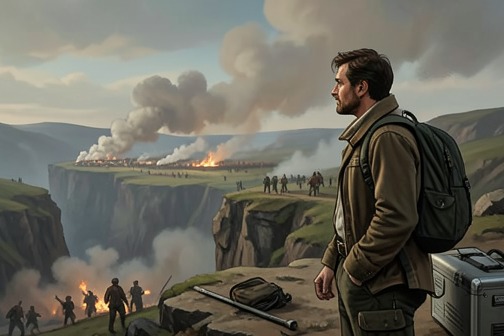
[Lemminkainen is excluded from Ilmarinen's wedding](entity:event-recall-event-lemminkainen-is-exclude-48c4bf837992) is a deliberate social rejection that turns a public celebration into a personal provocation. [Louhi](entity:character-recall-character-louhi-6ccf075fe1c4) invites the people of [Pohyola](entity:location-recall-location-pohyola-86563c228405) and neighboring communities to her daughter’s marriage to [Ilmarinen](entity:character-recall-character-ilmarinen-eeb892d7bfb2), but explicitly orders her trusted servant not to invite [Lemminkainen](entity:character-recall-character-lemminkainen-ee8fbdcc2336). He sees signs of the feast, watches its preparations with envy, and later sets out from his field for home after recognizing what is taking place.
## The Wedding Preparations
The wedding is being prepared in Sariola, on Pohyola’s promontory. Lemminkainen first looks toward the scene and wonders at what appears to be the smoke and confusion of warring armies. Wanting to learn what has caused the commotion, he strains to see it more closely. The apparent martial spectacle resolves into a wedding preparation: beer is being brewed for the marriage of Louhi’s daughter, the [Maiden of the Rainbow](entity:character-recall-character-622ef58ec52a), to Ilmarinen.
Lemminkainen watches for a long time, peering toward the activity until his attention gives way to envy. He addresses Louhi as a beloved second mother and well-intentioned hostess, asking her to brew honey-flavored beer for the marriage. The beer is eventually ready and stored in casks and barrels. His language places him imaginatively within the feast, but it does not change the fact that he has not been invited.
## The Invitation and Its Omission
Louhi entrusts the invitations to a trusted maiden-servant and directs her to summon the people of Sariola and Karelen, including the old, the sick, and the needy. The guest list is broad: Louhi also names [Wainamoinen](entity:character-recall-character-wainamoinen-d8e4019ef0c6), the famous bard and wisdom-singer. Against this inclusive invitation, she gives an explicit exception: the servant must not invite Lemminkainen, whom she also identifies as the island-dweller Ahti.
The servant asks why Lemminkainen should be excluded. Louhi answers that she has good reasons, but the passage does not fully specify them. It associates him with a dwelling near the water, far out at sea; whatever the force of that explanation, the practical outcome is clear. The servant distributes the invitations among the people of Pohyola, asking young and old, rich and needy, while withholding one invitation from Lemminkainen. His absence is therefore not an oversight but a stated decision by the hostess.
## Discovery and Response
Later, while living on an island near the Kauko-point and harbor, Lemminkainen recognizes that the gathering is the wedding of the Maiden of the Rainbow. He stops, shakes his sable locks, and turns his head in anger. The wedding that had earlier drawn his envious attention is now unmistakably a celebration from which he has been excluded.
He immediately leaves his plowing and sowing, abandoning the furrows in the field. Mounting his steed, he gallops home to his mother and gives her directions, beginning with a request for beer and provisions. The episode thus moves from distant observation to purposeful preparation: the invitation has denied him entry to the feast, but his response is to ready himself rather than quietly accept the exclusion.
## Narrative Significance
The episode sets the scale of Louhi’s hospitality against the precision of her refusal. The invitation extends across communities and social conditions, yet that apparent breadth makes the singled-out omission more conspicuous. Lemminkainen first reads the distant scene through the imagery of battle, then discovers a wedding; the contrast binds the feast’s festive preparations to the conflict his exclusion will provoke.
The narrative also gives the rejection a clear sequence of consequences. Louhi’s order becomes a circulated invitation that marks Lemminkainen’s absence, while his recognition of the wedding interrupts ordinary work and sends him back to his mother to prepare. The supplied passage establishes that response and its immediate urgency, without yet detailing what follows from his preparations.
Event 27
Ilmarinen's marriage to the Maiden of the Rainbow
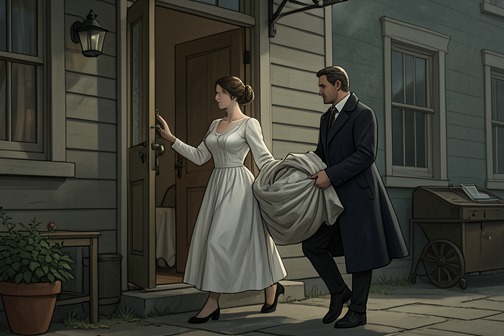
[Ilmarinen's marriage to the Maiden of the Rainbow](entity:event-recall-event-ilmarinen-s-marriage-to-2dd0e572bae0) turns a promised match into a completed union, then makes its cost visible in the bride's departure from [Pohyola](entity:location-recall-location-pohyola-86563c228405). The wedding is marked by feasting, [Louhi](entity:character-recall-character-louhi-6ccf075fe1c4)'s formal consent, advice for the bride, and the bride's own leave-taking; its movement from celebration to separation gives the event both a public and a personal dimension.
## From promise to marriage
Louhi's consent establishes the match before the wedding is complete. When asked whether the affianced bride is ready and whether she will be given, the hostess of Pohyola answers that she will give her daughter and prepare the snow-white maiden. Her words place the marriage within a family arrangement, but the later farewell gives the [Maiden of the Rainbow](entity:character-recall-character-622ef58ec52a) a voice in how that arrangement is understood: she calls [Ilmarinen](entity:character-recall-character-ilmarinen-eeb892d7bfb2) her chosen husband and is urged to join him and follow him.
The exchange also recalls the delay before the union. Louhi addresses Ilmarinen as her daughter's suitor and says that he has waited three times in kindness. That detail makes patience part of the marriage's immediate background: the wedding follows a period of waiting, and Louhi acknowledges that history as she brings the match to its conclusion. The scene thus moves beyond a bare announcement of marriage. Consent, preparation, and the suitor's endurance precede the joining of the couple.
## Feast and instruction
The wedding is presented as a completed communal occasion: the narrative says that the marriage was completed and that the many guests had feasted. Its scale is indicated by the guests and the feast, while the event's sequence places the bride's departure after the celebration rather than treating the marriage as a private agreement alone. The wedding also opens onto instruction. The next rune is titled [Osmotar](entity:character-recall-character-osmotar-af0e3b357b60) the Bride-adviser, and its stated concern is that the bride must be instructed. At the end of the advice, the bridegroom, too, has been instructed and the last counsels have been given.
The advice is not represented as a simple celebration of married life. One remembered example describes a wife responding with kisses when threatened with a lash, and the passage then turns back to the instruction given to the bridegroom. That unsettling example belongs to the counsel surrounding the marriage, not to a reported incident in Ilmarinen's new household. Its presence complicates the wedding's festive surface: the episode places marriage within a set of expectations and warnings about life between spouses, even as the couple's actual future is not fully narrated here.
## The bride's leave-taking
After her mother has spoken, the Maiden of the Rainbow speaks as she departs. Her farewell remembers the scenes of childhood and the happiness of departed days. The narrative then makes the separation concrete: Louhi's daughter leaves her native fields and fallows and the darksome Sariola, setting out with Ilmarinen, identified as a famous son of [Kalevala](entity:location-recall-location-kalevala-1532cc3f896a). The change is both geographic and familial. She leaves the place and past that formed her, and goes with her husband into a different home and community.
The departure gives the marriage an emotional counterweight to the feast. Louhi's earlier language of giving and preparing her daughter has treated the match from a mother's and hostess's position; the bride's own speech dwells instead on what she is leaving. Her parting does not cancel her stated willingness to follow her chosen husband, but it prevents that choice from making separation seem effortless. In the episode's order, joining and parting are inseparable: the marriage carries the bride forward only by taking her away from her childhood home.
## Place in the narrative
The wedding does not end with the departure from Pohyola. A subsequent rune is titled [Wainamoinen](entity:character-recall-character-wainamoinen-d8e4019ef0c6)'s Wedding-songs, and its opening shifts to Ilmarinen's home, where people have long been watching and waiting. The sequence carries the celebration into the bridegroom's household and places the wedding within a wider social response. Ilmarinen is later shown coming to his cottage and to his father's fireside, anchoring this continuation in the home as well as in the northern setting the bride has left.
The event therefore joins two movements that the surrounding narrative keeps distinct: a public match confirmed by Louhi and celebrated before guests, and an individual crossing marked by the bride's farewell. Its details do not describe every element of the ceremony; instead, the account concentrates on consent, waiting, instruction, feasting, and departure. Those emphases make the wedding a threshold in the story: Ilmarinen gains a wife, while the Maiden of the Rainbow enters that union with the memory of home still present in her final words.
Event 28
Wainamoinen sings at Ilmarinen's wedding
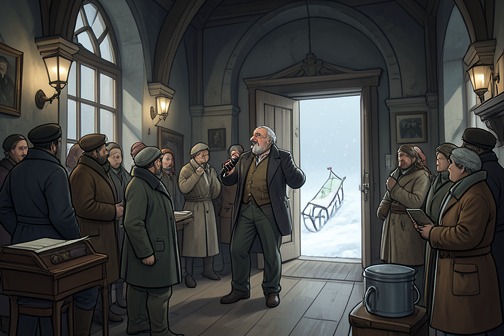
[Wainamoinen sings at Ilmarinen's wedding](entity:event-recall-event-wainamoinen-sings-at-il-da5c57fe2070) as its aged, wise enchanter and the feast's presiding singer. After the bride and bridegroom have been welcomed and richly entertained, his songs give the gathering a sequence: he addresses the company, chooses whom to praise, and recognizes guests in turn. The performance is more than entertainment within the scene; it makes the wedding community audible to itself, linking the couple's new union with their hosts, kin, childhood companions, and assembled friends.
## From departure to the feast
The singing belongs to a larger transition. After the marriage is completed and the guests have feasted, the [Maiden of the Rainbow](entity:character-recall-character-622ef58ec52a) leaves [Pohyola](entity:location-recall-location-pohyola-86563c228405) with her chosen husband. Her departure is voiced as a leave-taking from childhood scenes and familiar fields, so the wedding involves both a new marriage and separation from her native home. At the end of the journey, a winter morning brings the rumble of a swiftly moving snow-sledge to [Wainola](entity:location-recall-location-wainola-4a84a3e73606). Lakko, its hostess, recognizes the arrival with excitement, and the homecoming is described as a long-awaited reward: the sledge brings her son and hero home.
At the feast that follows, bride and bridegroom are refreshed with abundant food and drink. The passage names beer and mead among the refreshments, giving the singing a setting of hospitality rather than a private exchange between the couple. The guests are gathered in a household whose welcome has extended from the returning hero to his bride. [Wainamoinen](entity:character-recall-character-wainamoinen-d8e4019ef0c6)'s performance thus follows the bride's departure from one home and her reception into another; the song marks the public occasion on which that change is shared with the company.
## Wainamoinen takes the lead
The narrative asks who will lead the songs of [Kalevala](entity:location-recall-location-kalevala-1532cc3f896a), then identifies Wainamoinen as the singer. He is called old and truthful, an eternal and wise enchanter, and begins his incantations before singing the sequence that follows. These descriptions join age, authority, and the power of song in the person who conducts the feast's praise. The text does not describe an instrument accompanying this performance; its emphasis is on Wainamoinen's voice and the songs he begins.
He opens by addressing the company as dear kindred and gifted companions. This direct address establishes an audience inside the song: those present are not merely listening to a performance but are named as the community for whom it is sung. The spoken question of whom to praise first then gives the sequence an explicit order. Wainamoinen begins with the bridegroom's father, moving from the central couple to the family and social ties that surround their marriage.
## The order of praise
The praise proceeds by recognizable relationships. Wainamoinen lauds the hostess, then turns to the favored suitor and honored bridegroom. He also praises the young bride's playmate, identified through her companionship with the Maiden of the Rainbow in childhood. The song therefore does not confine honor to the newly married pair: it recalls the bride's earlier attachments and gives her companion a place in the celebration.
The assembled friends receive praise as a group. Wainamoinen observes their graceful manners and distinguishes the old, who are wise and silent, within his address to the company. The sequence concludes by declaring that all the friends have been lauded and each has received a share of honor. This ending answers the earlier question about whom to sing: praise has passed through particular family and personal ties and finally encompassed the gathered guests.
## Function and significance
The performance makes the feast's social structure part of its subject. The bride and bridegroom are central, but their union is presented among parents, hosts, companions, and friends, each recognized by a place in the song. Wainamoinen's movement from one person or group to another gives the gathering a measured progression, while the closing acknowledgment that each has been honored supplies a clear completion to the performance.
The scene also places song within a sequence of welcome and belonging. The Maiden of the Rainbow's farewell to Pohyola registers the cost of leaving childhood and native surroundings; the return to Wainola and the feast that follows offer a new household and a community of witnesses. Wainamoinen's praise does not erase that separation. Instead, by naming the people gathered around the couple, it gives their new life a public setting and turns hospitality into an occasion of shared memory and honor.
Event 29
Wainamoinen repairs his broken wedding sledge
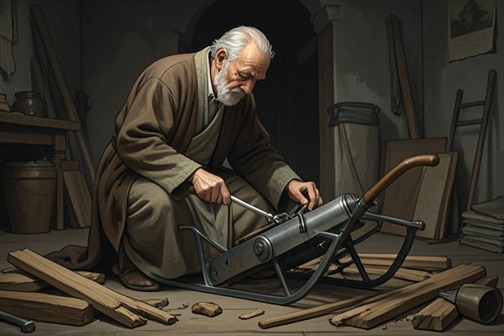
[Wainamoinen repairs his broken wedding sledge](entity:event-recall-event-wainamoinen-repairs-his-fa496a0d4c5c) through a perilous recovery of [Tuoni](entity:character-recall-character-tuoni-e881ffaf3b02)’s auger and an act of song-magic that brings the materials for its replacement into being. The episode turns a wrecked vehicle into a test of resourcefulness: [Wainamoinen](entity:character-recall-character-wainamoinen-d8e4019ef0c6) must cross into the realm of the dead for the tool, then use his singing to make and shape a new sledge before he can return to his dwelling.
## The sledge is wrecked
The episode presents Wainamoinen as an old, truthful song-deliverer, a figure whose authority rests both on age and on his command of song. After singing for one day, then a second, and chanting legends through a third, he travels in a sledge that is jolted over rocks. Its runners rattle; the vehicle catches on a birch stump and breaks into many pieces. The account makes the failure physical and complete: the parts are torn asunder, and the magic sledge is ruined.
The destruction interrupts a journey connected with the wedding and reduces a celebrated vehicle to scattered parts. The contrast matters: Wainamoinen has spent the preceding days sustaining his role as singer, but the road now confronts him with a problem song alone has not yet solved. The broken sledge prompts him to seek a particular tool rather than simply attempt to put the pieces back together.
## The journey for Tuoni’s auger
Wainamoinen asks whether anyone among the living, whether young or old, will go to Mana’s kingdom and the empire of Tuoni to obtain the magic auger needed to mend the sledge. The question establishes the difficulty of the task by placing the needed instrument beyond the ordinary world. Wainamoinen then undertakes the journey himself, going again to Mana’s empire, crossing the dark stream of Deathland, and reaching the stronghold in the realm of the dead.
There he finds Tuoni’s auger and brings it away safely. The sequence makes the repair depend on passage through a boundary: the vehicle cannot be restored until Wainamoinen has entered the dangerous otherworld and retrieved its tool. Yet the episode does not describe a battle or a contest with Tuoni. Its decisive action is the crossing, the recovery, and the return with the instrument required for the work.
## Song as craft
With the auger secured, Wainamoinen does not merely reassemble the broken pieces. He sings a purple forest into life, and slender birches grow within it. He shapes the birches into shafts and runners, moulding them by his will and power, and makes a new magic sledge. The forest is therefore not incidental scenery: it supplies the material for the vehicle, but only after song has called it into existence and Wainamoinen has shaped it for use.
The rebuilding joins two kinds of practical action. The auger has to be retrieved from Tuoni’s realm; the timber has to be made available and formed into the sledge. Wainamoinen’s magic is not a substitute for craft so much as the means by which its materials and their proper form are secured. The damaged vehicle is replaced through a sequence of distinct acts—journey, recovery, singing, shaping, and construction—rather than restored by a single gesture.
## Return and narrative significance
Once the sledge is made anew, Wainamoinen harnesses his steed, binds it securely, takes his place on the cross-bench, and returns to the threshold of his dwelling. The ending gives the expedition a concrete measure of success: he has not only recovered the auger but converted it into a completed repair and resumed his homeward journey.
The episode also brings together the poem’s recurring association between song and effective action. Wainamoinen is introduced as a singer of legends, and after the accident his singing makes the forest and the birches from which the new sledge is fashioned. The song does not erase the wreck or spare him the journey through Deathland; it enables him to answer both the loss and the difficulty of finding what the repair requires. In this way, the return home closes a compact chain of consequence: the sledge breaks, the needed tool lies in Tuoni’s realm, Wainamoinen retrieves it, and song supplies the wood and power to travel again.
Event 30
Lemminkäinen’s journey through the dangers on the road to Pohjola
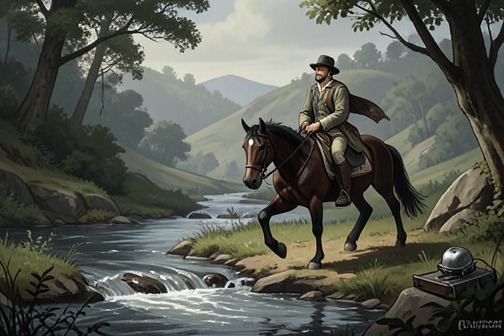
[Lemminkäinen](entity:character-recall-character-lemmink-inen-bdc945d92935)’s journey through the dangers on the road to [Pohyola](entity:location-recall-location-pohyola-86563c228405) presents travel as a chain of thresholds rather than a direct passage from one place to another. Along the highway, hazards appear in succession: a stream, a sudden flight of hazel-chickens, a fire-gulf stretching across the path, and finally a monstrous [Serpent](entity:creature-recall-creature-serpent-113ecb300b7d) at Pohyola’s entrance. His stallion’s trembling stop makes the danger bodily and immediate; the Serpent’s retreat supplies the sequence’s clearest resolution, opening the way to the portals.
## A road measured by successive encounters
The journey is measured first by distance and time. After Lemminkäinen has travelled only a little way—at one point, the narration marks that he has travelled only one day—a stream comes along the highway. The account does not describe how he crosses it; instead, the stream establishes the road’s pattern: movement brings him to another obstacle, and progress is registered by what appears before him.
After the horse has flown onward and galloped on its distant journey, Lemminkäinen has again travelled little distance when hazel-chickens rise before his coming. The birds are not identified as attackers, and the passage does not say that they injure or detain him. Their sudden appearance nevertheless interrupts the otherwise purposeful movement of the journey. The repeated measure of a short distance makes the road feel crowded with incidents: even before the greater dangers arrive, the landscape answers each advance with something newly encountered.
## The fire-gulf and the mother’s warning
The journey’s most expansive barrier appears as a fire-gulf yawning across Lemminkäinen’s pathway and extending far to the east. Its scale is conveyed through its breadth and direction: it lies crosswise over the route, while its reach continues beyond what the immediate path alone would suggest. The image transforms the highway from a route of ordinary travel into a place where passage itself is in question.
At this sight, Lemminkäinen recognizes that his mother’s words were truthful and her augury well-taken. The recognition connects the visible obstacle to a warning already given, without explaining the full terms of that warning here. This is a change in what the journey means to him: the danger is not merely a surprise in the landscape, but confirmation that his mother had anticipated what lay ahead. The passage records that recognition before it moves on, making foreknowledge part of the ordeal even as the route continues.
## The stallion at the threshold
Farther along, the stallion neighs loudly, stops on the highway, and trembles. The animal’s response marks a new kind of warning. Earlier hazards are introduced through what appears along the route; here, danger is registered through the mount’s refusal to proceed. The journey’s forward motion, sustained by the galloping horse, becomes momentarily uncertain.
The poem does not state in these lines what the stallion sees or why it stops. Its neighing and trembling are enough to make the interruption legible: the road ahead demands attention before the next threat is named. Lemminkäinen subsequently passes through a breach and reaches the portals of Pohyola. The movement from an open highway to a breach and then to an entrance gives the sequence a narrowing shape. The hazards have brought him toward a guarded boundary, not simply across a difficult stretch of country.
## The Serpent at Pohyola’s portals
At the entrance lies a Serpent, stretched crosswise in the way and described as longer than the longest rafters. Its position repeats the image of the fire-gulf: once again, a danger lies across the line of passage. But the setting has changed. The fire-gulf interrupts the highway; the Serpent occupies the entry itself, directly before the portals of Pohyola. The comparison with rafters gives the creature a measure drawn from a built structure, making its length intelligible while preserving its monstrous scale.
The encounter ends not with the Serpent’s destruction but with its retreat. It uncoils and crawls away to other portals, leaving the way before Lemminkäinen. That withdrawal is the sequence’s decisive change: a creature that had lain across the entrance no longer blocks it. The journey thus reaches its immediate goal by passing through one obstacle after another, and its last danger yields by moving aside rather than being killed.
## Narrative shape and significance
The episode’s structure depends on repeated interruptions to forward travel. Distance is announced, a new presence or barrier appears, and movement resumes or changes character. The stream and the hazel-chickens give the road successive encounters; the fire-gulf expands the danger into a vast landscape feature; the stallion’s stop turns apprehension into physical action; and the Serpent brings the sequence to the threshold of Pohyola. The increasing proximity of the dangers to the destination gives the journey a clear progression without requiring every obstacle to be overcome in the same way.
The mother’s confirmed augury links this outward route to knowledge established before the encounters themselves. Meanwhile, the repeated crosswise barriers—the fire-gulf across the pathway and the Serpent across the entry—make passage the episode’s governing problem. Lemminkäinen’s advance is not effortless, but the available account keeps him moving toward Pohyola, with the final obstruction withdrawing from the portals. The journey’s force lies in this alternation between progress and interruption: each step forward exposes another danger, and arrival is marked by a passage finally left open.
Event 31
Ilmarinen's Abduction of the Northland Maiden
[Ilmarinen](entity:character-recall-character-ilmarinen-eeb892d7bfb2)’s Abduction of the [Northland](entity:location-recall-location-northland-8351eb6a39dd) Maiden turns a failed courtship into a forcible removal and, through song-magic, into transformation. The [Maiden of Pohyola](entity:character-recall-character-maiden-of-pohyola-00d4357f8cf2) explicitly refuses to go with Ilmarinen; he answers not with persuasion but by seizing her and carrying her away from [Louhi](entity:character-recall-character-louhi-6ccf075fe1c4)’s court. The episode’s sharp reversal—from her spoken refusal to his iron grasp—makes coercion, rather than consent, the decisive fact of the encounter.
## Louhi’s Court and the Refusal
Louhi appears as hostess of the Northland and speaks to Ilmarinen before her daughter answers him. The daughter’s reply is unequivocal: she will never follow him. She also condemns the weapons he presents as instruments of bloodshed and murder, fit only for the unworthy. Her words make the scene more than an unsuccessful proposal. She names the violence attached to Ilmarinen’s courtship before that violence is enacted, giving her refusal both personal force and an explicit moral judgment.
The contrast between the two speeches shapes the event. Louhi addresses Ilmarinen, but the daughter speaks for herself and directly rejects the future he seeks. Nothing in the encounter indicates that her refusal is mistaken for acceptance; it is stated plainly. The scene’s next action therefore sharply overrides a choice the narrative has made unmistakable.
## Seizure and Departure
Ilmarinen turns his head away in disdain and shakes his dark locks in anger. He then seizes the trembling Maiden of Pohyola, holds her in an iron grasp, and hurries from Louhi’s court. The sequence replaces the language of wooing with bodily force: her refusal is followed by anger, restraint, and removal. The detail that she trembles marks her vulnerability, while the iron grasp makes the imbalance between them concrete.
His departure carries the conflict beyond the court. Ilmarinen does not win the daughter’s agreement; he takes her away despite her declaration that she will not follow. The episode thus distinguishes possession from consent, and a successful abduction from a successful courtship. Its movement is abrupt: a verbal rejection becomes an act of capture, and the Northland Maiden is separated from her mother’s household by force.
## Song and [Transformation](entity:concept-recall-concept-679f97586a45)
After the seizure, the magic minstrel responds in rage through song. His singing is powerful enough to split rocks and send their sound echoing among distant hills; he then sings the Maiden of Pohyola into the form of a sea-gull. The transformation changes the terms of her removal. She is no longer simply a captive being carried away from Louhi’s court, but a bird calling from ocean ledges and islands.
The song does not present the abduction as a marriage or as a reconciliation. Instead, it follows Ilmarinen’s violence with a supernatural alteration of the maiden’s condition. The sequence moves from refusal, to physical capture, to metamorphosis, and its final image is not domestic union but the sea-gull’s cry across the ocean. In that reversal, song becomes an answer to force: the courtship’s intended human outcome gives way to separation and an altered identity.
Event 32
Wainamoinen's Expedition for the Sampo
[Wainamoinen's Expedition for the Sampo](entity:event-recall-event-wainamoinen-s-expeditio-cbea4b5a6046) is the northward undertaking through which [Wainamoinen](entity:character-recall-character-wainamoinen-d8e4019ef0c6) gathers companions and sets out toward [Pohyola](entity:location-recall-location-pohyola-86563c228405) in pursuit of the [Sampo](entity:object-recall-object-sampo-fa7a38a9f0fa). The episode makes the expedition’s formation part of its significance: Wainamoinen first addresses [Ilmarinen](entity:character-recall-character-ilmarinen-eeb892d7bfb2) as a brother and wonder-worker, while [Lemminkainen](entity:character-recall-character-lemminkainen-ee8fbdcc2336) later asks to join the journey. The poem thus presents the venture not as a solitary quest but as an alliance taking shape on the road to the [Northland](entity:location-recall-location-northland-8351eb6a39dd).
## A Journey Proposed
The expedition takes form in Rune XXXIX, identified as Wainamoinen's Sailing. Wainamoinen, described as old and faithful, speaks to Ilmarinen and proposes that they go to Sariola. The appeal joins a personal bond to a practical undertaking: he addresses Ilmarinen as his brother and acknowledges him as a wonder-worker before inviting him north. The wording establishes cooperation as the journey’s starting point, even though these lines do not detail how the companions prepare or what terms they agree upon.
The destination and purpose acquire sharper definition as the passage proceeds. Wainamoinen calls the Northland unpleasant, and the expedition is identified as a journey for the Sampo. The poem first names Sariola in the invitation and later refers to Pohyola and the Northland. Those place-names anchor the movement northward, while the Sampo gives the voyage its objective. The distinction between the initial invitation and the later departure also gives the episode a measured beginning: proposal comes before the declared moment to journey.
## Departure and Readiness
Before that moment, the text stresses the value of protection. It observes that a man is stronger in armor and safer in copper mail. The lines present readiness as a condition of the Northland journey, not as a report of a particular battle or a description of a specific attack. The emphasis is on the danger implied by the destination: the party is going somewhere against which armor and mail matter.
The narrative then makes departure explicit, announcing that the time has come to journey to the never-pleasant Northland. Wainamoinen is again called ancient, connecting the expedition’s forward motion to the veteran figure who initiated it. The sequence moves from brotherly proposal, through counsel about protection, to an announced journey. It supplies a clear threshold into the adventure without detailing the route or the travelers’ equipment beyond the reference to armor and copper mail.
## Lemminkainen Joins the Venture
As the party approaches the Northland, the scene shifts to a jutting promontory where a Northland village appears. Lemminkainen stands there, presented by several names and descriptions: Kaukomieli, black magician, and Ahti, wizard of [Wainola](entity:location-recall-location-wainola-4a84a3e73606). His placement at this point in the journey makes him a figure encountered at the edge of the destination rather than one introduced in Wainamoinen’s initial invitation to Ilmarinen.
Lemminkainen asks Wainamoinen to take him to Pohyola, referring to the stone-berg and copper-bearing mountain. The request turns the expedition from the undertaking of the original pair into a venture that includes a third named companion. It also gives the approach a social encounter: as the Northland village comes into view, Lemminkainen openly seeks a place in the journey. The passage establishes his wish to accompany Wainamoinen, but does not, in these lines, describe a debate over his admission or specify what role he will play afterward.
## The Expedition's Narrative Place
The episode’s structure emphasizes assembly and approach rather than a continuous account of every stage of travel. Its key turns are compact: Wainamoinen proposes the journey to Ilmarinen, the text marks the need for protection and the time of departure, and Lemminkainen asks to join near a Northland village. Together, these moments show how the expedition’s company forms as its destination draws closer.
The rune sequence places the sailing before the later rune titled Capture of the Sampo. That transition connects the northward venture to its stated object and to the poem’s subsequent Sampo episode, without making the surviving expedition details a full account of the capture itself. Within the evidence presented here, the expedition’s decisive development is therefore its movement from proposal to departure and the enlargement of its company on the way to Pohyola.
Event 33
The Birth of Wainamoinen's First Harp
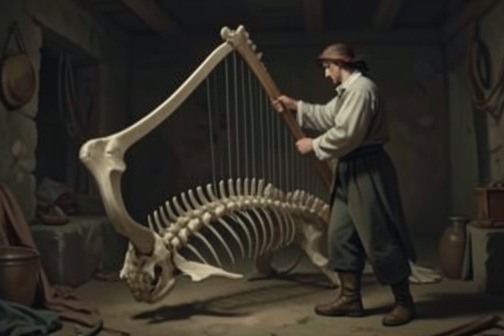
[The Birth of Wainamoinen's First Harp](entity:event-recall-event-the-birth-of-wainamoine-30ab83b56a91) is the episode in which [Wainamoinen](entity:character-recall-character-wainamoinen-d8e4019ef0c6) sees the remains of a mighty [Northland](entity:location-recall-location-northland-8351eb6a39dd) pike not as waste but as the beginnings of an instrument. The turn comes after force has failed: [Lemminkainen](entity:character-recall-character-lemminkainen-ee8fbdcc2336)’s sword breaks without harming the monster, while the feast leaves bones that can be put to another use. The first harp thus emerges from a change in attention—from the creature as an opponent to its remains as material for making.
## From open water to stillness
The episode begins in motion. The companions have passed through the dangers of the current, a sacred stream, and a whirlpool; at length the vessel reaches open water and the broad lake. There, suddenly, its motion ceases. The transition from perilous passage to an abrupt halt gives the encounter its threshold: the journey has not simply ended, but the water has brought the travelers face to face with the great pike.
Wainamoinen addresses Lemminkainen as they confront the mighty fish. The available account places the pike among the extraordinary things found in the water, making the encounter part of a larger world in which the lake yields both danger and material possibility. The scene’s focus, however, falls not on a detailed contest but on the sharply stated failure of the weapon: Lemminkainen breaks his sword into pieces and does not harm the water-monster. The attempted answer of force leaves the pike unharmed and the human weapon ruined.
## A failed weapon and a change of purpose
Wainamoinen then addresses his companions with a rebuke, calling them poor apologies for heroes. His words register the disparity between the challenge and their response: even a warrior’s weapon proves ineffective against the water-monster. The broken sword is a concrete measure of that failure, not a victory over the creature. The episode does not linger over a successful killing by combat; instead, it moves toward what can be made after the encounter.
After the feast, fish-bones remain on the rocks as its only relics. Wainamoinen, described as an ancient minstrel, looks at the pile of fragments and ponders it. That pause changes the meaning of the remains. What the feast has left behind is no longer merely the evidence of eating, and what the failed attack could not accomplish is answered by a different kind of skill. The story pivots from breaking a sword to studying bones: violence has reached its limit, while making has only begun.
## The pike’s remains become an instrument
Wainamoinen imagines that something wondrous might be built from the monster’s jaws, teeth, and fish-bones. He connects this possibility to the skill of the forger-artist and the hands of the magician. The proposed work therefore joins practical making to the epic’s world of magic: the bones are the physical substance, but their transformation depends on a maker capable of seeing and shaping their potential.
The narrative next shows Wainamoinen setting himself to work designing. It calls him a fish-bone artist, a description that gathers the episode’s reversal into a single image. The same creature that resisted the sword now supplies the material from which an instrument can be conceived. The account establishes the first harp’s pike-bone origin through this sequence of encounter, feast, observation, and design; its emphasis is on the moment when Wainamoinen recognizes a new use for the remains.
## Significance of the episode
The episode makes creation follow directly upon failed force. Lemminkainen’s sword is broken and the pike remains unharmed, but the aftermath is not empty: the bones left on the rocks become the basis for Wainamoinen’s design. The change is not a reversal in which the monster is defeated after all. Rather, the narrative redirects attention from mastery of the living creature to inventive work with what remains.
That redirection also defines Wainamoinen’s role in the scene. He is not presented only as a companion in danger or a witness to the feast; as an ancient minstrel, he recognizes artistic possibility where others have left fragments behind. The first harp’s origin is consequently tied to both the material world of the lake and the maker’s perception. Its beginnings are specific and humble—jaws, teeth, and fish-bones on the rocks—yet Wainamoinen’s design makes those remnants the starting point of something wondrous.
Event 34
Wainamoinen's Harp-Songs
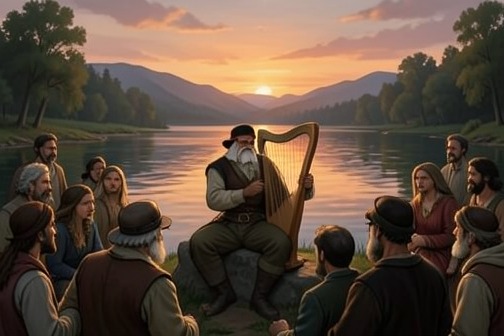
[Wainamoinen](entity:character-recall-character-wainamoinen-d8e4019ef0c6)’s Harp-Songs, narrated in Rune XLI, transform a performance into a communal event and an etiological myth: the music stops [Northland](entity:location-recall-location-northland-8351eb6a39dd) to listen, while the minstrel’s tears, gathered from the water by the [Duck](entity:creature-recall-creature-duck-3f0d924e3a1d), explain the origin of sea-pearls and the bird’s beautiful plumage. The episode makes music consequential in two registers at once. It gives the assembled people an experience of shared pleasure, and it converts the singer’s grief into enduring features of the natural world.
## The minstrel and his audience
Wainamoinen enters the episode as an ancient minstrel and eternal wisdom-singer. He has made the harp he is about to play, and the text emphasizes both the instrument’s construction and the performer’s command: he adjusts and tunes it, then works the strings with practiced fingers. The music is not merely a display of skill. As the sound spreads, gladness builds upon gladness, and the harmony echoes from hills and mountains.
The harp draws a broad audience. Young men come to see it, as do older people with children, mothers, and their daughters; the instrument is presented as a source of pride and beauty in Northland. Wainamoinen lets the aged try its strings and gives it to young magicians, extending the performance beyond a single singer. The scene therefore places the harp within a community of listeners and prospective players: its sound belongs to a public world, even as Wainamoinen remains its defining maker and performer.
The response exceeds the human gathering. All Northland stops to listen, and creatures from the forest bound toward the music. The poem enlarges the audience from people assembled around an instrument to the surrounding living world. This widening response gives the harp-song the reach of an event in nature, not simply an entertainment heard by those nearest the singer.
## The performance and its emotional turn
Wainamoinen plays for three days: first one day, then a second, and then a third from morning until evening. The duration makes the performance sustained rather than incidental, and the repeated playing holds the episode within a continuing musical present. The harp’s effect is also inward. Wainamoinen’s tears begin to flow as he plays and sings; they well from his eyelids and course downward as pearly drops.
The tears change the direction of the scene. A performance that has spread pleasure through its listeners becomes a moment of sorrow for the performer, and the water receives what his body releases. The drops mingle and form streamlets from his eyes; some are assigned to the earth and some to the water. The minstrel’s grief is thus given a physical course through the landscape rather than remaining private or abstract. His tears eventually disappear into deep, clear waters among reeds and rushes, beyond his immediate reach.
Wainamoinen then asks whether anyone in the assembly can gather the drops from the depths. The question turns listeners into potential participants in the next action: the music has assembled them, but recovering what it has carried into the water requires a different kind of service. When he asks again, he makes the reward explicit. Whoever gathers the tears will receive beautiful plumage in recompense for that service.
## The Duck and the origin of pearls
The Duck accepts the task. It swims here and there, circles, and dives beneath the foam and waves to search for Wainamoinen’s lost tears. The episode gives the bird a practical role in the transformation: the precious material does not rise by itself, nor does the minstrel retrieve it. The Duck’s movement through the water connects the singer’s sorrow to the objects that will emerge from it.
The episode identifies the result as the origin of sea-pearls and the Duck’s beautiful plumage. The tears acquire a second life as ornaments for heroes and jewels for beautiful maidens, while the bird receives the promised reward of plumage. The story links natural beauty to a particular act of musical grief and to the Duck’s service. Its origin account is therefore reciprocal: the singer supplies the tears, the bird gathers them, and recompense accompanies the recovery.
## Place in the harp’s larger story
The episode belongs to a broader sequence in which the harp is made, performed, lost, and made again. The harp-song follows the presentation of the instrument to a Northland audience and precedes the later storm that tosses Wainamoinen’s warship and casts the fish-bone harp into the sea. That loss gives the first instrument’s public life a limit: a harp capable of stopping Northland to listen can still be carried away by the waters. Later, a sacred harp is finished again, renewing the place of music in [Wainola](entity:location-recall-location-wainola-4a84a3e73606).
This larger movement sharpens the episode’s contrast between what the sea takes and what it gives back. The fish-bone harp is lost to the storm, while the Duck’s dive retrieves the minstrel’s tears from the water and makes their recovery meaningful as an origin of pearls. The harp-song is not simply a self-contained musical interlude: its sound gathers a community, its emotional turn generates a quest, and that quest leaves its mark on the natural world. Elsewhere, the poem also frames singing as shared remembrance, with a call to clasp hands and sing together. Here that communal principle becomes audible in the assembled audience, then expands until people and forest creatures alike respond to Wainamoinen’s playing.
Event 35
The Capture of the Sampo
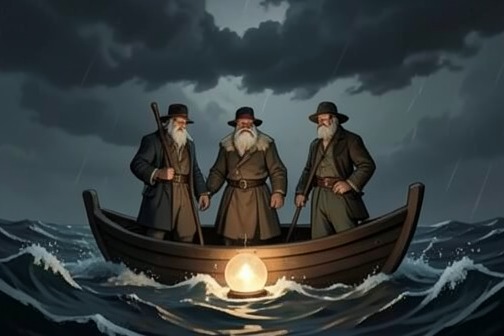
[The Capture of the Sampo](entity:event-recall-event-the-capture-of-the-samp-0fe74ebf3572) is the episode in which [Wainamoinen](entity:character-recall-character-wainamoinen-d8e4019ef0c6), [Ilmarinen](entity:character-recall-character-ilmarinen-eeb892d7bfb2), and [Lemminkainen](entity:character-recall-character-lemminkainen-ee8fbdcc2336) seize the [Northland](entity:location-recall-location-northland-8351eb6a39dd) treasure through a combination of enchantment, strength, and craft. Its decisive reversal comes through music: Wainamoinen’s harp quiets the defenders, allowing his companions to reach the [Sampo](entity:object-recall-object-sampo-fa7a38a9f0fa) and carry it away. The capture makes the instrument more than a mark of the minstrel’s art; it becomes an active force in the expedition, even as the storm that follows takes it from him.
## The Sampo and the Northland
The capture belongs to the [Kalevala](entity:location-recall-location-kalevala-1532cc3f896a)’s recurring contest between the heroes of [Wainola](entity:location-recall-location-wainola-4a84a3e73606) and the people of Northland. The poem’s preface presents raids into the northern country to claim the mysterious Sampo as a repeated part of that conflict, and compares the Finns’ struggles with the darksome Laplanders to the contests between Greeks and Trojans in the Iliad. It also offers a more allegorical interpretation, reading the opposition as one between light and darkness, good and evil. In either framing, the Sampo is not an incidental prize: its possession stands at the center of an ongoing rivalry.
The episode is identified as Rune XLII, following the account of the harp’s creation and music. That placement connects the capture to the preceding scenes of performance rather than treating the raid as an isolated feat of force. The Sampo is found inside a mountain, where its roots have grown nine fathoms deep into the earth. The image gives the heroes a formidable physical task: the treasure is secured not merely behind a gate but bound into the ground.
## Music as a means of entry
Wainamoinen’s fish-bone harp has already gathered listeners into a shared response. When the aged try its strings and the young magicians receive it, its music spreads gladness and echoes across the hills and mountains. Wainamoinen’s playing also brings tears to his eyes; the poem makes those pearly tears the origin of sea pearls and the blue duck’s beautiful plumage. Music in these scenes moves between communal feeling and the creation of natural things.
At the mountain, the same instrument acquires an immediate tactical use. As the people of Northland threaten Wainamoinen and his companions, he hastens to the harp and begins to play. He continues until the maidens, the young and the old, and then all the Northland warriors fall asleep. The change is decisive: the defenders’ numbers and hostility no longer block the way to the Sampo. Wainamoinen’s performance does not simply accompany the raid; it creates the opening through which the other heroes can act.
## Opening the mountain and taking the treasure
With the Northlanders asleep, the heroes from Wainola hurry to obtain the Sampo and its many-coloured lid. Wainamoinen calls to Lemminkainen, his daring friend in times of trouble, directing him toward the work ahead. Lemminkainen finds the Sampo within the mountain and labours to free it. The poem stresses the depth of its hold: roots have extended nine fathoms into the sand and earth. A mighty ox is also introduced in Northland before the account reports that the Sampo loosens and its coloured lid falls silently.
The work depends on more than Lemminkainen’s strength. Ilmarinen, the magic blacksmith, anoints the hinges, bars, and locks. The gates then open in silence for Wainamoinen. The contrast between the minstrel’s loud, enveloping music and the quiet opening of the barriers gives the capture its characteristic combination of spectacle and craft: the defenders are overcome by sound, while the mountain’s fastenings yield through careful preparation.
Once the Sampo is free, Wainamoinen brings Ilmarinen and Lemminkainen together, hides the treasure in his waiting vessel, and places it aboard Wainamoinen’s warship. He then calls his people, crew, men and maidens, and heroes together. The capture thus becomes a collective departure, not just the private achievement of the three leaders. The Sampo is removed from Northland by a company assembled under Wainamoinen’s command.
## Aftermath and narrative significance
The successful seizure reverses the balance of the northern contest: the heroes have reached a treasure guarded in the mountain and put it aboard their ship. Yet the return does not preserve every instrument of their success. In the storm that follows, the warship is tossed high and the fish-bone harp is swept away. The poem therefore places the loss of Wainamoinen’s harp in the immediate aftermath of the capture, separating the instrument from the treasure it helped secure. The account does not make the harp’s fate identical with the Sampo’s; it establishes the harp’s loss as a distinct consequence of the voyage.
That contrast sharpens the episode’s treatment of power. The Sampo is taken through coordinated action, while the harp’s reach proves temporary: its music can overcome the Northland warriors, but it cannot protect itself against the sea. The event also makes the [Kalevala’s song-magic](entity:concept-recall-concept-kalevala-s-song-magic-f41e2061520a) concrete. Singing and playing do not merely describe a contest or praise its heroes; they change what the heroes can do, turning a guarded mountain into an accessible prize. The capture joins enchantment, workmanship, and communal effort, while the storm that follows begins to unsettle the victory.
Event 36
The Loss of the Sampo
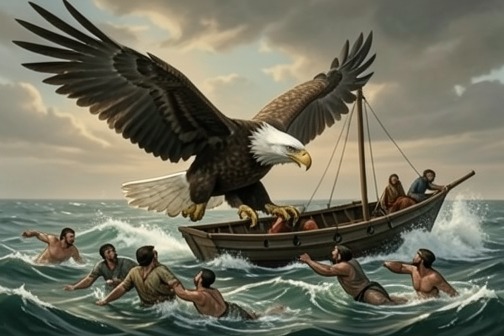
[The Loss of the Sampo](entity:event-recall-event-the-loss-of-the-sampo-2bb8d4e0ef61) is the turning point in which the treasure sought by [Wainamoinen](entity:character-recall-character-wainamoinen-d8e4019ef0c6) and his companions is dragged into the sea and shattered. [Louhi](entity:character-recall-character-louhi-6ccf075fe1c4), hostess of [Pohyola](entity:location-recall-location-pohyola-86563c228405), enters the struggle as a formidable adversary, transforming into a monster-eagle to seize the [Sampo](entity:object-recall-object-sampo-fa7a38a9f0fa); its destruction ends possession of the whole treasure but leaves fragments that promise renewed abundance.
## The pursuit at sea
The episode unfolds amid the dangers of a sea crossing: the voyagers pass through a whirlpool and deep waters, while winds and waves carry them through hardship. Louhi calls her many tribes together, bringing the conflict between Pohyola and Wainamoinen’s party onto the water. The vessel is in danger of sinking, and Louhi tries to free it and rescue it from destruction. The struggle is therefore not simply over who will possess the Sampo; the ship and those aboard it are also threatened by the perilous conditions.
## Louhi attacks
Louhi quickly spreads her powerful pinions and rises as a monster-eagle. Wainamoinen addresses her during the confrontation, naming her as the hostess of Pohyola. Louhi then swoops down upon the Sampo’s many-colored lid and grasps the treasure in her talons. In the continuing struggle she holds the Sampo with one talon, drags it toward the water, and drops the magic lid into the sea. The action turns a contest over the treasure into its physical loss: what Louhi seizes cannot remain intact in the violence of the encounter.
## Fragments and aftermath
The Sampo breaks apart, and many fragments float across the boundless waters. Its destruction is consequential, but the ending does not present the fragments as worthless debris. Wainamoinen declares that they will bring forth sprouting seed-grain, begin good fortune, and provide resources without end. The conclusion thus holds loss and renewal together: the complete Sampo has vanished beneath the sea, while its scattered remains carry the promise of fertility and future prosperity. The episode closes not with the recovery of the treasure, but with a new account of what its fragments can make possible.
Event 37
The Loss and Failed Recovery of Wainamoinen's First Harp
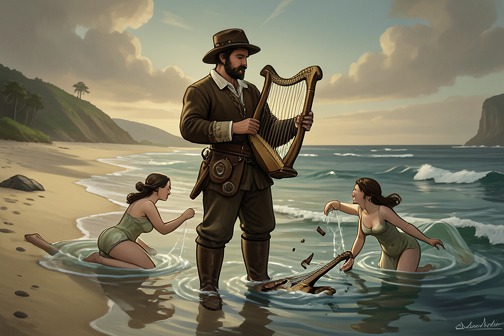
[The Loss and Failed Recovery of Wainamoinen's First Harp](entity:event-recall-event-the-loss-and-failed-rec-2d3ae774b6ba) is the turning point at which a handmade source of music and communal delight disappears into the sea. The storm casts the fish-bone instrument from [Wainamoinen](entity:character-recall-character-wainamoinen-d8e4019ef0c6)’s ship, and the water-maidens carry it below the waves. His later search yields only the scattered matter of the seabed, not the harp; the loss is permanent, and a second instrument must take its place.
## The Harp Before the Storm
The lost instrument had been fashioned by Wainamoinen and was presented as a wonder: the harp of joy, described as the pride and beauty of [Northland](entity:location-recall-location-northland-8351eb6a39dd). Its value is established not only by its making but by its use. Wainamoinen first lets the aged try its strings, then gives it to the young magicians. The harp thus passes among generations and becomes a shared instrument, rather than remaining merely the possession of its maker.
When Wainamoinen plays the strings he has fashioned, gladness gathers upon gladness, and the harmony carries across hills and mountains. The scene makes the harp’s musical force part of the surrounding world. Later, as Wainamoinen plays and sings, tears flow from his eyes like pearls. Joy and grief are both present in the instrument’s history before it is lost: its music can move the community, while the minstrel’s own response gives that music a deeply personal weight.
## The Storm and the Loss
The loss comes amid a violent reversal. Winds roar and lash the waters until the waves turn white; the warship is tossed high into the air, and the fish-bone harp is thrown away. The storm is described as tearing up the bottom of the deep sea, enlarging the scale of the upheaval: the instrument does not simply fall within reach of its owner but vanishes into a sea made violently inaccessible.
[Water-maidens](entity:creature-recall-creature-water-maidens-308f026e0e55) carry the magic harp to their home beneath the billows. That detail gives the disappearance a destination, but not a route back. Wainamoinen is heavy-hearted and speaks of having lost what he created. He tells his comrades not to weep, even as he declares that the harp will never again be found on land or ocean during his heroic lifetime. His words register both attachment to the work of his hands and the finality he assigns to its loss.
## The Search Beneath the Waves
In the account of the second harp’s making, Wainamoinen reflects that [Ahto](entity:character-recall-character-ahto-6b9012bf8f7e) will never return the first one and that joy and music seem gone forever. He asks [Ilmarinen](entity:character-recall-character-ilmarinen-eeb892d7bfb2) to forge an iron rake, setting it thickly with copper teeth, so that the seabed can be searched. The effort turns grief into a practical attempt at recovery: instead of accepting the harp’s disappearance at once, Wainamoinen equips himself to rake through the place where it has been lost.
Wainamoinen descends to the waters and rakes the sea beds. The search brings up water-flowers, broken reeds and rushes, deep-sea shells, and colored pebbles. These are concrete traces of the seabed, but none is the instrument he seeks. The sequence delays the final answer through a catalogue of recovered fragments, each emphasizing how much the sea yields without yielding the harp. At last, the narration confirms that the fish-bone harp is not found and is lost forever to [Wainola](entity:location-recall-location-wainola-4a84a3e73606).
## A Second Harp and the Aftermath
The failure makes the first harp’s loss more than a temporary interruption of music. Wainamoinen’s earlier assertion that it cannot be found is borne out by the search, and the treasure carried beneath the waves does not return. The episode also distinguishes two outcomes: the original instrument remains irrecoverable, while music itself is not abandoned. The answer to loss is not a successful rescue but another act of making.
Wainamoinen eventually finishes a second sacred harp. The poem associates its completion with sources of eternal pleasure for the people of Wainola. The new instrument therefore answers the first harp’s disappearance at the level of use and community, though it does not undo the loss of the original. The contrast is decisive: the storm removes a singular creation from its maker, the seabed search confirms that it cannot be retrieved, and renewed musical pleasure comes through a new harp rather than the recovery of the old one.
Event 38
The Birth of Wainamoinen's Second Harp
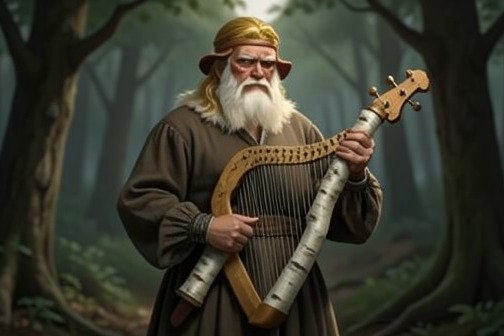
[The Birth of Wainamoinen's Second Harp](entity:event-recall-event-the-birth-of-wainamoine-3699eedc0387) is the making of a new instrument after a storm sweeps the minstrel’s fish-bone harp from his ship. [Wainamoinen](entity:character-recall-character-wainamoinen-d8e4019ef0c6) turns his own grief into a musical response to the lament of a birch tree: he makes the tree’s wood the body of a sacred harp, gathers tuning pins from an oak, and seeks golden ringlets from a maiden as he completes the work. The episode replaces a lost instrument not with an exact copy, but through a sequence of exchanges between the singer and the living landscape.
## From loss to a new beginning
The new harp follows the destruction of Wainamoinen’s first one. During a storm, winds roar and the waters lash the vessel; the waves toss the war-ship high and cast away the fish-bone harp. The loss brings an abrupt interruption to the minstrel’s music. He laments that his songs will no longer echo over the hills of [Kalevala](entity:location-recall-location-kalevala-1532cc3f896a), then wanders through the forest.
That movement away from the sea and into the woods changes the scene’s terms. The earlier harp was lost amid violent weather and a ship at risk; the next is made through attention to trees and the materials they can provide. Wainamoinen’s response is not to abandon music, but to find another way to give it form. The episode makes recovery a process of listening, asking, and crafting rather than a reversal of the storm itself: the fish-bone instrument is gone, and a different harp must be made.
## The birch answers the minstrel
As he passes through the forest, Wainamoinen hears a juniper complaining and draws near to listen. He then addresses a birch tree, treating it as a companion rather than inert timber. The birch’s lament describes it as left naked on the mountain, lonely, helpless, and disheartened. Wainamoinen answers by promising to turn its grief to joy and to make it laugh and sing.
The promise becomes an action: he fashions a harp from sacred birch-wood, made in the days of summer. The scene links the tree’s voiced sorrow to the instrument’s eventual music. The birch is not simply cut down to serve the minstrel’s craft; the poem first gives it a complaint, lets Wainamoinen hear it, and makes the making of the harp an answer to that complaint. His words to the tree as a friend and brother establish a relation of kinship that the finished instrument carries into the song-making that follows.
## Materials and completion
The birch supplies the harp’s body, but Wainamoinen must find the smaller parts needed to make it playable. He asks where the hooks and tuning pins can be found so that the harp may sing in concord. Nearby stands an oak with evenly spreading branches and an acorn on each twig. Wainamoinen takes the merry harp-pins from it, a practical use of the oak’s growth in service of the instrument’s ordered sound.
Even after completing the pins, he recognizes that the harp remains unfinished. He hastens to a maiden and asks her for her golden ringlets. The episode thus assembles the instrument through successive encounters: the birch offers its wood after its sorrow has been heard, the oak supplies pins for tuning, and the maiden is asked for her ringlets. The text identifies the request and then announces the harp’s completion; it does not dwell on the intervening workmanship. The resulting harp is presented as a made object whose materials have been gathered from distinct relationships and acts of address, not as a ready-made treasure discovered by chance.
## Music restored to [Wainola](entity:location-recall-location-wainola-4a84a3e73606)
Once the sacred harp is finished, Wainamoinen sits upon the rock of joyance. The instrument’s stated consequence reaches beyond the maker: it becomes a source of lasting pleasure for the people of Wainola. The ending therefore resolves the episode not merely by replacing an object, but by returning the possibility of shared music after the storm had seemed to silence the minstrel’s songs.
The second harp also forms a deliberate counterpoint to the first. The fish-bone instrument was carried away by forces beyond Wainamoinen’s control; the birch-wood harp emerges from a measured sequence of listening and making. Earlier harp episodes associate performance with gladness and with Wainamoinen’s tears, so the renewed instrument belongs to a recurring pattern in which music can gather pleasure and sorrow together. Here, however, the emphasis falls on recovery: a tree’s grief is answered with a promise of song, and the finished harp restores music to Wainola without undoing the loss that made its creation necessary.
Event 39
The Birth of the Nine Diseases
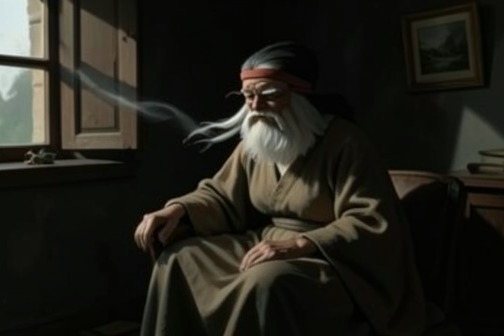
[The Birth of the Nine Diseases](entity:event-recall-event-the-birth-of-the-nine-d-caf08015f32f) makes illness a family of supernatural offspring: [Lowyatar](entity:character-recall-character-lowyatar-1dbd1a9cec36), a blind and ancient woman of [Tuonela](entity:location-recall-location-tuonela-9d298dc10af4), bears nine children after the east wind impregnates her, and the poem links their arrival to sickness among the people of [Wainola](entity:location-recall-location-wainola-4a84a3e73606). Their birth joins the Death-land to the living world, while [Louhi](entity:character-recall-character-louhi-6ccf075fe1c4)’s intervention turns the children’s story into a threat directed beyond their mother’s home.
## Lowyatar and the Wind
Lowyatar is introduced as the blind daughter of [Tuoni](entity:character-recall-character-tuoni-e881ffaf3b02), an old and wicked witch described as the worst among the women of the Death-land. The account gives her a stark identity before describing her pregnancy: she belongs to the realm of the dead, and her blindness distinguishes her even within that sinister setting. The poem presents her not as an ordinary mother but as a figure through whom destructive forces enter the world of the living.
The change begins when the evening winds rise. Lowyatar becomes heavy with child through the east wind’s impregnation, a conception in which no human father or ordinary domestic setting is named. The wind connects the supernatural birth to weather: what moves through the air becomes the means by which the burden of disease is formed. The passage thus places the origin of the children in elemental forces rather than in a human household.
The birth scene also invokes [Ukko](entity:character-recall-character-ukko-316a9dd36b1c). The Highest speaks from the heavens while Lowyatar wonders how to lose her burden and where to lay her evil children. The supplied passage preserves the beginning of his speech but not its full instruction, so the precise counsel cannot be established from these lines. What is clear is the contrast in scale: Lowyatar’s distress and impending delivery are met by a voice from above, making the birth part of a cosmic order as well as a private ordeal.
## Delivery and Naming
At last Lowyatar is delivered of her burden. She lays the offspring in a cradle beneath golden covers, an image that sets the precious appearance of the bedding against the harm associated with the children. The poem locates the birth on a summer evening and states that nine children are born. That number makes the event more than the arrival of a single affliction: disease emerges as a multitude, with several distinct forms gathered into one supernatural family.
Lowyatar names her offspring. The names given in the passage include Colic, Pleurisy, Fever, Ulcer, Plague, and Consumption. They make the children’s nature legible through bodily suffering: rather than leaving illness as an abstract misfortune, the poem assigns it names and familial origin. The evidence here does not supply the remaining names, so the list cannot be completed without going beyond the passage.
The account compares Lowyatar’s care for her offspring to an artist’s love for what skilled hands have fashioned. The comparison gives the scene an unsettling double quality. The children are described as evil, yet their mother tends them with the attachment of a maker to a finished work. Creation and nurture, ordinarily associated with care, are therefore turned toward beings whose existence threatens others. The image does not make the diseases harmless; instead, it places their destructive potential alongside a mother’s evident investment in them.
## Louhi’s Intervention
Louhi, identified as the hostess of [Pohyola](entity:location-recall-location-pohyola-86563c228405), enters the sequence after the children have been born and named. She banishes the other children to a fog-point in the ocean. The passage does not identify in these lines which child, if any, is excepted, or explain the exact circumstances of Louhi’s decision. It does establish a decisive separation: the offspring do not remain together with Lowyatar, and their path leads outward from her cradle toward a remote, mist-covered place.
The banishment links the children with the purpose of bewitching the lowland people and engendering strife and envy. Their danger therefore extends beyond the fact that their names signify diseases. The poem associates them with social disruption as well as bodily affliction, making their reach communal. Louhi’s action gives the birth a further consequence: the children become subject to movement and direction beyond their mother’s immediate care, and the ocean’s foggy boundary becomes part of the story of how their influence travels.
## Sickness in Wainola
The consequences become visible when Wainola’s maidens sicken. The affliction is not confined to one age or station: young and old, men and heroes are all included among those struck by the worst diseases. The passage moves from a birth in Tuonela to a broad outbreak among the living, giving the episode its central reversal of scale. Nine children emerge from one mother, but their effects extend across a community.
The event’s force lies in this progression from origin to consequence. Wind impregnates Lowyatar; she delivers and names the children; Louhi sends the other offspring away; and sickness reaches the people of Wainola. The poem explains disease through supernatural genealogy rather than treating it as an unexplained condition. At the same time, its images resist a simple separation between the beautiful and the harmful: golden covers surround the cradle, and a mother cherishes what she has made, while the named children bring affliction and threaten social peace. The birth episode thus makes illness both intimate, as a mother’s burden and care, and collective, as a force that can overtake a whole people.
Event 40
Wainamoinen's Healing of the Nine Diseases
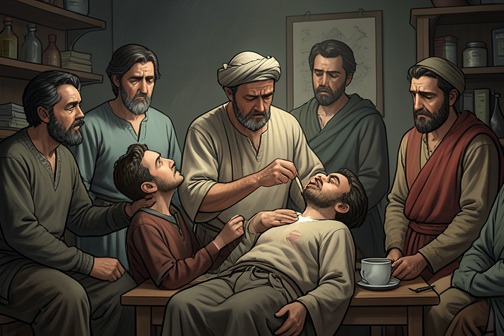
[Wainamoinen's Healing of the Nine Diseases](entity:event-recall-event-wainamoinen-s-healing-o-149c4bf1ab56) turns a mysterious outbreak into a test of communal survival and the healer's power. As sickness strikes the maidens, men, heroes, young, and old of [Wainola](entity:location-recall-location-wainola-4a84a3e73606), [Wainamoinen](entity:character-recall-character-wainamoinen-d8e4019ef0c6) hastens to rescue his people. He prepares a treatment grounded in heat and healing substances, calls on [Ukko](entity:character-recall-character-ukko-316a9dd36b1c) for aid, and rubs the sufferers with balsams. The episode ends with the expulsion of all nine diseases: a threatened community is restored through practical preparation joined to supernatural appeal.
## Outbreak and Stakes
The sickness is not confined to one household or age group. Wainola's maidens sicken, and the affliction reaches the young and aged, men and heroes; the people are described collectively as sick and dying. Its breadth makes the episode a public emergency rather than an individual illness. The threatened community includes the very people Wainamoinen will act to save, so the crisis measures his responsibility not merely by his skill but by the number and range of those who need it.
The diseases are presented as new and nameless, emphasizing how little ordinary recognition or naming can do to contain them. Their origin is also given a supernatural dimension: they are the evil children of [Lowyatar](entity:character-recall-character-lowyatar-1dbd1a9cec36). The outbreak therefore carries two related dangers. It harms the people of Wainola in the present, while its association with Lowyatar places the affliction within a hostile supernatural order. Wainamoinen's response must meet both the bodily suffering and the force represented by the diseases.
## Wainamoinen's Healing
Wainamoinen is identified as the wise and wonderful enchanter, and his first response is immediate: he hastens to his people's rescue. His action is organized around preparation. He heats the bath rooms and the blocks of healing sandstone, using the magic wood of [Northland](entity:location-recall-location-northland-8351eb6a39dd). These concrete materials give the cure a physical setting and a sequence of operations; healing is not represented as a bare declaration of authority, but as work involving heat, prepared stones, and substances applied to the afflicted.
The heated pebbles possess virtue, and their magic is made present through their glowing heat. The cure thus joins material treatment to enchanted potency: the stones are useful not simply because they are warm, but because their warmth carries a healing virtue. This combination suits Wainamoinen's identity as an enchanter. His intervention works through objects and actions, while the poem also presents those objects as participating in a power beyond ordinary medicine.
Preparation does not make the episode purely self-reliant. Wainamoinen speaks in supplication and calls on Ukko to come to his rescue, addressing him as a god of mercy and asking for his presence. The appeal places the healer's own work in relation to a greater divine power. Rather than replacing the heated stones or the treatment that follows, the invocation accompanies them: Wainamoinen prepares the means of healing and seeks Ukko's aid as he does so.
The treatment reaches the sufferers directly. Wainamoinen rubs them with balsams, an action that brings the cure from the heated healing place to the bodies of the afflicted. At the close, the poem describes him as expelling the nine diseases. The outcome answers the scale of the crisis: against an outbreak that had struck the population broadly, the healer's work drives away the diseases themselves, rather than merely offering relief to a single named patient.
## Resolution and Significance
The episode moves from collective danger to collective rescue. Its sequence is carefully cumulative: the sickness spreads through Wainola; Wainamoinen hurries to help; he heats the rooms and stones with magic wood; he appeals to Ukko; and he applies balsams before the nine diseases are expelled. Each step gives the healing a different dimension—urgency, preparation, supernatural assistance, bodily contact, and decisive result. The resolution is not a sudden reversal detached from the scene's details; it follows a course of action that the poem has made visible.
Wainamoinen's authority here is defined by service to his people. The episode calls attention to his wisdom and enchantment, but it also shows what those qualities are for: he hastens toward a population in danger and treats its sufferers. His role is not simply to identify a supernatural enemy. The heated rooms and stones, the appeal to Ukko, and the balsams all make healing an enacted responsibility.
The ending also establishes the limits of the crisis within this episode. The diseases have threatened the people of Wainola, but they do not remain an ongoing affliction: Wainamoinen expels all nine, and his closing wish denies them a return. The movement from nameless sickness to named number, and from widespread suffering to expulsion, gives the event its formal shape. A disorder that seemed to overwhelm the whole community is brought under control through the combined force of preparation, healing practice, and invocation.
Event 41
Wainamoinen's Hunt and Feast of Otso
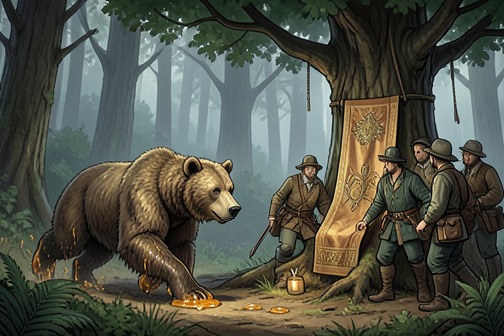
[Wainamoinen's Hunt and Feast of Otso](entity:event-recall-event-wainamoinen-s-hunt-and-caa14d504763) joins a threatened herd, a woodland hunt, and a communal feast in one episode. [Louhi](entity:character-recall-character-louhi-6ccf075fe1c4) sends a hungry bear from its cavern toward the cattle of [Wainola](entity:location-recall-location-wainola-4a84a3e73606) and the flocks of [Kalevala](entity:location-recall-location-kalevala-1532cc3f896a); [Wainamoinen](entity:character-recall-character-wainamoinen-d8e4019ef0c6) follows the trail to [Otso](entity:character-recall-character-otso-670b9262d278), whose sacred robe becomes the focus of a deliberate act of respect. The feast that follows turns the hunt’s outcome into food shared among the assembled hosts and the wider village.
## Threat to the Herds
The episode opens with news reaching [Pohyola](entity:location-recall-location-pohyola-86563c228405), the village of the [Northland](entity:location-recall-location-northland-8351eb6a39dd). Louhi is introduced as its hostess, toothless and envy-laden. The account then brings her together with the danger facing Wainola’s cattle and Kalevala’s flocks: she drives the hungry bear of Pohyola from its cavern toward the meadows. Rather than meeting Otso by chance, Wainamoinen pursues a threat that has been set moving against the herds.
Otso is addressed through a cluster of honorific images: a forest apple, a bear of honey-paws and fur-robes. The praise gives the hunt a ceremonious register even as the bear is being tracked. Wainamoinen’s words place the pursuit in relation to the animals and hunters waiting for it, making the coming encounter part of an ordered hunt rather than an anonymous act of violence.
## The Woodland Hunt
The pursuit becomes concrete through sound. Wainamoinen hears his dog barking in the forest and hears the hunter’s call and its echo. The poem then brings him to Otso’s cavern doors, at the border of the woodlands. Its movement from call and echo to the bear’s lair gives the hunt a clear route and destination.
There Wainamoinen, described as old and trusty, finds the mighty bear waiting and lifts the golden covers in joy. The text’s emphasis shifts from tracking to encounter: Otso is not merely a danger to livestock, but a formidable presence met at its own dwelling. The episode identifies Wainamoinen as both experienced hunter and the figure who leads this encounter to its communal aftermath.
## The Robe and the Feast
After the hunt, wise Wainamoinen pulls the sacred robe from Otso and spreads it in the open courtyard. He refuses to have it made into garments for the protection of unworthy people. This treatment distinguishes the robe from ordinary spoils: the bear’s covering is handled as something sacred, and its use is limited by a judgment about who deserves its protection.
The event ends not with the pursuit but with provision. Food and drink are abundant for the assembled hosts, and there is still plenty to give the village. The people’s question about Otso’s birth then turns the gathering toward an account of the bear’s origins. The ending thus joins material plenty to oral explanation: the hunt feeds the community, while the question opens a further tale about the creature at its center.
Event 42
Louhi's Theft of the Sun, Moon, and Fire
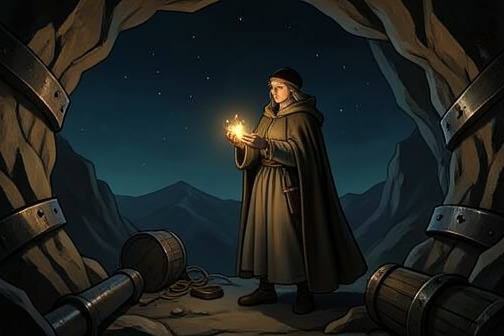
[Louhi's Theft of the Sun, Moon, and Fire](entity:event-recall-event-louhi-s-theft-of-the-su-708e9cf24590) is the sudden collapse of light in [Kalevala](entity:location-recall-location-kalevala-1532cc3f896a): [Louhi](entity:character-recall-character-louhi-6ccf075fe1c4) captures the Sun and Moon, then takes the fire from [Wainola](entity:location-recall-location-wainola-4a84a3e73606), leaving homes and the wider world in darkness. The event makes illumination something that can be seized, hidden, and lost, and its consequences reach from the sky to the hearth and even to [Ukko](entity:character-recall-character-ukko-316a9dd36b1c)’s home.
## The Seizure of the Sun and Moon
The episode belongs to Rune XLVII, where [Wainamoinen](entity:character-recall-character-wainamoinen-d8e4019ef0c6) has again touched the strings of his magic harp. Against this musical setting, Louhi, hostess of [Pohyola](entity:location-recall-location-pohyola-86563c228405) and described as [Northland](entity:location-recall-location-northland-8351eb6a39dd)’s old wizard, takes control of the lights above the world. The poem presents the act as a deliberate capture: she calls the Sun down from its station among the bending fir-tree branches and carries the Sun and Moon to upper Northland, to darksome Sariola.
The removal is followed by concealment. The Moon no longer glimmers, and the golden Moon and silver Sun vanish into iron-banded caverns. The contrast between their precious brightness and the enclosing iron makes the theft more than a change in the sky: the lights remain in existence, but are inaccessible, held captive behind barriers. Louhi’s power consists not simply in making night, but in removing the celestial bodies from view and keeping them from their ordinary place.
## Darkness in Kalevala and Wainola
Louhi’s theft extends from the Sun and Moon to fire. The poem places this loss in the regions of Wainola and describes its immediate effect on habitation: the mansions grow cold and cheerless, and the cabins are filled with darkness. Night becomes unbroken; darkness rules in Kalevala and reaches the home of Ukko as well. The movement from the missing lights in the heavens to cold houses gives the supernatural act a material consequence. Without fire, domestic shelter no longer offers warmth or light.
Ukko’s response establishes the scale of the disturbance. As the first of creators, he lives in wonder at the darkness and reflects on it. The loss has unsettled even a creator figure; it is not merely a local inconvenience that can be ignored. The poem thus makes the stolen light a common deprivation, shared by dwellings, the land, and the divine household.
## A New Fire and a Further Loss
A little fire is kindled and placed by Ukko in the cloud-space, inside a box of gold and silver. The attempted remedy changes the course of the episode without immediately restoring ordinary light below: the new flame is held aloft and entrusted to the care of the Ether-virgin. Its precious container and heavenly location distinguish this fire from the missing fire of the homes, while its custody makes clear that the recovery of light depends on preserving a vulnerable flame.
That safeguard fails. The fire slips from the hands of the one who nurses it, and the heavens are burst asunder as the vault of Ukko opens; the wayward Fire-child drops downward. The poem therefore follows one theft with a second crisis of loss: even the replacement fire does not remain securely in its appointed place. The fall does not, in the evidence of this episode, itself amount to the restoration of warmth and light in Kalevala; instead it carries the fire’s danger and promise into a new stage.
## Significance of the Event
The sequence links three forms of vulnerability. The Sun and Moon can be captured and shut away; the fire that sustains homes can be taken; and a newly kindled flame can escape its keeper. Each loss moves between different scales, from celestial bodies to cold cabins and back to the heavens. The episode’s pattern is not simple darkness followed by a completed cure: Ukko’s response produces another moving, precarious fire, while the original captives remain hidden in the caverns.
The theft also reveals how closely cosmic order and daily life are joined in the poem. The disappearance of the Sun and Moon means more than an altered sky, and the loss of fire means more than a missing object: the mansions are cold, the cabins dark, and Ukko himself is left in darkness. By making the lights captives and the replacement flame a wayward child, the episode gives the crisis both a political shape, through Louhi’s act of possession, and a fragile material one, through fire that must be guarded but cannot be kept still.
Event 43
The Recovery of the Celestial Fire
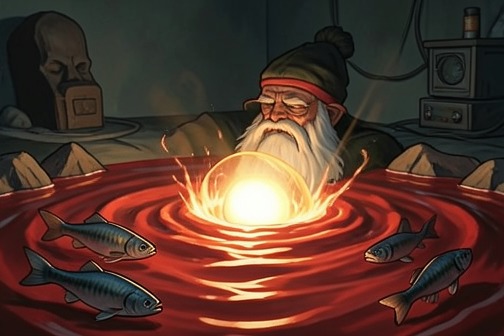
[The Recovery of the Celestial Fire](entity:event-recall-event-the-recovery-of-the-cel-4c73d3f00fe4) turns a cosmic loss into a chain of physical encounters: fire descends into the waters, passes through the bodies of fish, and is finally taken back to the hearths of [Northland](entity:location-recall-location-northland-8351eb6a39dd). [Wainamoinen](entity:character-recall-character-wainamoinen-d8e4019ef0c6)’s recovery joins two scales of the [Kalevala](entity:location-recall-location-kalevala-1532cc3f896a)’s world—the extraordinary route of a heavenly fire-ball through the waters and the practical need to warm the dwellings of [Wainola](entity:location-recall-location-wainola-4a84a3e73606) and Kalevala.
## Background and the fire in the waters
The [Alue Waters](entity:location-recall-location-0fa96b45fa57) react violently to the Fire-child. Their surface hisses and sputters, and the waters are described as fiery red while the disturbance recurs through three nights of summer and nine nights of autumn. The lost fire is therefore not simply absent from human dwellings: its presence has unsettled an entire aquatic environment, making the waters both the place where the crisis is visible and the medium through which the fire must be recovered.
The fish register that disturbance as a loss of their own. The salmon weeps for its grotto, the whiting mourns its cavern, and the lake-trout laments its dwelling. These brief images give the crisis a sequence of submerged homes under threat, rather than presenting the waters as an empty setting. The Fire-child’s passage has consequences for the creatures that inhabit the waters, and their grief accompanies the fire through the stages of its concealment.
## The fire passes through the fish
The fire’s underwater passage is represented through predation. A trout darts out and swallows the whiting, the fish that has eaten the Fire-child. Later, a gray-pike swallows the lake-trout and quickly eats the tortured Fire-fish. The repeated pattern makes the fire’s location difficult to reach: it is carried inside one creature, then concealed within another, as each predator becomes the next container. The chain also links the earlier mourning of the fish to the later capture of the pike; the same aquatic world that suffers from the fire’s presence holds the means of recovering it.
Wainamoinen, identified as an ancient minstrel, uses a net to break this chain. The fish are driven in countless numbers toward the magicians’ net, which he draws through the water on ropes of flax-thread. He carries the catch to a blue point in the waters near a red bridge on the headland, then lands the fish there and casts the pike onto the shore. The capture is methodical: a search through the water becomes a haul of many fish, and the particular pike that matters is found among the catch. The named point and bridge give the recovery a definite landing place between the waters and the shore.
## From the pike to the heavenly fire
The pike is identified as the Fire-pike, and the Sun-child responds to its capture by expressing a wish to carve and handle the fire-fish. The episode thus shifts from concealment to exposure: what had been inaccessible within a succession of fish is now brought onto land, where it can be approached and handled. The Fire-child, Fire-fish, and Fire-pike names track the changing forms through which the fire appears in this part of the story, while the caught pike makes the hidden route materially present.
Wainamoinen considers how to carry the magic fire-ball to Wainola’s fireless hearth-stones and cold dwellings. Its path is also described on a cosmic scale: it has come from the heights of the seventh heaven and through nine regions of the ether. Wainamoinen then snatches the fire of heaven from the fingers of the Sun-child. The act brings the celestial object within reach, but not without consequence: the fire singes Wainamoinen’s beard. The return is achieved through direct contact with a power that remains physically dangerous, rather than through a costless recovery.
## Return to Northland
Wainamoinen takes the willing [Panu](entity:character-recall-character-panu-13dd8ff97d35) and the willing fire of [Ukko](entity:character-recall-character-ukko-316a9dd36b1c), placing them in a box of tinder. This careful containment contrasts with the fire’s earlier passage through the waters and fish: once recovered from the pike and taken from the Sun-child, it must still be carried in a form that can be conveyed home. The fire’s willingness is explicitly noted, and the tinder box becomes the practical vessel for its return.
The closing movement restores fire to Northland, to the chambers of Wainola, and to the hearths of Kalevala. The destinations narrow from a region to dwellings and finally to hearths, locating the consequence of the celestial recovery in domestic life. The event’s structure follows the fire from cosmic height to aquatic concealment, through a net and onto the shore, then into a tinder box and back to inhabited homes. Its significance lies in that conversion: an extraordinary heavenly power, lost amid the waters, becomes warmth again at the hearth.
Event 44
The Restoration of the Sun and Moon
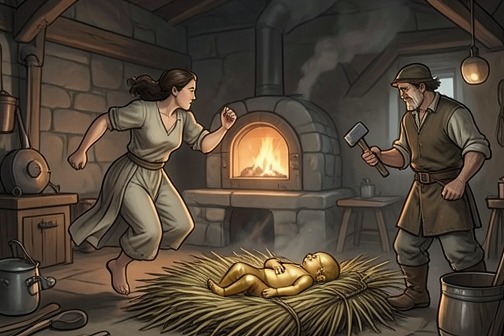
[The Restoration of the Sun and Moon](entity:event-recall-event-the-restoration-of-the-0875f00248f4) resolves the darkness left after the fire has returned to [Northland](entity:location-recall-location-northland-8351eb6a39dd): the Sun and Moon remain imprisoned, and [Wainamoinen](entity:character-recall-character-wainamoinen-d8e4019ef0c6) must discover where they are held and how they can be released. Its movement from failed artifice and divination to confrontation, smithcraft, and renewed appeal to the heavens makes the recovery a test of the limits of magic as well as a restoration of the world’s celestial order.
## The Lights Still Missing
The episode opens with an incomplete recovery. Fire has returned to Northland, but the golden Moon is still absent, and the Sun has not resumed its place in the sky. The return of fire therefore does not end the crisis: warmth and light are not interchangeable, and the celestial disorder continues to mark the land.
A maiden, running to [Ilmarinen](entity:character-recall-character-ilmarinen-eeb892d7bfb2)’s furnace, urges the smith to rise. His proposed answer is to make replacements and swing them into the heavens, an attempt to manufacture celestial objects rather than recover the originals. Wainamoinen rejects this as futile. The contrast is decisive: Ilmarinen’s craft can shape metal, but a forged Sun or Moon cannot correct the loss of the actual lights. The Moon’s failure to shine from the pine tree’s highest branches confirms that the proposed solution has not changed the sky.
## Discovery in [Pohyola](entity:location-recall-location-pohyola-86563c228405)
Wainamoinen turns from manufacture to knowledge, proposing that the Fates be consulted and the oracles examined. The inquiry produces a concrete answer: an alder speaks truthfully and identifies the Sun as hidden in the stone-berg of Pohyola, in its copper-bearing mountain. The revelation transforms a mystery into a specific task. The missing light is not simply extinguished or lost in the sky; it is concealed in a hostile place under [Louhi](entity:character-recall-character-louhi-6ccf075fe1c4)’s power.
Wainamoinen sets out for Northland and addresses Louhi’s hosts, declaring that he has come for the Sun. Louhi’s answer makes clear that she intends the imprisonment to endure: the lights are not to regain their freedom or shine over Northland. Wainamoinen counters with the stakes of the confrontation. If the Sun is not uncovered and the Moon does not leave her dungeon, the dispute cannot be settled by negotiation alone.
## Combat and the Failure of Wainamoinen’s Magic
The heroes rush into the courtyard and hasten to deadly combat on the plains of Sariola. During the encounter, Wainamoinen finds a crevice in the rock from which a gleam of sunlight escapes. The narrow opening is evidence that the light remains present behind its confinement, but it does not itself provide a way to release it. Wainamoinen draws his broadsword and strikes the pillar, yet the struggle does not end with this discovery.
He next seeks to open the portals through magic, using his hands and words. The attempt fails: his hands have lost their cunning, and the ordinary authority of the wizard-singer cannot undo the locks. The episode thus places a limit on Wainamoinen’s most characteristic power. Knowing where the lights are hidden, and possessing magical speech, are not enough to free them; the obstacle requires another kind of work.
Wainamoinen is not discouraged by the failure. He hastens to Ilmarinen and tells him that the smith’s skill is needed to free the sunshine and moonlight from their dungeon. The sequence gives Ilmarinen’s craft a different purpose from the earlier proposal to forge substitute heavenly bodies. The first plan sought to imitate what was missing; now smithcraft is enlisted against the actual confinement.
## Louhi’s Transformations and the Return
Louhi prepares to resist the approaching danger. She fastens wings to her shoulders, while Wainamoinen imagines binding her with a collar to the iron rock of Ehstland. Seeing misfortune approaching, Louhi changes her withered features and becomes a dove of good luck. Her repeated changes of form make her resistance unstable and difficult to meet directly; the threat is not confined to the mountain, but is embodied in a ruler who can alter her appearance as the conflict turns against her.
The account returns to the mountain’s iron-banded caverns and copper-bearing heights, then follows Ilmarinen as he hurries to the threshold of his smithy and scans the distant horizon. Wainamoinen, too, goes out to the courtyard and looks toward the sky. His appeal is no longer a plan to create new lights or an attempt to force open the prison with his own magic: he calls the Sun and Moon from their long-neglected places and stations in the sky-vault. The episode concludes with the restoration of the celestial lights, completing the recovery begun when fire returned but leaving the Sun and Moon still absent.
Event 45
Mariatta's Miraculous Conception and Birth
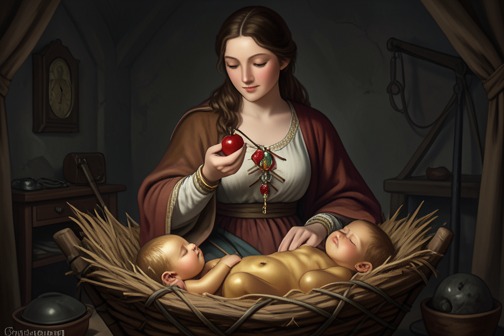
[Mariatta's Miraculous Conception and Birth](entity:event-recall-event-mariatta-s-miraculous-c-aaed99c69445) transforms an encounter with a mountain-berry into an unexplained pregnancy and a vulnerable birth. [Mariatta](entity:character-recall-character-mariatta-f118739b8de0), a maiden from [Northland](entity:location-recall-location-northland-8351eb6a39dd), becomes pregnant when the berry settles in her bosom, despite her insistence that she did not pluck it. Shunned at home, she finds refuge in a stable, where the child is born and cradled in a woodland manger; soon afterward, the infant vanishes while she sleeps, turning the birth into the beginning of a search.
## The berry and the unexplained conception
The episode begins by establishing Mariatta as a maiden who has grown to maidenhood in Northland. Its conception scene gives the mountain-berry an uncanny agency without identifying it as a serpent or lizard: what appears to call from the landscape is, in fact, the berry. Mariatta listens to its pleading and runs to pick it. The fruit is described through familiar measures of taste and appearance—as cranberry-like in shape and strawberry-like in flavor—yet it remains a woodland stranger, not simply an ordinary object of appetite.
The decisive distinction is that Mariatta cannot pluck the berry. She cuts a charm-stick, and the berry moves on its journey before settling in her bosom. The narrative thus makes conception depend on an encounter she neither completes as an act of picking nor explains through an ordinary human relationship. The berry’s arrival is the concrete event; its meaning remains mysterious. Mariatta is thereafter described as a bride, wedded to the mountain-berry, and pregnant. That paradoxical marriage language gives the pregnancy a mythic form while preserving the story’s central uncertainty about how it occurred.
## Waiting and rejection at home
The change does not immediately bring security. Mariatta watches and waits, anxiously counting the days as she anticipates trouble. When she turns to her mother hoping to lessen her burdens, the response is condemnation: her mother calls her a bride unworthy and treats the pregnancy as dishonor. Mariatta herself names the berry as the source of her trouble, connecting the strange encounter to the shame now imposed on her.
Her mother’s refusal makes the household an unsafe place to seek comfort. Mariatta therefore asks her father for help. She rejects the accusation that she is a child of [Hisi](entity:character-recall-character-hisi-d32032d13353) and pleads for a place where her burdens might be eased. The appeal marks a shift from waiting in fear to seeking shelter, but the evidence does not establish that her family resolves the conflict or accepts her explanation. Instead, she is shown as a hapless, tearful virgin-mother, forced to continue beyond the home in search of a place where the child can survive.
## Shelter and the birth
The stable becomes the setting for the birth. Mariatta arrives there while the child’s survival is in question; the passage frames the danger as the possibility that her guiltless infant might perish. The stable is associated with the flaming horse of Hisi, a striking and inhospitable setting rather than a secure household. Yet help is given to the afflicted Mariatta, and the child is born there.
The birth’s image is spare and distinctive: the baby is cradled in a woodland manger. The manger provides the child with a resting place where the family home has failed to provide the mother with welcome. The scene joins extraordinary conception to physical vulnerability. Whatever the berry’s power, Mariatta still needs aid, shelter, and a place to cradle her newborn; the episode does not make the miraculous birth painless or socially accepted.
## The vanished infant and the event’s turn
After the birth, Mariatta guards the child, cherishing him as a golden child and a beloved gem of silver. That tender vigilance gives way to a sudden reversal: while the mother sleeps, the baby vanishes. Mariatta is left alone and wretched, weeping and setting out to seek him. She searches everywhere, carrying the maternal care established at the manger into a new ordeal.
The disappearance changes the episode’s movement from the mystery of conception and the danger of childbirth to the loss of the child and the mother’s pursuit. A star comes to meet Mariatta as she searches, and she beseeches it. The surviving scene therefore ends not with settled safety but with a search that has reached beyond ordinary human help. The birth is both a miraculous arrival and an unstable beginning: the child is born into rejection, sheltered in a stable, and lost before Mariatta’s anxious watch can protect him.
Event 46
Mariatta’s child’s recognition as heir
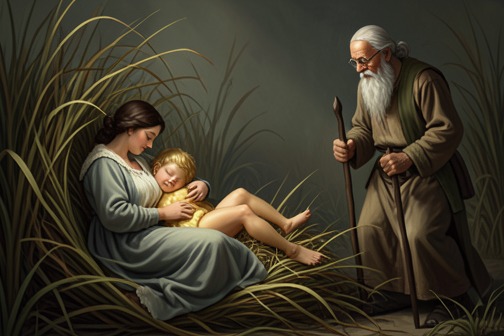
[Mariatta’s child’s recognition as heir](entity:event-recall-event-mariatta-s-child-s-reco-9271881e2293) turns a baptism into a public judgment over who may inherit authority. [Wirokannas](entity:character-recall-character-wirokannas-0d5a923b10d8) summons the aged [Wainamoinen](entity:character-recall-character-wainamoinen-d8e4019ef0c6) to assess the infant, but the child himself answers the accusation against him; the scene ends not with Wainamoinen’s verdict, but with Wirokannas’s blessing and the grant of royal heirship.
## The child brought for judgment
The episode begins with [Mariatta](entity:character-recall-character-mariatta-f118739b8de0) searching for her child and finding him among reeds and rushes. She takes him on her bosom to her father’s dwelling. The child is described as a golden infant, while the account of his birth places him in a manger and associates his paternity with a berry. These details become the grounds on which his status is disputed: he is not presented as a conventional heir whose standing is already settled, but as a child whose birth makes others question whether he can be accepted and blessed.
When Mariatta seeks the priesthood to baptize him, Wirokannas intervenes. His refusal makes the baptism more than a private act: the child’s fitness is put before Wainamoinen for judgment. Wirokannas calls the ancient singer to inspect the infant and report whether he is good or evil. The scene thus makes religious recognition depend on a verdict about the child’s origin and worthiness, while placing that verdict in the hands of the old hero.
## Wainamoinen’s ruling
Wainamoinen examines the infant carefully. His decision rests on the child’s lowly circumstances and unusual parentage: the baby is an outcast, born and cradled in a manger, and, as Wainamoinen puts it, “the berry is his father.” From these premises he condemns the child as unworthy. He does not merely refuse approval; he orders Mariatta’s son taken to the marshes and his head dashed against a birch tree.
The severity of this sentence makes the judgment a decisive conflict rather than a disagreement over ritual procedure. Wainamoinen has been called to distinguish good from evil, but he treats the child’s disputed birth as proof of guilt. The infant’s smallness intensifies the disparity between the power of the judge and the vulnerability of the person judged: the child is only two weeks old, yet the ruling threatens his life before he can otherwise establish his place among the people.
## The infant’s answer
The sentence is interrupted when Mariatta’s child speaks. He directly addresses Wainamoinen as the “Son of Folly and Injustice” and calls him a “Senseless hero of the [Northland](entity:location-recall-location-northland-8351eb6a39dd).” Rather than accept the older hero’s authority as final, the infant challenges the fairness of the judgment. His reply recalls that Wainamoinen himself was not treated justly or welcomed by his people, turning the judge’s own experience into evidence against his decision.
This answer reverses the scene’s hierarchy. Wainamoinen had been summoned to assess the child and report on his moral character; now the child’s speech exposes a failure in the judge’s reasoning. The infant is no longer simply the object of other people’s decisions. By speaking for himself, he contests the standard by which he has been condemned and makes the question of injustice central to the recognition ceremony.
## Blessing and succession
After the child’s reply, Wirokannas acts as the authority who can complete the rite. He touches the infant with holy water and gives him a blessing. He also grants him the rights of royal heirship, freedom to live and grow into a hero, and the prospect of becoming King and Master of [Karyala](entity:location-recall-location-karyala-70d951228216). The movement from a threatened death sentence to blessing and succession is the event’s sharpest reversal: the child whom Wainamoinen would banish is formally admitted to a future among the living and the powerful.
The final grant is prospective rather than a report that the child already rules. Wirokannas authorizes him to grow into a hero and ruler; the scene establishes a recognized claim and anticipated future. Its closing emphasis on Karyala makes the outcome more than a rescue from immediate danger: Mariatta’s child receives a public place in the political order. In the surrounding narrative, the years pass and Wainamoinen recognizes his powers waning, setting the old singer’s decline beside the child’s newly declared future.
## Narrative significance
The episode brings the poem’s old and new orders into direct encounter. Wainamoinen represents established wisdom and is given the role of judge, yet his verdict fails when the child answers with an argument grounded in remembered injustice. Wirokannas’s blessing, not the old hero’s condemnation, determines the child’s recognized standing. The transition is therefore enacted through speech and ritual: judgment is challenged, holy water is applied, and heirship is conferred.
The sequence also makes the infant’s origin and social vulnerability inseparable from the dispute over legitimacy. His unusual parentage and manger-born status first furnish the accusation against him; his reply then prevents those circumstances from being treated as a sufficient reason for exclusion. Recognition does not erase the contested origin. Instead, the scene resolves the immediate contest by granting the child a future that Wainamoinen’s sentence would have denied, and by naming him as a prospective ruler of Karyala.
Event 47
Väinämöinen Leaves Kalevala
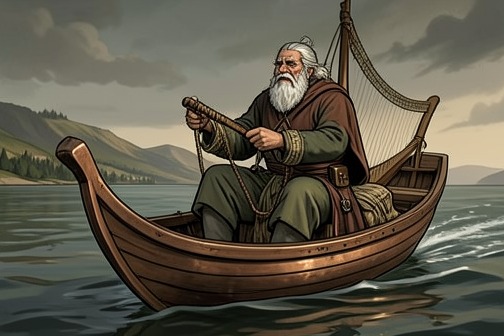
[Väinämöinen Leaves Kalevala](entity:event-recall-event-v-in-m-inen-679406bf85fb) is the epic’s final departure: an aging hero, conscious that his powers have diminished, sails away rather than meeting a final death. He sings farewell to [Northland](entity:location-recall-location-northland-8351eb6a39dd) and [Wainola](entity:location-recall-location-wainola-4a84a3e73606), fashions a copper boat through song, and leaves his people with his harp, his wisdom-sayings, and a promise that he may return. The ending makes absence provisional: [Väinämöinen](entity:character-recall-character-v-in-m-inen-de75453bbc03) is gone, but the knowledge and music he leaves behind remain, and his own prophecy keeps open the possibility of a future need for him.
## The decision to depart
As the years pass, Väinämöinen recognizes that his powers are waning. The poem describes him as empty-handed and heavy-hearted, a striking contrast with the ancient wisdom-singer who has repeatedly shaped events through knowledge, song, and magic. His departure is therefore not a victory or a new conquest. It follows the recognition that his former authority has diminished, though the poem does not say that he has died or been defeated in a final contest.
He answers this change by singing a farewell to Northland and to the people of Wainola. The song makes departure an act he can still command: instead of simply vanishing from the community, Väinämöinen marks his leaving in the medium most closely associated with his power. The farewell is at once a recognition of separation and a last communication with those he leaves behind.
## The voyage west
Väinämöinen sings himself a beautiful magic boat of copper and takes his place at its helm. The vessel carries him westward over the waters, extending the poem’s association between song and the making of things into the final scene. His craft is not described as an ordinary means of travel; it is produced by the same creative power that has enabled him to act upon the world through song.
The westward movement carries him beyond the immediate reach of his community. The poem traces the boat toward the far horizon and a purple-colored harbor, where the bark is firmly anchored. The destination is not explained as a known land or a final resting place, and the episode supplies no account of what Väinämöinen does there. Its emphasis is instead on the visible act of leaving: the hero sails away from Wainola, while the narrative carefully distinguishes that departure from extinction.
## A future return promised
As he leaves, Väinämöinen projects the story beyond his own lifetime and the present generation. He foretells that, after the suns have risen and set in [Suomi](entity:location-recall-location-suomi-8ffb66e2a563) for generations, the North will remember his teachings and wisdom-sayings and hunger for true religion. At that future moment, he says, Suomi will need his coming. The prediction gives the departure a double temporal direction: he moves away in the present, while his words direct attention toward a possible return in the future.
The return he imagines is linked to the restoration of what the North has lost. He speaks of bringing back the [Sampo](entity:object-recall-object-sampo-fa7a38a9f0fa), silver sunshine, peace, and plenty. These are not presented as events that occur before the poem ends; they belong to the future he forecasts. The distinction matters: the ending offers a promise, not a completed restoration. Väinämöinen’s absence leaves the need for renewal unresolved, but his prophecy makes that need part of the epic’s closing horizon.
## The harp and the inheritance
At the harbor, Väinämöinen leaves his magic harp, his songs, and his wisdom-sayings to Suomi, describing them as a lasting joy for the people. This bequest gives the departure a communal consequence. He does not take every source of his influence with him: the instrument and the knowledge carried in song remain among those who have heard him. His physical separation thus coincides with the continuation of a cultural inheritance.
The harp’s place in the ending recalls the poem’s earlier emphasis on music as an event, not merely an ornament. The first fish-bone harp had been tossed from the war-ship by wind and waves; later, when the sacred harp was finished, its music brought gladness and pleasure to the people of Wainola. Now Väinämöinen’s final act is to leave the magic harp behind. Across these episodes, the instrument passes through loss, renewal, shared enjoyment, and finally transfer to the community. The departure closes the hero’s active presence while allowing the music associated with him to outlast it.
## Significance of the ending
The close avoids a simple return-to-order ending. Väinämöinen does not reclaim the Sampo or restore the promised plenty before sailing away; instead, he leaves with his powers waning and places his confidence in a future generation’s memory and need. His song both acknowledges what has ended and gives his people something that can continue without him: the harp, the songs, and the wisdom-sayings.
The epic’s final image is therefore one of separation with an open horizon. Väinämöinen departs from [Kalevala](entity:location-recall-location-kalevala-1532cc3f896a), but the prophecy of his coming again prevents the departure from becoming an absolute severance. The community retains his music, while the future remains charged with the possibility that it will call for him—and for the Sampo, sunshine, peace, and plenty—once more.