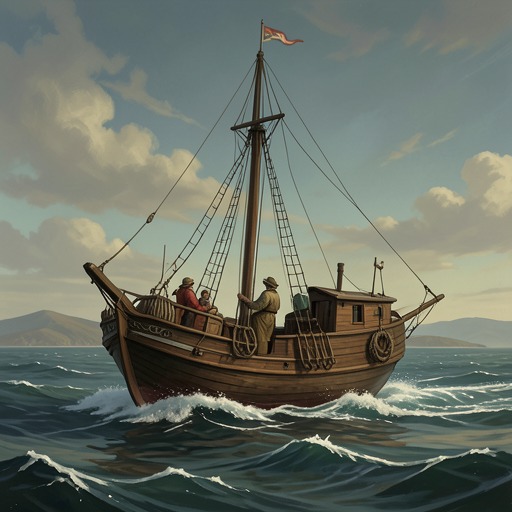
Azores
Kensuke's KingdomThe Azores enter the voyage as the destination of the Peggy Sue’s next passage after La Coruña: a waypoint between the family’s first hard weeks at sea and the longer Atlantic route south. Although the supplied account does not describe a landfall there, the islands help make the journey legible as a sequence of intended crossings, changing conditions, and distant shores.
A waypoint after La Coruña
The family spent only a couple of days in La Coruña. Michael’s mother slept frequently, while Michael’s father worked on the rudder cable, which still troubled him. Two days before the log entry describing the best sailing day so far, the family had set off for the Azores. The stop therefore followed both a demanding passage and a practical pause for rest and repair; the account does not specify whether they ultimately landed in the islands.
Place in the Atlantic route
The Azores belong to a voyage planned by stages. The family had hoped to sail about two hundred miles a day, roughly eight knots, but during the first week they sometimes managed only fifty miles a day. After leaving the islands, their broader route continued south: Michael later records sighting Africa and describes the plan to follow its west coast before crossing the Atlantic to South America. The Azores thus stand within a route shaped not only by distance but by the ship’s actual pace and the family’s need to respond to conditions.
The sea between destinations
Michael’s log contrasts the difficult Bay of Biscay crossing with a later day of strong breeze, blue sky, and warm sun, when the family could dry their belongings. Gannets dived around the boat, and Stella Artois barked excitedly. The improvement is recorded as an experience of life at sea, not as an event on land in the Azores; its place beside the departure for the islands shows how quickly the voyage could shift from strain to pleasure.
Narrative significance
The islands function as a named point on the family’s itinerary rather than a fully depicted setting. Michael’s account is assembled from short log extracts, with dates and observations preserving the voyage as it unfolded for an eleven-year-old sailor. In that route-based narration, the Azores help orient the reader between the family’s brief stay in Spain and the later sight of Africa, while the absence of a described visit keeps the emphasis on the moving passage itself.