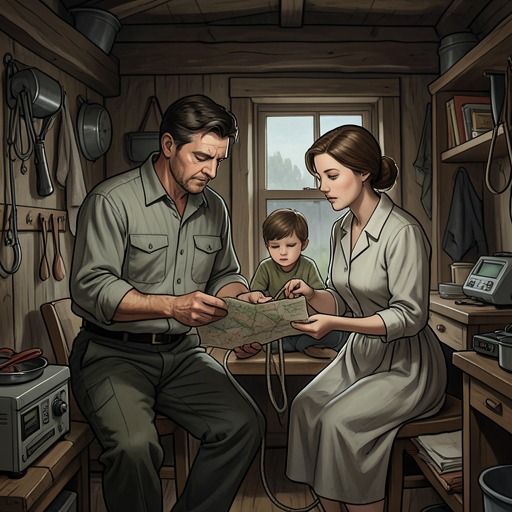
Brickworks closure and family unemployment
Kensuke's KingdomThe brickworks closure and the unemployment of Michael’s parents break the routine that had anchored family life, but also set in motion the voyage that takes the family around the world. The loss begins as a letter at the breakfast table; its consequences accumulate through silence, failed job searches, and a household growing unfamiliar to Michael. His father eventually answers that impasse with a risky alternative: spending the family’s limited resources on a sailing adventure rather than watching them dwindle at home.
The closure and its immediate effects
Michael’s parents both worked at the brickworks: his father there, and his mother part-time in the office. When the closure notice arrived, Stella Artois savaged it as it came through the letterbox. The letter was damp and punctured, but its message was clear enough: the brickworks would shut down, and both parents would be laid off.
At breakfast, the family met the news with a terrible silence. Sunday sailing stopped; Michael understood without asking why. His parents tried to find new jobs, but neither could find work. The loss therefore reached beyond income: it removed the family’s shared weekly ritual on the water, previously a source of pleasure and togetherness.
A household under strain
The aftermath came on gradually. Misery settled over the house, where Michael sometimes found his parents no longer speaking to one another. They began arguing over small matters, a change he noticed precisely because they had not been like that before. His father, once an indefatigable fixer, stopped repairing things around the house and was scarcely home. When he was not looking for work, he sat among yachting magazines, saying little.
Michael tried to spend as much time as possible playing soccer outside the house, but that refuge also weakened: Eddie Dodds moved away after his father found work down south, and the Mudlarks disbanded. The family’s economic setback thus coincided with the loss of Michael’s familiar household and football routines. One Saturday, after his paper route, he found his mother sitting at the bottom of the stairs and crying—a sight that contradicted the strength he had always associated with her.
From unemployment to a voyage
The same job loss that narrowed the family’s prospects also made Michael’s father consider a dream he had previously lacked the courage to pursue. He proposed sailing around the world, reasoning that they loved sailing and that their severance pay, savings, and money from selling the car could fund a once-in-a-lifetime journey. Rather than leave their limited funds in the bank to be gradually spent, he wanted to use them to visit places the family had only imagined seeing.
The plan was not presented as an impulsive escape. Michael’s father proposed six months of training and an absence of a year, perhaps eighteen months, depending on how long the money lasted. He promised a properly prepared voyage aboard a forty-two-foot Bowman. Michael’s mother would earn her Yachtmaster’s certificate and skipper; his father would serve as first mate and handyman; Michael would be ship’s boy, and Stella Artois the ship’s cat. For Michael, the proposal was immediately exhilarating. His mother’s quiet question about whether she really would be skipper showed that the plan also offered her a new role.
Setting sail and the voyage’s record
The family’s transition from unemployment to sailing took preparation and collective work. Michael later recalled that his mother mastered books and charts through relentless study and that he and his father became friends and shipmates. The three relied on one another, and the family came to regard itself as a capable team.
On September 10, 1987, with the boat’s nooks and crannies loaded with stores and provisions, the family set sail. Grandma and friends, including Barnacle Bill and Eddie Dodds, came to see them off; Eddie threw Michael a signed soccer ball as a lucky mascot. The departure made the father’s proposal real: the family had converted severance pay and savings into a voyage rather than remaining in the strained home created by unemployment.
Michael’s private log preserves the journey in the voice of an eleven-year-old recording what he saw. Ten days after leaving Southampton, the family faced a Force 9 gale in the Bay of Biscay, sometimes Force 10; the Peggy Sue survived the storm and reached Spain. Later, off the west coast of Africa, the family plotted a course across the Atlantic toward South America, wary of the windless Doldrums. On April 3, off Perth, they celebrated reaching Australia from England, halfway around the world, by hugging and jumping together.
Significance and limits of the new beginning
The voyage reverses the direction of the family’s fortunes without erasing their vulnerability. Unemployment supplies the occasion for the decision, and the journey restores shared purpose, but it does not guarantee security: by the time the family reaches Australia, Michael’s mother’s stomach cramps have returned, and she promises to see a doctor there. Later, in the Coral Sea, worsening illness, repeated storms, and a snapped rudder cable leave the family navigating under serious strain. The voyage is therefore not a simple escape from hardship; it carries the family’s hope into new dangers.
The book places the distant voyage against the small, recognizable objects and practices of the disrupted home: yachting magazines, the family’s former Sundays on the water, and the soccer ball Eddie throws at departure. In the island years that follow, Michael and Kensuke still depend on daily provisions, stored food, and practical work; the story’s different settings repeatedly make survival a matter of limited resources and shared labor. At the family’s eventual reunion, Stella Artois races out barking at the Peggy Sue, and Michael’s parents are aboard. The return cannot undo the closure or the grief that followed it, but the journey it prompted brings the family back together.