Coral Sea
Kensuke's KingdomThe Coral Sea is the maritime setting where the Peggy Sue’s journey north from Australia turns from open-ended adventure into a prolonged crisis. In Michael’s voyage account, the sea is both a route toward the next stage of the family’s travels and an exposed space where storms, illness, and mechanical failure leave the crew increasingly vulnerable.
Route and Expectations
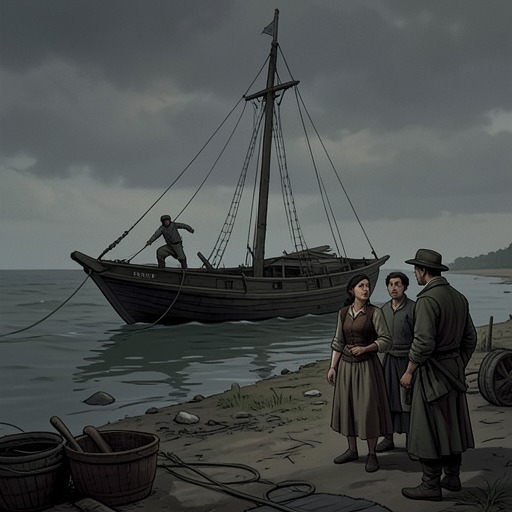
After reaching Australia, Michael’s family planned to stop in Sydney, explore the Great Barrier Reef, and continue through the Coral Sea toward Papua New Guinea. The intended route made the sea a passage onward rather than a destination in itself. By then, the family had already crossed from England to Australia, a distance Michael regarded as halfway around the world; the prospect of continuing the voyage brought the excitement of further travel, while familiar gulls underscored how certain features of the sea accompanied them across widely separated places.
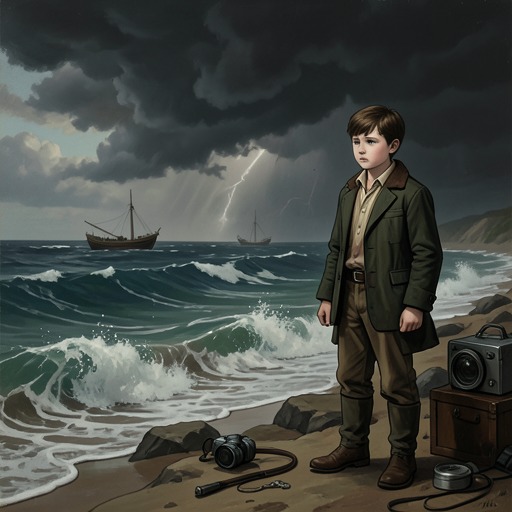
The family’s earlier experience of the Bay of Biscay had shown how severe weather could make a planned passage frightening and slow. They had expected rough conditions there, and the Peggy Sue survived gales that tossed the boat and delayed progress. The Coral Sea brings a harsher repetition of that maritime danger: after leaving Sydney, the family encounters storm after storm, and each drives them farther north. The route no longer feels like a line they control; weather repeatedly alters their course.
Storms and the Boat’s Failures
The danger grows through successive failures rather than a single isolated squall. The rudder cable snaps, and Michael’s father cannot fully repair it. The self-steering stops working, so someone must remain at the wheel continuously. With Michael’s mother too ill to take that watch, Michael and his father carry the steering and navigation together. The storm conditions thus compound the demands of damaged equipment and reduced crew capacity.
In his entry on the dark, calm night before his twelfth birthday, Michael describes the family’s uncertainty about their position. He and his father have been navigating as best they can, but he fears they no longer know where they are. His father wants to send a Mayday call, while his mother refuses, treating it as surrender. The contrast between the calm at the moment of writing and the succession of storms that preceded it does not restore security: the boat remains damaged, the family exhausted, and the route uncertain.
Illness and Separation
The storms strike while Michael’s mother’s recurring stomach cramps have worsened. She has stopped eating, takes only sugared water, and has not been able to consult the charts for several days. Michael and his father must therefore manage both the navigation and the continuous watch, while his mother’s condition limits the family’s ability to respond. Michael keeps Eddie’s soccer ball beside him at the wheel, holding on to a familiar reminder of home as he worries that his mother must recover and that the family cannot endure another storm.
The Coral Sea is also the setting associated with Michael’s eventual separation from the Peggy Sue. After he falls overboard, the account describes him reaching an island, while his parents continue searching for him. Much later, the Peggy Sue arrives at the island and Michael sees his mother and father aboard. The sea that had helped carry the family across the world has also made separation possible; the sight of the returning boat turns that distance into a reunion.
Narrative Significance
The Coral Sea’s importance lies in the way its geography becomes active in the plot. It channels the family north from Sydney, while repeated storms push them farther off their intended course; the broken rudder cable and failed self-steering translate that altered course into constant labor at the wheel. Weather, machinery, illness, and navigation converge, making the passage a test of both the boat and the family’s ability to cooperate under pressure.
In the voyage narrative, the sea also marks a change in Michael’s sense of the journey. Earlier, reaching Australia is a shared achievement: the family celebrates having sailed there on their own. In the Coral Sea, the same independence becomes precarious as the family loses confidence in its position and Michael worries about another storm. Its role is therefore not merely to connect places on the route, but to turn travel into exposure and to prepare the story’s separation-and-return movement.