Fire and the Rescue Signal
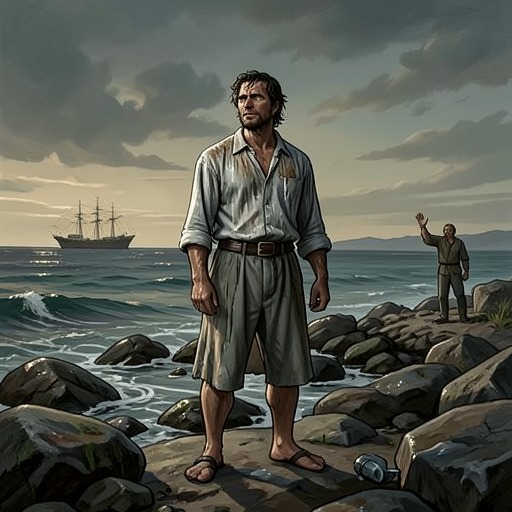
Kensuke's KingdomFire and the Rescue Signal is both a survival tool and the clearest measure of the changing relationship between Michael and Kensuke. At first, Michael sees fire as a way to keep animals away and make a passing ship notice him; Kensuke extinguishes it and draws a boundary that confines the boy to one end of the island. Later, fire becomes something they choose to build together. Its smoke finally brings the Peggy Sue to the island, turning Kensuke’s protection from a rule that keeps Michael isolated into an act that helps him return home.
A practical hope, and a prohibition
Michael’s first plan for fire is rooted in immediate needs. He remembers how Eddie Dodds showed him to focus sunlight through a piece of glass, gathers dry leaves and twigs, and tries to start a flame. He hopes a fire will keep flies and animals away at night, while its smoke might alert a passing ship. The attempt fails, but the purpose is clear: the same small flame could help him endure the island and offer a way out of it.
Kensuke interrupts the effort with an emphatic prohibition. He tells Michael that fire is no good and insists, “Dameda!” and “No fire!” When Michael points out to sea to explain that his parents might see the smoke, Kensuke instead marks out the island in sand, draws a line between its two ends, and assigns Michael to the smaller one. He identifies himself and claims the island, then orders the boy away. Fire thus becomes bound up with a larger division: Michael wants a signal that would bring people to the island; Kensuke wants to prevent people from finding it.
The rule is not simply a denial of food or shelter. Kensuke continues to leave fish, bananas, and water for Michael and Stella Artois, and he renews the boundary line as needed. Michael recognizes the contradiction: the man appears to care for their survival while limiting their freedom to leave. A passing supertanker makes that tension concrete. Michael watches it cross the horizon without seeing him and realizes that the fire he was forbidden to use might have given him a chance to be noticed. From then on, he thinks of Kensuke not only as his provider but as his captor.
The hidden beacon and its destruction
After the tanker disappears, Michael decides to prepare another signal in secret. He keeps his fireglass and gathers branches on Watch Hill, building a large beacon on the seaward side where a ship might see it, but Kensuke would not. He does not light it at once: he plans to wait until a ship appears, then use dry leaves to start a fire quickly. The careful preparation turns his original, improvised attempt into a deliberate strategy for escape.
When a junk appears offshore, Michael runs up Watch Hill with Stella Artois and prepares the tinder. A wisp of smoke develops into a small flame. Kensuke arrives before it can grow, stamps it out, throws the fireglass against a rock until it breaks, and dismantles the beacon, scattering its wood down the hill. Orangutans gather to watch. Kensuke says only “Dameda,” then apologizes, but he does not explain why he is preventing the signal. Michael watches the junk recede and, furious at losing another chance, crosses the boundary and goes swimming despite Kensuke’s rule. The conflict over fire has now become an open challenge to the regime that governs Michael’s movement as well as his hope of rescue.
From protection to shared purpose
The meaning of Kensuke’s prohibition becomes clearer when he later explains his past. Hunters had come to the island with guns, frightening the orangutans and killing gibbons; Kensuke hid the orangutans and came to regard people as killers. He feared that a fire would draw others to the island, putting the animals and his own refuge at risk. His rule has a protective purpose, but it also keeps Michael separated from any possible rescue. Kensuke’s history explains the fear behind the prohibition without removing the cost it imposes on the boy.
Their relationship changes through care, shared routines, and eventually direct explanation. Kensuke rescues Michael and Stella Artois from the sea, treats Michael after the jellyfish incident, and over time allows him into a closer life together. When Kensuke finally tells Michael that he is like a son to him, he also acknowledges that Michael wants to return to his parents. He understands that a child cannot spend his whole life on the island with an old man, and changes his mind: the next day, they will build a new, large fire, ready for the next ship. The change is significant because the signal is no longer a threat Michael must make against Kensuke’s wishes. It becomes a shared decision, made possible by the trust that has grown between them.
The beacon succeeds, and the friends part
When two white sails appear offshore, Michael and Kensuke act together. Michael fetches binoculars, confirms that the sails belong to a yacht, and carries a lighted stick to the prepared beacon. Kensuke gives him permission to light it. The fire catches quickly; although Michael wants the thick smoke more than the flames, Kensuke assures him the people aboard will see the signal. They take turns watching through the binoculars and add wood as smoke rises.
The yacht turns toward the island. Michael and Kensuke embrace beside the blazing beacon, and Michael recognizes the dark blue hull as the Peggy Sue. He sees his mother’s cap and understands that his parents have returned for him. The signal succeeds, but its success brings a final separation: Kensuke withdraws to the cave, holding Michael’s soccer ball, and tells him to go. He gives the ball back and asks Michael to promise not to forget him. At the departure, fire has changed from the instrument of a forbidden rescue attempt into the means by which Kensuke knowingly helps Michael leave.
Significance
The repeated contrast between extinguished and permitted fires gives the rescue signal its emotional and ethical weight. Early on, Kensuke’s care and control are intertwined: he supplies what Michael and Stella Artois need while forbidding the very signal that might bring help. The beacon’s destruction exposes how protection can also confine. Later, after Kensuke has shared the reasons for his fear and accepted Michael’s need to return, the same act of making fire becomes an expression of care that respects the boy’s future.
Fire also changes the island’s relation to the outside world. Kensuke fears that human attention will bring danger to the animals and to his sanctuary; Michael needs that attention because he cannot get home alone. Their eventual agreement does not erase the danger that shaped Kensuke’s rule, but it resolves the immediate conflict through a choice he makes freely. The beacon draws the Peggy Sue in, while Kensuke’s farewell makes clear that helping Michael be found also means letting him go.