Honour and Responsibility
Kensuke's KingdomHonour and responsibility in Kensuke’s Kingdom are not presented as abstract ideals but as duties negotiated between people who depend on one another. Kensuke initially expresses care through strict rules and secrecy, shaped by war, loss, and fear for the island’s wildlife. As trust grows, the same sense of duty that once kept Michael confined leads Kensuke to support his return to his parents, even though their parting grieves him.
Rules, Protection, and Control
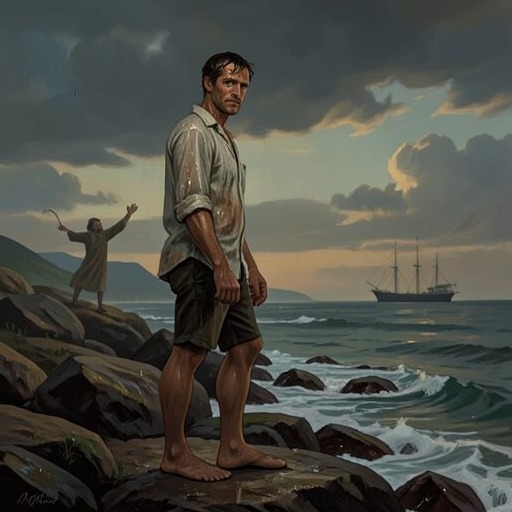
When Michael first lights a fire, Kensuke makes the prohibition unmistakable. He draws the island in the sand, marks a boundary between its two ends, assigns Michael to the beach near his cave, and identifies the island as his own. The line turns an unspoken limit into a visible rule: Michael must stay on his side and must not make fires. Kensuke then smothers the fire, while continuing to leave food and water for Michael and Stella. His actions combine care with control; he keeps them alive but determines where they may go and how they must behave.
Kensuke renews the boundary as it wears away, and Michael generally obeys, in part because he depends on Kensuke’s daily supplies. The rule becomes more pressing when Michael goes into the sea after a storm. Kensuke wades out, leads him back to the beach, and insists that swimming is dangerous and forbidden. Michael resents the restriction and considers defying him, but does not return to the water. His need for food and water, and his hope of eventually attracting a ship, constrain his choices. The scene complicates the difference between a protective warning and an imposed command: Kensuke has real grounds for concern, but Michael has little power to refuse him.
Responsibility Shaped by War and Loss
Kensuke’s understanding of honour is formed by the destruction of the life he knew. During the war, he hides from American soldiers because surrender would, in his view, be dishonourable; he is also afraid. Hearing the soldiers say that everyone in Nagasaki has died, he believes his family and friends are gone and decides to remain on the island. His isolation is therefore bound up with grief as well as a code of conduct, rather than being simply a preference for solitude.
Later, hunters come to the island with guns. Kensuke hides with the orangutans, which gather in his cave when he sings to them, but the hunters shoot gibbons, kill mothers, and take their young. Kensuke’s anger leads him to distrust people as a whole and to fear that anyone discovering the island may harm its animals. His prohibition on fire and his insistence that Michael keep to one end of the island arise partly from that fear. In this context, safeguarding the island’s nonhuman inhabitants is a responsibility Kensuke has taken on, although his protective purpose does not erase the restrictions he imposes on Michael.
Care, Truth, and Reconciliation
Kensuke’s account of their first encounters changes the meaning of his earlier actions. After Michael falls into the sea, Kensuke hears cries and a song, finds Michael, Stella, and the football, and saves them. The next morning he carries Michael to the island and leaves food and water, intending to prevent his death while keeping strangers away. When Michael makes a fire, Kensuke fears that it could bring other people to the island and endanger the orangutans and gibbons. The care was present from the beginning, but Michael could not see its reasons while Kensuke refused to explain them.
Their friendship gives both men a chance to understand the other’s obligations. Kensuke tells Michael that he has come to regard him as a son, while also recognising the pain Michael’s absence may cause his mother. When Kensuke discovers Michael’s message in a bottle, he initially feels hurt that Michael did not tell him what he was doing. He calls that silence dishonourable, but then acknowledges that Michael may want both to remain with him and to return home. Rather than demand that Michael choose the island, Kensuke proposes that they build a large fire to signal a passing ship. His decision marks a change from keeping Michael safe by restricting him to caring for him by helping him leave.
The Parting and Its Promises
When the Peggy Sue returns, Kensuke refuses to go with Michael. He says that Japan belongs to an earlier life, that he would be a stranger if his family were still alive, and that the orangutans are his family now. He understands that the animals may again face danger from hunters and sees their protection as his responsibility. His declaration that an emperor must stay in his kingdom and look after his people makes his choice a matter of honour as he defines it: he will not abandon those in his care, even when returning to Japan might reunite him with his past.
Kensuke nevertheless accepts that Michael’s duty and future are different. He tells the boy to paint throughout his life, to remember him when looking at the full moon, and to keep their story secret for ten years so that no one will come searching for him. Michael promises. Their farewell preserves their bond without requiring them to remain together: Kensuke stays to protect his island family, while Michael returns to the family he has lost and hopes to find. The novel’s ethical resolution lies in that distinction. Responsibility is not simply obedience to a rule or loyalty to one place; at its most generous, it means recognising what another person needs, even when honouring that need brings separation.