Island orangutans
Kensuke's KingdomThe Island orangutans are a community of wild animals whose lives on Kensuke’s island are bound to the island’s forest and to Kensuke’s attentive care. They help define the limits Michael must observe when he first arrives, but, as the relationship between the boy and Kensuke changes, they also become companions and dependants whose welfare gives Kensuke a reason to stay. Their trust is earned through years of living alongside them; their vulnerability to hunters makes that trust carry real stakes.
Identity and Life on the Island
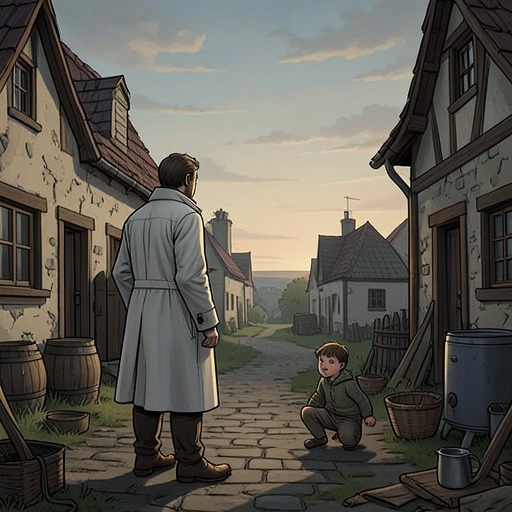
The orangutans live in the forest on the island, apart from Michael’s first restricted territory. When Kensuke draws a map in the sand to explain his rules, he divides the island into two parts and assigns Michael the area around his cave and hill. The boundary is not just a personal prohibition: Michael fears entering the orangutans’ territory because he does not know how they or their companions might react. At this stage, their presence helps make the forest an uncertain place, one in which Michael must learn how to live rather than assume it belongs to him.
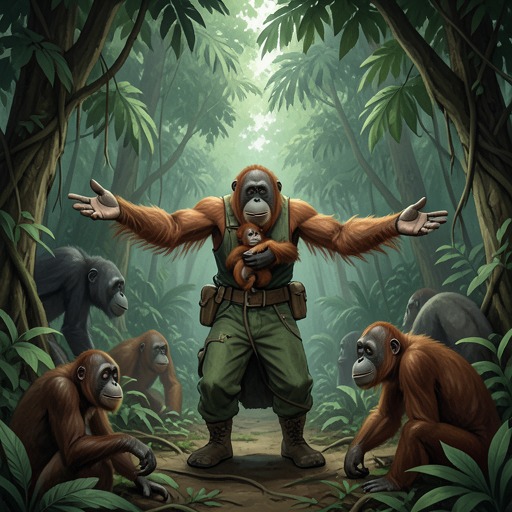
From his hill, Michael later sees Kensuke spearfishing in the shallows with a group of fourteen or fifteen orangutans watching from the beach. Sometimes Kensuke carries one of the young animals on his back; moving among them, he seems almost to belong to their community. The scene contrasts with the boundary Kensuke first imposes on Michael: the orangutans are not simply inhabitants to be kept at a distance but a group with whom Kensuke has built an everyday closeness.
A Relationship Built Through Knowledge and Trust
Kensuke’s knowledge of the forest comes in part from observing what the orangutans eat and avoid. He learns to climb as they do and to recognize their signals, including darting eyes and nervous scratching. In turn, his relationship with them is expressed through practical companionship: they shadow him along the forest tracks, go ahead on patrol, and scamper behind him. When he sings, they come toward him, apparently drawn by his voice. His ability to gather them later depends on this established trust, not on force or a formal command.
As Michael is gradually invited to accompany Kensuke, he sees the animals at closer range. At first the orangutans and the newcomers remain cautious around one another. One evening, a young orangutan climbs onto Michael’s lap and examines his nose and ear; soon others follow, treating him as a place to play. The larger animals also reach out to touch him, though more carefully. Stella and the orangutans, by contrast, continue to keep some distance from one another. These encounters mark an important change: Michael’s relationship with the island’s animals shifts from anxious speculation about a potentially dangerous territory toward cautious, embodied familiarity.
Threat and the Work of Protection
The orangutans are threatened by armed hunters who have come to the island before. Kensuke tells Michael that, during that earlier raid, he sang to gather the orangutans into his cave, where they hid. The hunters did not find them there, but they shot gibbons and took their young. That history explains why Kensuke regards the returning boat as a danger rather than an opportunity for rescue. When he recognizes it, he immediately tells Michael that the hunters have come back and that they must bring the orangutans into the cave for safety.
Kensuke gathers them by singing as he walks into the forest. They appear in twos and threes until fifteen have assembled, but four are still missing. Three more arrive, including Tomodachi, leaving only Kikanbo unaccounted for. Michael helps bring the younger animals toward the cave, carrying two who are more interested in playing than following. The sequence makes their individual responses matter: gathering the group is not automatic, and Kensuke’s familiar song must compete with the threat outside and the need to find those who have not come.
When the hunters arrive, the orangutans shelter with Michael and Kensuke in the cave. The animals remain frightened and need Kensuke’s reassurance; Tomodachi is especially agitated. Kensuke sings softly throughout the shooting, while Michael comforts the young animals as they huddle close to him. They stay concealed for hours, waiting until the boat’s engine starts and Kensuke is willing to let the group emerge. The retreat protects those who have gathered, but it does not make the raid harmless.
Loss, Reunion, and Kensuke’s Responsibility
After the hunters leave, Kensuke and Michael search the island for Kikanbo, calling and singing without finding him. They then come across the bodies of two dead gibbons, both mothers, and bury them. Kensuke is devastated by the loss. The hunters’ violence thus reaches beyond the orangutans themselves, affecting the wider animal community Kensuke protects and leaving him without words or songs for a time.
On the way back along the beach, Kikanbo suddenly charges out of the trees and climbs up Kensuke’s leg, wrapping himself around Kensuke’s neck. His return changes the search’s ending from absence to reunion, but it does not undo the deaths of the two gibbons. That night, Kensuke and Michael sing “Ten Green Bottles” over fish soup, at once mourning the dead animals and celebrating Kikanbo’s safe return. The orangutans’ presence makes the song both a personal expression of relief and part of the care through which the two humans share their grief.
When the Peggy Sue eventually returns for Michael, Kensuke explains that he will stay. He calls the orangutans his family and fears that hunters may come again; someone must look after them. His decision is tied to the life he has made on the island and to a responsibility grounded in long familiarity, protection, and trust. The orangutans are not merely the reason he refuses to leave: their relationship with him helps define what he means by home and by the people he must continue to care for.
Narrative Significance
The orangutans alter the meaning of the island’s boundaries. At first, the division Kensuke draws restricts Michael’s movement and reinforces his isolation. Later, the same island becomes a shared habitat in which learning, companionship, and protection depend on attending to other lives. The orangutans’ forest knowledge has already helped Kensuke survive; their trust makes his calls effective; their danger gives his warnings about the hunters a concrete purpose.
Their independent responses also keep the animals from functioning only as symbols of Kensuke’s feelings. They gather unevenly, play, remain wary of Stella, and depend on the cave for shelter during the raid. The missing Kikanbo and the two dead gibbon mothers make the limits of protection visible: care can organize a refuge, but it cannot guarantee that every animal will be safe. In the ending, Kensuke’s choice to remain is therefore both an expression of attachment and an acceptance of continuing responsibility for the animal community that has become his family.