Japan
Kensuke's KingdomJapan is Kensuke Ogawa’s homeland, the place where his family life began and where the war’s losses shaped his decades of isolation. For much of his life on the island, he believes that his wife Kimi, his son Michiya, and the rest of his family died in the atomic bombing of Nagasaki; only after living alongside Michael does he decide that returning to Japan to learn the truth may be possible.
Homeland and Family Background
Kensuke tells Michael that he was born and grew up in Nagasaki, a large coastal city. As a young man he studied medicine in Tokyo, became a doctor, and later continued his studies at Guy’s Hospital in London. He returned to Nagasaki, where he had a wife, Kimi, and a son, Michiya. He remembers this period as a happy family life: he often went home from his naval service to see them, and Michiya grew quickly while the family remained together.
War and Separation
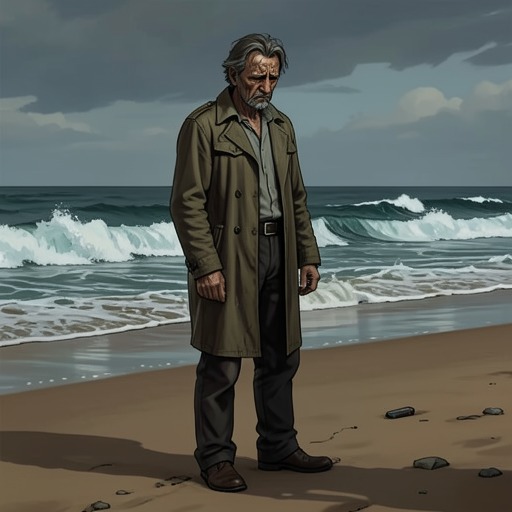
When war came, Kensuke joined the navy as a doctor aboard a warship. During a major sea battle, American aircraft bombed his ship. He stayed with his patients while the attacks continued and eventually found himself the only survivor aboard a vessel still moving at sea. By radio he then heard that an atomic bomb had fallen on Nagasaki. He believed Kimi, Michiya, his mother, and the rest of his family had been killed.
After Japan surrendered, Kensuke felt that he had no reason to live. A storm and the sea carried him to the island, where he survived and eventually made a home. His warship later went aground and sank; its rusting remains, partly buried in sand and incorporated into the island’s shore, become a physical trace of the history he recounts to Michael. Japan is therefore present in the island not only as Kensuke’s memory but also through the wreckage left by the journey that separated him from home.
Belief and Longing in Exile
Kensuke’s belief that his family died is reinforced by what he heard from American soldiers who came to the island. He hid rather than surrender, which he considered dishonourable, and overheard the soldiers say that everyone in Nagasaki was dead. He took their words as confirmation that there was no family left to return to. When later discussing the possibility of going home, he insists that the bomb destroyed every house and that his family must be dead; he chooses to remain on the island, where he feels safe.
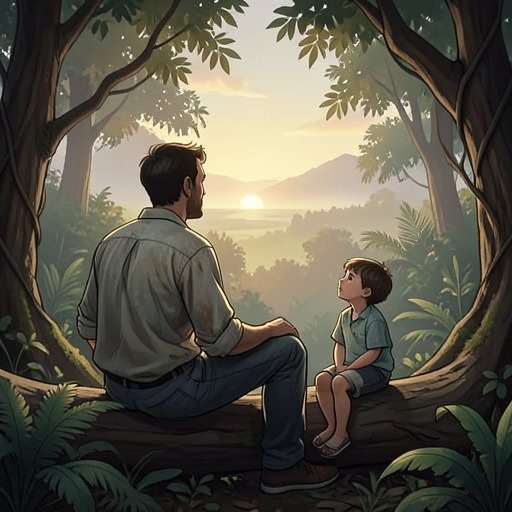
His isolation is bound up with that conclusion. After hunters come to the island and kill gibbons, he begins to think of people as killers and wants no human company. He rescues Michael from the sea, then initially tries to keep him at a distance, fearing that other people might come and harm the island’s animals or take Kensuke away. Their eventual friendship gives him a new relationship to family, but it does not immediately undo his conviction that Japan holds only loss.
The Decision to Return
Michael helps make return imaginable by describing the outside world and suggesting that Kensuke could go to Japan if a ship found them. Kensuke first rejects the idea, certain that his family cannot have survived. His decision changes during the night the sea turtles hatch. Watching the young turtles make their way into the water, he calls them brave for setting out without knowing what awaits them. He takes their departure as a lesson and resolves that, when a ship comes, he will leave the island with Michael and go to Japan to find out what happened to Kimi and Michiya.
That choice does not establish what became of his family; the evidence ends with Kensuke prepared to seek the truth. Japan thus remains both the home he lost and a future destination. His decision to go is a movement away from the certainty that has sustained his retreat, toward the uncertain possibility of reunion or knowledge.