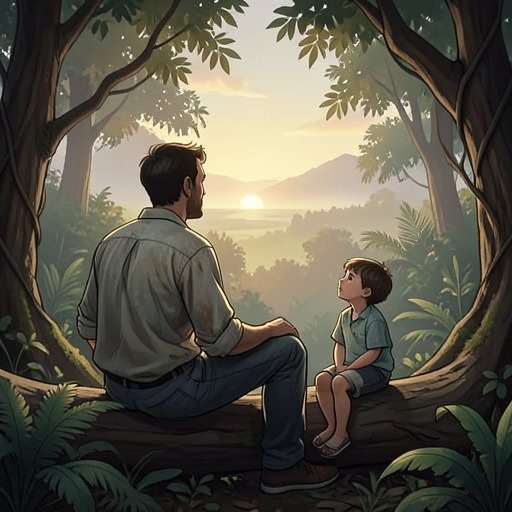
Kensuke and Kimi
Kensuke's KingdomKensuke and Kimi’s marriage is the lost center of Kensuke’s story: he remembers their happiness in Nagasaki, but war and the atomic bombing separate them without confirming what became of her. Convinced that Kimi and their son Michiya were killed, Kensuke withdraws from other people and remains on the island for years. His attachment to Kimi persists in memory, and his later relationship with Michael brings that private grief into the open without resolving the uncertainty at its heart.
Family Life Before the War
Kensuke tells Michael that he was born and raised in Nagasaki, studied medicine in Tokyo, and later trained at Guy’s Hospital in London. After returning to Nagasaki, he married Kimi, and they had a son, Michiya. He describes himself as happy and proud of his work as a doctor, caring for mothers and babies; family life, as he recalls it, was a source of ordinary closeness before the war remade his circumstances.
Kensuke’s account links his work and his home life to a world that war soon dismantles. He entered the Japanese Navy as a doctor aboard a large warship, but his family remained in Nagasaki. He says he went home often to see Kimi and Michiya, who was growing quickly. The remembered visits and the image of a family together make the later separation more than a change of location: it becomes the loss around which his life on the island is organized.
War and Separation
During a major sea battle, American aircraft bombed Kensuke’s ship. He stayed with his patients, and after further attacks he found that the others aboard had died. The ship continued moving, beyond his control. Listening to the radio, he heard that an atomic bomb had fallen on Nagasaki. Because Kimi, Michiya, his mother, and the rest of his family were there, he concluded that they had all died.
The ship eventually stopped and, after a storm, came ashore on the island where Kensuke would live. He survived, salvaged supplies from the vessel, and later hid when American soldiers came to the island rather than surrendering. He heard the soldiers speak about the deaths in Nagasaki and took their words as confirmation of his worst fear. The wreckage and the radio report connected the island’s present to the war that had separated him from Kimi; neither, however, gave him direct knowledge of her fate.
Life in Memory and Isolation
Kensuke says that he did not want to live after believing his family and friends were dead. Meeting the orangutans gradually helped him accept survival and remain on the island. He also describes a later encounter with hunters who killed gibbons and took their young. Their violence strengthened his distrust of people, and he came to think of humans as killers. This history helps explain why, when Michael arrived, Kensuke initially wanted him gone and feared that other people might follow and harm the island’s animals.
Yet Kensuke says he never forgot Kimi or Michiya. The distinction matters: he does not describe his island life as erasing his earlier family, but as continuing alongside their permanent presence in his mind. When he tells Michael about his mother’s grief at losing a child, he compares it with his own attachment to Kimi and Michiya, whom he says remain in his thoughts forever. Michael’s separation from his mother gives Kensuke a way to speak about his own loss, though it does not make the two situations identical: Michael may still return to his family, while Kensuke believes his family is dead.
A Possible Return, and the Choice to Stay
After he and Michael reconcile, Kensuke speaks more freely about his past while they fish together. Michael tries to comfort him by suggesting that the bombing may not have killed everyone and that Kimi and Michiya could still be alive. Kensuke considers the possibility but rejects it, relying on what he heard about Nagasaki’s destruction. He says he is safe on the island and intends to remain there. The conversation exposes how firmly his life has been built around an unverified conclusion: hope of reunion exists, but Kensuke does not choose to pursue it.
When the Peggy Sue returns, Kensuke explains that even if Kimi and Michiya survived, they would have believed him dead for many years, and he would be returning as someone changed by the intervening life. He also identifies the orangutans as his family and feels responsible for protecting them from hunters. He calls the island his kingdom and frames staying as an honorable duty to the people in his care. His decision does not diminish his marriage; it shows how the memory of his former family coexists with a new sense of obligation and belonging.
The Relationship’s Continuing Meaning
Kensuke’s marriage to Kimi remains present through the way he remembers his family and through the possibility Michael raises but Kensuke cannot accept. The story never establishes whether Kimi survived the bombing. Instead, it leaves Kensuke’s belief and the limits of his knowledge in tension: he treats his family as lost, while Michael’s suggestion makes clear that certainty is not the same as confirmed fact.
Kensuke’s final choice to stay on the island therefore carries both loss and care. He does not return to Japan, but he asks Michael to remember him and keep the island secret, so that the animals will be left in peace. His years of solitude began in the conviction that everyone he loved had died; by the time Michael departs, he has formed another family without ceasing to remember Kimi and Michiya. The marriage remains an enduring bond in memory, not a relationship the narrative resolves through reunion or confirmed death.