Kensuke's outrigger boat
Kensuke's KingdomKensuke's outrigger boat is a handmade, carefully hidden fishing craft that links survival with disclosure. When Kensuke reveals it beneath canvas and branches on a secluded beach, it carries Michael’s lost soccer ball and takes the two of them into open water, where Kensuke begins telling the story of his life. The boat is therefore both a practical means of getting food and the setting for a decisive change in their relationship: Michael learns that Kensuke rescued him at sea, and hears how war, loss, and a long life alone shaped the man who has become his friend.
Discovery and Construction
Kensuke leads Michael through the forest to a hidden sandy bay, where he uncovers what first appears to be a log. The object proves to be a long, wide dugout fitted with an outrigger frame on either side. Branches and canvas conceal it from view; Kensuke draws the covering back slowly, turning the discovery into a deliberate reveal. The craft is his own work, and he describes it as very safe, insisting that it will not go down.
The boat’s appearance also ties it to the island’s earlier history. Michael has already found a rusted piece of ship’s hull half-buried in the sand, and the wreckage raises questions about the ship and its possible survivors. Kensuke’s craft is not that wreck: it is a separate boat he made himself. The distinction matters when Kensuke later explains that he was carried away from the island while fishing and eventually found Michael in the sea. The beach discovery, the wreckage, and the boat’s story gradually bring the island’s scattered traces into focus.
Work at Sea and a Recovered Object
Kensuke takes two fishing rods and a net into the forest, then brings Michael to the bay to catch larger fish for smoking. After uncovering the boat, he and Michael drag its considerable weight down the beach and into the water. Kensuke lifts Stella aboard, pushes off, and rows standing at the stern with a single oar, using a motion Michael compares to punting. The craft carries them beyond the shelter of the cave and into the open-water swell, where they fish from opposite sides.
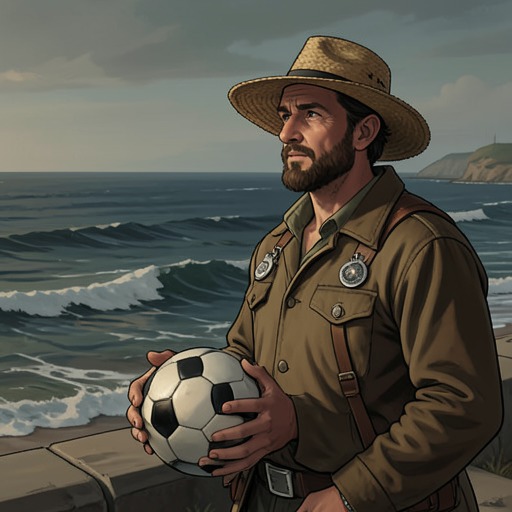
Beside the long oar lies Michael’s soccer ball, softened by time, with much of its white leather cracked and discoloured. Eddie Dodds’s name remains just visible. The ball had been thrown to Michael as the Peggy Sue departed, and he had clung to it when he was lost at sea; in the boat, Kensuke returns it to him. Michael receives it as a lost part of home restored. The boat thus brings together two kinds of survival: the deep-sea fishing that helps feed the island’s inhabitants and the recovery of an object that preserves Michael’s connection to his family and former life.
The Boat as a Setting for Disclosure
Fishing aboard the outrigger gives Kensuke and Michael a shared task and a reason to travel to the water where Kensuke’s history can be told. Michael is eager to ask how Kensuke found the ball, but waits rather than risk making him withdraw. While they fish, Kensuke explains that he was born in Nagasaki, trained as a doctor, served as a doctor aboard a warship, and spent many years alone on the island after the war. He also recounts how hunters came to the island, prompting him to hide with the orangutans, and how his fishing boat carried him away when the wind changed.
Kensuke says that, while stranded offshore, he heard shouting and singing and saw a light. He came toward them and found Michael, Stella, and the ball. The boat’s voyage had brought him into the water where he could rescue Michael; the child had not known who saved him. Kensuke also explains that, after returning to the island with Michael, he left the boy food and water but kept him at a distance, fearing that human visitors might find the island and harm its animals. The craft’s fishing journey therefore opens a conversation that connects its ordinary use to the origin of their relationship.
Shared Family and Divided Longing
After Kensuke describes Michael as a son and says they are family, the boat carries a different weight. Michael accepts the bond, but he also thinks of his mother and father, who may believe he has drowned. He considers using the boat to escape and signal for help, then recognizes that leaving without Kensuke’s knowledge would betray the trust between them. The boat makes escape physically imaginable, but the relationship formed through their shared work at sea makes that choice morally difficult.
When Michael later finds a plastic Coke bottle on the beach, the thought of escape returns. He writes a message to the Peggy Sue and his parents, seals it inside the bottle, and sends it out to sea; the outrigger is not the means of that attempt. Its relevance lies in the contrast: the boat has brought Michael and Kensuke together in an honest exchange, while the secret message creates distance between them. The recovered soccer ball and the fishing journeys bind Michael to both home and his new island family, but the longing to return to one family unsettles the other.
The outrigger is more than transport or equipment. Its concealed construction reflects Kensuke’s guarded life, while its dependable passage into open water enables food-gathering, rescue, and the telling of a past he has kept private. As Michael learns to wait, fish, and row alongside Kensuke, the boat becomes a material record of their cooperation: a handmade craft carrying not only a catch, but also the recovered ball, the story of a rescue, and the difficult recognition that affection does not erase the pull of home.