Kensuke’s Self-Imposed Isolation on the Island
Kensuke's KingdomKensuke’s self-imposed isolation on the island is both a refuge from the violence he associates with people and a life he ultimately chooses to preserve. After the war, believing his family dead and fearing that human contact would bring further danger, he builds a solitary existence among the orangutans. His encounter with Michael tests that withdrawal: at first he keeps the boy at a distance while secretly sustaining him, but care and friendship gradually alter their relationship. When the Peggy Sue returns, Kensuke lets Michael go home and remains on the island, defining his choice as loyalty to the place and its animal inhabitants.
Origins of His Withdrawal
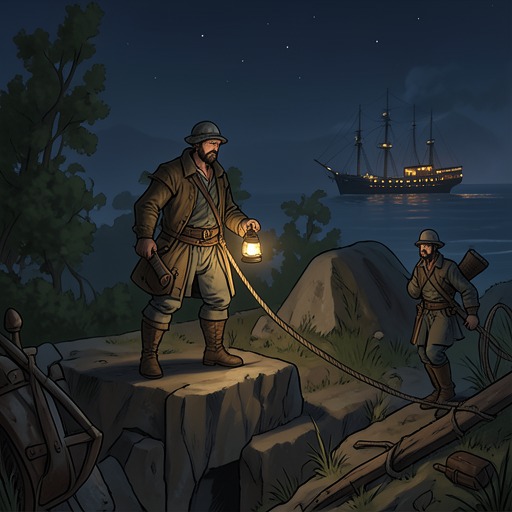
Kensuke’s isolation takes shape after his wartime ship is carried to the island. He finds food and water, salvages supplies from the vessel, and learns to live from the land, at first describing himself as feeling like a bad person because he believes that his friends and family have died while he survived. Meeting the orangutans changes the meaning of his survival: their kindness and the island’s peacefulness lead him to think that he may be fortunate to be alive and to stay there.
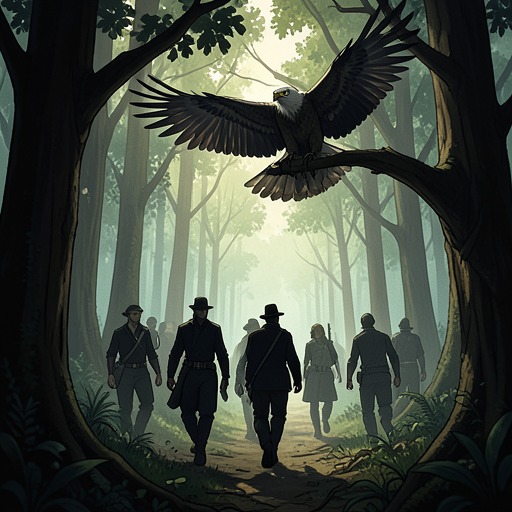
His decision to remain is reinforced by a later encounter with American soldiers. Hiding in the forest, he hears them laughing and saying that everyone in Nagasaki is dead. He takes this as confirmation that his family has been lost and sees no reason to go home. The ship he had salvaged eventually founders on the rocks and sinks; its remains become part of the island. For Kensuke, survival and concealment become linked: he has a place to live, but the outside world seems to hold only loss and the possibility of renewed danger.
Isolation as Protection and Control
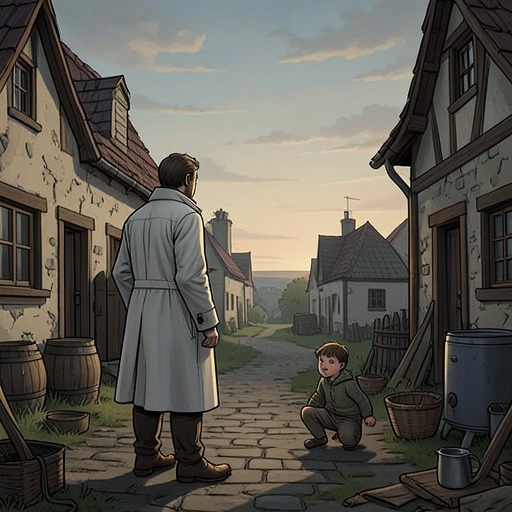
Kensuke’s solitude becomes an active effort to keep people away from the island. When Michael lights a fire, Kensuke draws a map in the sand, divides the island with a line, and assigns the boy to one end while claiming the other for himself. He orders Michael not to make fires and repeatedly maintains the boundary. The prohibition is not simply a personal rule: Kensuke fears that smoke will attract people who might discover him and harm the orangutans or gibbons.
The arrangement is contradictory in practice. Kensuke refuses friendship and demands distance, yet leaves Michael food and water, keeping him and Stella alive. He later explains that he had carried Michael to the beach after finding him at sea, then left provisions because he did not want the boy to die. His protection does not initially respect Michael’s wishes: when Michael tries to swim, Kensuke forcibly brings him back to shore and insists that swimming is dangerous. Michael depends on Kensuke’s daily supplies, so the boundary and other prohibitions have real authority over his movements.
That authority grows harder for Michael to accept as the prospect of rescue fades. He feels alone and bewildered, and comes to regard his cave as home because he has nowhere else. Later, after seeing a junk sail away, he deliberately crosses the sand boundary and swims, defying Kensuke’s ban. A jellyfish stings him, and Kensuke rescues and treats him. The episode exposes the double edge of Kensuke’s rules: they are controlling, but the swimming prohibition arose from knowledge of a danger that Michael did not understand.
The Island, the Orangutans, and Human Danger
Kensuke’s withdrawal is not a refusal of all relationship. During his years alone, he learns from the orangutans what is safe to eat, how to climb, and how to interpret their warnings. By observing them and responding to their signals, he gradually earns their trust and becomes part of their community. His account presents the island not as empty wilderness but as a home shared with animals whose safety gives his solitude a continuing purpose.
That purpose becomes especially clear when Kensuke recounts the hunters’ arrival. He hides the orangutans in his cave when the armed men come, but the hunters shoot gibbons, kill mothers, and take their young. Kensuke’s anger at this violence hardens into a general conviction that people are killers and that he does not want to see them again. His insistence on secrecy is therefore tied not only to his own painful past but also to his fear that outsiders will return and threaten the animals he protects.
The same fear explains his reaction to Michael’s rescue fire. Kensuke sees it as a risk of attracting people to the island, becomes angry, and puts it out. His later account connects this conflict to the history Michael could not know: to Kensuke, a visible signal is not merely a chance of rescue but a possible invitation to renewed human violence. The island’s boundary makes that distrust legible, dividing their space even while Kensuke continues to provide for Michael.
From Withdrawal to Chosen Care
The bond with Michael gradually unsettles Kensuke’s wish to live entirely apart from people. After rescuing the boy and treating him for jellyfish stings, he tells him that they have become friends and that Michael is like a son. He also admits that he had hated Michael at first and had wanted to be alone. Their shared life—painting and fishing—allows Kensuke to accept closeness without immediately abandoning the island that has become his refuge.
When Michael admits that he tried to send a message in a bottle, Kensuke first names the concealment as wrong, then recognizes the conflict behind it: Michael wants both to stay with him and to return home. Kensuke accepts that the boy is young and has a whole life ahead of him, while an old man cannot be his companion forever. He changes his mind about rescue and proposes that they build a large fire to signal a ship. The decision marks a shift from keeping Michael within the island’s boundaries to helping him leave it.
When the Peggy Sue returns, Kensuke refuses to accompany Michael. He believes that, if Kimi and Michiya are alive, they would have thought him dead for years; he also feels that he is no longer the same person who left Japan. Most decisively, he has a family on the island: the orangutans may need his protection if the hunters return. He calls the island his place and his kingdom, and frames staying as a responsibility rather than an inability to return.
Kensuke’s final choice preserves his solitude but changes what it means. He does not reject Michael or the possibility of love; he accepts the boy’s return home while asking him to remember their bond, paint throughout his life, and keep the island’s location secret for ten years. The terms allow Michael to leave without exposing Kensuke or the animals to unwanted visitors. Isolation, once a response to grief and fear, becomes a chosen life shaped by care: Kensuke remains apart from human society, but no longer simply because he believes that all people are killers.