Kikanbo
Kensuke's KingdomKikanbo is a young orangutan on Kensuke’s island, remembered as Tomodachi’s errant, mischievous son. His habit of wandering away makes him a source of repeated concern, but also gives him an active place in the island’s animal community: he plays, explores, and frustrates attempts to keep him close. When hunters return, his absence delays the retreat to safety; when he reappears, his return becomes a moment of relief in the aftermath of the attack.
Identity and Family
Kikanbo is Tomodachi’s baby, though he is already mobile and independent enough to run off repeatedly. Kensuke describes him as wicked and says he often makes Tomodachi sad by disappearing. Her visits to the mouth of the cave, where she lingers as if seeking comfort, connect Kikanbo’s absences to the distress of his mother. Kensuke recognizes that the orangutans come near him when they are frightened or upset, and Tomodachi’s behavior places their bond within the larger circle of trust he has built with the animals.
The name Kikanbo is used by Kensuke as he speaks about the young orangutan’s recurring habit of wandering. The narration calls him Tomodachi’s errant son, distinguishing him among the young orangutans not by size or appearance but by his repeated escapes and spirited temperament.
Playfulness and Daily Life
Kikanbo is described as the cheekiest and most playful of the young orangutans. During a walk with Kensuke and Michael, he steals their binoculars and runs into the forest rather than surrendering them. Kensuke eventually gets the binoculars back by exchanging a red banana for them. The incident shows Kikanbo’s capacity to disrupt the humans’ practical plans, even in a small way: the binoculars are being carried so that the two can watch for ships, but for Kikanbo they become an object to take and play with.
His mischief is not simply a passing joke. Kikanbo’s tendency to roam has consequences for Tomodachi, who is repeatedly left searching for him, and later for the group’s attempt to gather the orangutans before the hunters arrive. His playfulness marks him as a distinct individual within the animals’ community, while also making him harder to protect when danger becomes immediate.
The Hunters’ Return
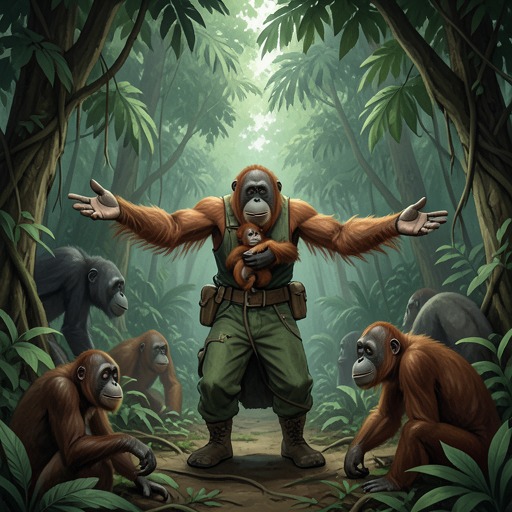
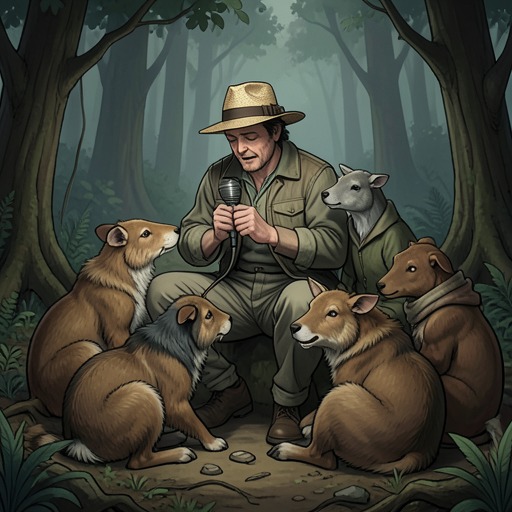
When Kensuke recognizes the returning boat as one associated with men who kill gibbons and take young orangutans, he urges Michael to help bring the animals into the cave. Kensuke gathers them by singing, and they emerge from the forest in groups. Fifteen orangutans have been found, but four are still missing. Three more arrive as Kensuke continues to sing; only Kikanbo remains unaccounted for.
Kensuke sings for him repeatedly in a clearing, surrounded by the orangutans, but Kikanbo does not come. The sound of an outboard motor and the voices of the approaching men make the delay increasingly dangerous. Kensuke decides they cannot wait any longer and leads the others toward the cave. Michael has to carry two younger orangutans who are more interested in playing than following, while looking back and calling for Kikanbo. Kikanbo’s absence thus affects the rescue itself: the group must retreat without knowing whether he is safe.
Return and Aftermath
After the attack, Kensuke and Michael search the island and call and sing for Kikanbo, but initially find no sign of him. Kensuke is left in despair. Their search takes place alongside the discovery of two dead mother gibbons, whose bodies they bury at the edge of the forest. The loss of the gibbons makes the uncertainty about Kikanbo especially painful: the animals they had tried to shelter have not all escaped the hunters.
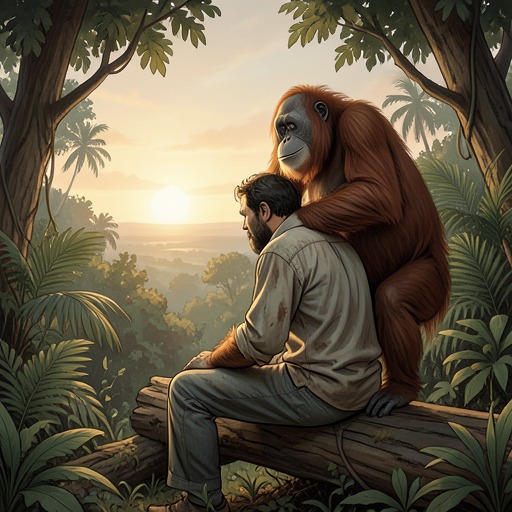
As Kensuke and Michael make their way back along the beach, Kikanbo suddenly charges out of the trees and climbs up Kensuke’s leg, wrapping himself around his neck. His return resolves the immediate fear that he was taken or lost, and the narration emphasizes the moment as a profound one. Relief does not erase the deaths of the gibbons, but it gives Kensuke and Michael a reason to rejoice together. That night they sing “Ten Green Bottles” over fish soup, making the song both a memorial for the dead gibbons and a celebration of Kikanbo’s return.
The raid continues to shape what happens afterward. Kensuke broods over the danger and builds a stout bamboo cage at the back of the cave to shelter the orangutans more securely if the hunters return. He also arranges for branches and brush to conceal the cave entrance. Kikanbo’s escape is a relief, but his absence during the gathering has shown how vulnerable a wandering young orangutan can be when the animals face organized human threats; the protective measures are a response to that vulnerability as much as to the raid itself.