Michael Stranded on the Island After Being Lost at Sea
Kensuke's KingdomMichael Stranded on the Island After Being Lost at Sea marks the abrupt change from a family voyage aboard the Peggy Sue to Michael’s isolated struggle for survival. After a night-time fall leaves him adrift, he reaches an island with Stella Artois but without his parents, a boat, or a visible means of rescue. The island first seems empty; its actual inhabitant, Kensuke Ogawa, soon makes survival possible while forbidding Michael to approach him. That enforced separation gives way, slowly and unevenly, to companionship, revealing that being stranded is not only a physical predicament but the beginning of a difficult new relationship.
The Fall and the Arrival
Michael’s danger grows out of a voyage already marked by strain. The Peggy Sue has endured severe storms, and, after leaving Sydney, repeated bad weather has carried the boat north across the Coral Sea. Its rudder cable has snapped and its self-steering no longer works, so someone must remain at the wheel. Michael’s mother is suffering worsening stomach cramps, cannot eat, and has been unable to study the charts for three days. His father and Michael share the navigation, but they fear they have lost track of their position. On the calm night before Michael’s twelfth birthday, he is on watch with Eddie Dodds’s soccer ball beside him, hoping his mother will recover and knowing the family cannot afford another storm.
When the separation comes, it is sudden. Michael goes forward to retrieve Stella Artois, who is reluctant to leave the bow. He recognizes that he is without his safety harness and life jacket, but before he can reach for the guardrail the boat veers and throws him into the sea. The Peggy Sue’s lights disappear into the darkness. Michael expects his cries to go unheard and believes there is no hope of rescue. In the water, he mistakes the pale soccer ball for Stella, then realizes what he has found and clings to it for buoyancy. He must eventually stop calling for the dog and concentrate on saving himself.
Michael’s first imagined rescue is a dream: he pictures the Peggy Sue returning and his family hauling him aboard. He wakes instead on sand. Stella is alive and comes out of the shallows to greet him, but the sea and sky are empty, and there is no sign of his parents or their boat. His confused memory of being rescued proves unreal; he concludes that the ball kept him afloat until the sea carried him ashore. The ball itself is gone. His survival is therefore also a bewildering loss: he has Stella, but no explanation of where he is or how he can get home.
An Island Without a Way Out
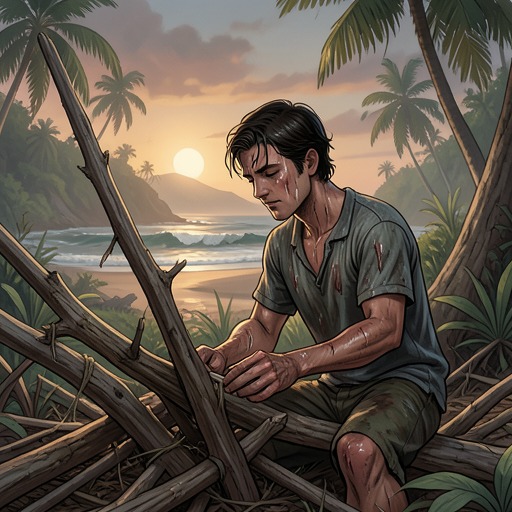
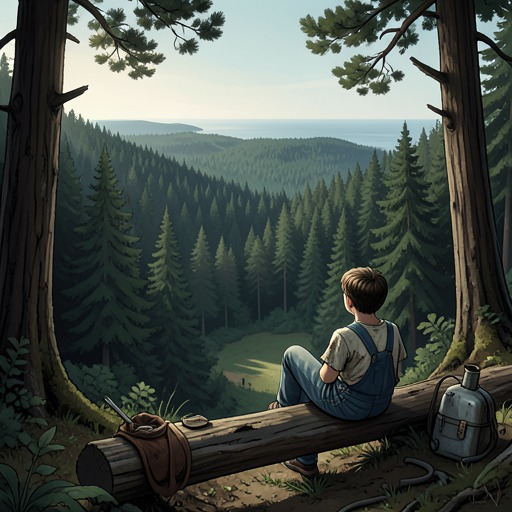
The first sounds Michael recognizes on the island are the gibbons calling in the forest. Their cries offer a clue to the life around him but no answer to his immediate need for help. He and Stella enter the trees, and the short walk becomes an exhausting journey through unfamiliar ground. When he reaches a high point, the view leaves no doubt about his situation: sea surrounds the island on every side, with no sail in sight. He estimates that the island is only two or three miles long. It is forested, with two hills and broad white beaches, and he sees no sign of human life.
Even in that moment of fear, Michael is struck by the island’s beauty. The green, forested land and white shore set against the sea do not erase the fact that he is alone, but they complicate his response: he feels unexpectedly elated to be alive, and Stella is alive too. The island thus appears both as a place of remarkable beauty and as an enclosure with no evident exit. The view confirms his isolation while giving him a reason, at first, to think that he and Stella might endure it.
Michael tries to turn that hope into a plan. He tells Stella that his parents will return, that his mother will get better, and that the two of them must keep watch and stay alive. Water comes first, followed by food; he reasons that if the animals can find water, so can they. Stella’s presence matters in practical and emotional terms: talking to her helps steady the panic that rises in waves, and their companionship supports him through his first hours ashore. Rather than immediately enter the forest, he decides to search along the shore for a stream and something to eat.
That confidence does not last unchanged. With no ship visible and no known way off the island, Michael begins to imagine that he might remain there for the rest of his life. He is frightened by the insects and forest noises, misses his parents, and thinks of the reservoir and his mother laughing in her skipper’s cap. The cave where he shelters begins to feel like home only because there is nowhere else for him to go. He describes himself as feeling like an orphan, abandoned and alone, an image that makes clear how completely the loss of contact has unsettled his sense of belonging.
Kensuke’s Rules and Michael’s Dependence
Michael discovers that the island is not uninhabited when he first tries to make a fire. Kensuke extinguishes it and makes plain that Michael must keep to one end of the island and never light fires. The prohibition is more than a personal restriction: Michael understands that a fire might draw people to the island, endangering the man who has been living there and the animals in the forest. But he does not know this when the rule is imposed. From his perspective, the contradiction is bewildering: the same hidden stranger who has provided fish, bananas, and water now banishes him and refuses to meet him.
The supplies reveal the terms of Michael’s survival. Each morning he finds food and water set out for him and Stella, with an upside-down tin protecting them on a rock shelf. Kensuke keeps both alive, but the care is conditional: Michael must remain on his side of the island and obey the ban on fire. Kensuke marks a boundary in the sand from the forest down to the sea on both sides and renews it as needed. Stella crosses it sometimes, but Michael respects it. He is afraid of Kensuke, whose hostility and large knife make a confrontation seem dangerous, and he has too much to lose to risk the daily provision on which he depends.
The arrangement neither makes them friends nor leaves Michael free. He continues looking for food himself, finding some edible fruit, including a prickly fruit he later learns is rambutan, but not enough to rely on. Coconuts are difficult to find intact, and their contents are sometimes spoiled. As the prospect of quick rescue fades, he becomes more resigned to accepting Kensuke’s terms. His dependence is practical, but it also heightens his frustration: he is kept alive by someone who will not explain himself, and the person’s help comes with a boundary Michael cannot understand.
A four-day typhoon intensifies the island’s dangers. Michael and Stella shelter in the cave while rain and powerful waves keep them from going out. Even through the worst of the storm, their fish-and-fruit breakfast waits beneath Kensuke’s tin each morning, continuing the pattern of care without conversation. When the weather clears, Michael climbs Watch Hill looking for a ship and finds none. His own beacon remains intact but sodden, so he cannot light it until it dries. The scene brings together the two opposing forces shaping his life there: the recurring hope of rescue and the immediate limits imposed by weather, isolation, and Kensuke’s rules.
Disobedience, Rescue, and New Understanding
The boundary eventually becomes a point of open conflict. Angry at Kensuke, Michael deliberately crosses the line and swims, insisting that the sea belongs to him as much as to the old man. His defiance puts him directly in danger. Kensuke appears at the forest’s edge, calling and waving his stick, but Michael is stung by a jellyfish and loses the ability to swim back to shore. His belief that he can reject Kensuke’s rules collides with the danger of the sea and with his ignorance of the island’s hazards.
Michael wakes in Kensuke’s cave, unable to move freely and in great pain. The smell of vinegar brings to mind home and his father’s Friday fish and chips, while smoke and a sleeping mat make clear that he is not in his own shelter. Only later does he learn how he was saved. Kensuke explains that he recognized the jellyfish as dangerous and used vinegar he had made from berries to treat him. He carried Michael to the cave and cared for him through a long illness. What Michael had understood as control and rejection included, at its center, a rescue he could not have managed by himself.
Kensuke’s account also explains why he first kept Michael at a distance. Hunters had come to the island armed with guns, hunting the orangutans and shooting gibbons. Kensuke hid the orangutans in his cave and sang to bring them to safety, but the hunters killed gibbon mothers and took babies. He came to think of people as killers and wanted no further human contact. When Michael arrived, Kensuke feared that another person might attract danger to the island, the wildlife, and himself. The ban on fire, the boundary, and his refusal to speak were expressions of that fear, even though Michael initially experienced them only as inexplicable hostility.
The story of Kensuke’s own arrival deepens the reversal. He had gone fishing for a large fish to smoke, but the wind and sea carried his boat away from the island. Alone at sea, he sang to keep himself brave; hearing a shout and seeing a light, he went toward them and found Michael, Stella, and the soccer ball. Kensuke brought them back near the island, then set Michael and Stella on the beach with food and water because he wanted to remain alone. His account transforms the night Michael thought he had been abandoned at sea: the unseen stranger he feared had been the person who found and saved him.
From Stranded Child to Chosen Family
The island’s forced proximity changes both men, but it does not make their wishes identical. Kensuke eventually tells Michael that he had hated him at first and wanted him to leave, yet came to regard him as a son. Michael, in turn, becomes a companion whom Kensuke can speak with, paint with, and fish with. Kensuke calls them happy together and describes Michael as family. Their connection develops through care and shared activity, but the earlier conflict remains significant: their bond is not an instant erasure of fear or grief, but a relationship built after Michael has experienced Kensuke’s rules, rescue, and explanation.
Kensuke’s own sense of home helps define the difference between them. He says that he has chosen to stay on the island, where he has lived alone for many years, whereas Michael wants to cross the sea and return home. Kensuke understands that Michael’s mother may still be searching and that Michael may be absent when she finds him; he connects that possibility with his own continuing memories of Kimi and Michiya. His family, though he believes them dead, remains present in his mind. Michael’s longing for his parents and Kensuke’s remembrance of his family therefore meet without becoming the same desire: Kensuke can love Michael as a son and still know that Michael’s right course is to return to his own family.
The state of being stranded consequently changes from an immediate crisis into a test of what survival and belonging require. At first, Michael’s horizon contains only empty sea, a missing soccer ball, and the hope that his parents will come back. Then Kensuke’s daily food and water keep him alive, the boundary constrains him, and the rescue after the jellyfish sting forces him to recognize the human care behind an apparently hostile regime. The island does not replace home, but it gives Michael a new relationship to carry beyond it. His survival depends not only on staying afloat and finding shelter, but on discovering the person behind the rules and learning that attachment can form even in a place neither of them first imagined sharing.