Michael and his father
Kensuke's KingdomMichael and his father’s relationship changes from ordinary parenthood into a close partnership shaped by the family’s voyage aboard the Peggy Sue. His father’s decision to take the family to sea creates the conditions for that change: Michael becomes his friend and shipmate, and the two learn to rely on one another through demanding passages, shared responsibilities, and the long absence that follows Michael’s disappearance.
From family plan to shipmates
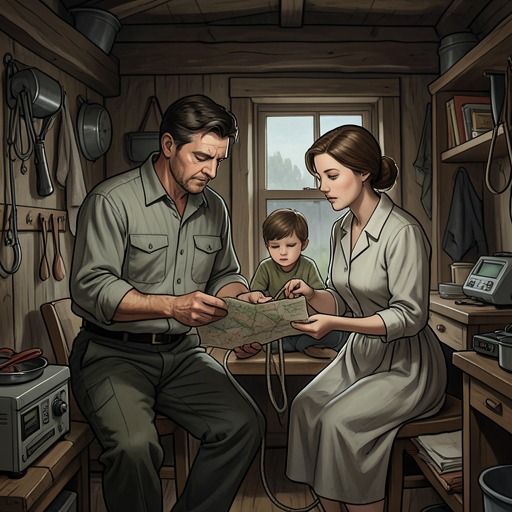
When Michael’s father announces that he has found a place for the family near the sea, he presents the move as a decision already made. He greets Michael and his mother at the station in Fareham, bright-eyed and laughing, helps with their suitcases, and promises that he has worked out the whole plan. The proposal is to buy a boat and sail around the world. His wife asks what will happen to Michael’s schooling; his father has already approached a local school and says that he and Michael’s mother will teach their son, while the voyage itself will also be an education. His wife agrees, and he reveals that he has already bought the boat.
The family’s new closeness is practical as well as emotional. Living in the confined space of a boat, Michael comes to see his parents as more than parents: his father becomes his friend and shipmate. They depend on one another, and the trust is tested by the sea rather than merely declared. In rough water, father and son share their fear without speaking; surviving the waves together makes them more confident in themselves and in the boat.
Michael’s father also makes room for play and reassurance amid the work. When Michael’s mother corrects them for failing to keep the boat shipshape, his father winks at him, and the two let the reprimand pass. The gesture marks a small alliance, but it does not undermine the family’s responsibilities: Michael’s mother is the skipper, and father and son accept her authority and have confidence in her. Their place in the crew is part of a larger family partnership, with each taking a role in keeping the voyage going.
A partnership tested at sea
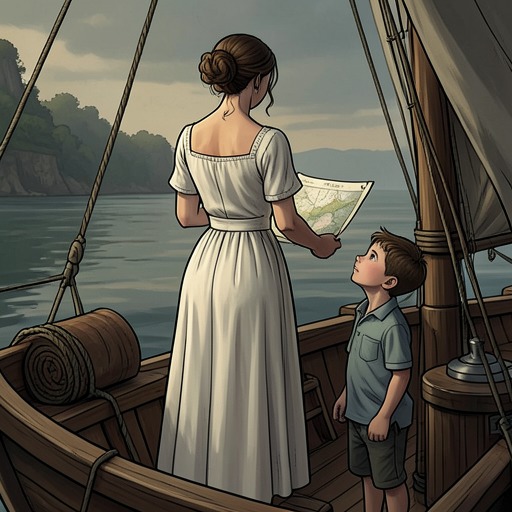
The voyage begins on September 10, 1987, after the Peggy Sue has been loaded with stores and provisions. Michael’s father is one of the adults who takes watch during the first nights after leaving Southampton, while Michael is not yet allowed to stand watch. As the journey continues, the father and son share the demands of sailing and the uncertainty of weather. In Michael’s log, his father’s presence appears in both routine and emergency: he repairs the rudder cable at La Coruña, and later the family faces storms that drive the boat across the Coral Sea.
Their companionship has an easy domestic rhythm as well as a working one. When Michael’s mother is snappy, his father’s wink helps Michael and him move on; when conditions are calm enough, the parents play chess. Michael keeps score, noting that his father leads his mother five games to three, though she says she does not mind losing. These details show Michael watching his parents as people sharing a life at sea, not only as authorities responsible for him.
The family’s progress also becomes something father and son can claim together. When they sight Australia off Perth after crossing empty ocean from Africa, they hug and jump with excitement. They have sailed from England to Australia, halfway around the world, under their own effort. Their achievement gives concrete shape to the confidence built at sea: Michael is no longer simply accompanying his father’s plan but participating in a demanding journey they have made together.
Care and danger
The partnership is most sharply tested when Stella Artois falls overboard in the Indian Ocean. The family has practiced the man-overboard drill many times, and Michael joins the rescue by shouting and pointing while his father lowers the sails and turns the boat back. On the first attempts, the Peggy Sue passes Stella without reaching her. Michael’s father leans over to grab her but is not wearing his safety harness, prompting Michael’s mother to reprimand him. On a final approach, the family brings Stella close enough for him to reach, and all three haul her aboard. His praise for Michael follows the rescue; his wife’s concern about his safety follows immediately. Their roles converge in the crisis: the father acts, the son helps, and the mother keeps the boat under control.
Later, the voyage’s shared confidence gives way to exhaustion and uncertainty. By July 28, the night before Michael’s twelfth birthday, repeated storms have pushed the Peggy Sue north across the Coral Sea. The rudder cable has failed, the self-steering no longer works, and someone must stay at the wheel. Michael’s father has done what he can to repair the cable, but the boat is still difficult to steer. With Michael’s mother seriously ill, father and son navigate together, though Michael fears they may no longer know where they are. His father wants to send a Mayday call, but his mother refuses; the decision and the strain of keeping the boat moving place the whole family under pressure. Michael sits at the wheel with Eddie Dodds’s soccer ball beside him, while his exhausted parents sleep below.
When Michael is swept from the Peggy Sue, the relationship is broken apart by distance and presumed loss. Alone in the dark water, he fears that the boat has gone too far away to hear him and that no one can save him. The account emphasizes the sudden isolation that follows his accidental fall; it does not show his father’s immediate response in that moment. The later reunion makes the separation’s duration clear: Michael’s parents spend almost a year searching for him, island by island. His father eventually admits that he had given Michael up for dead, unlike Michael’s mother, who continued to believe her son was alive.
Reunion and the meaning of home
When the Peggy Sue finally reaches the island, Michael first watches from the trees as his parents come ashore. His mother recognizes him, embraces him, and repeats that she had said they would find him. His father’s first words are the familiar greeting, “Hello, monkey face.” The affectionate nickname carries the sound of their earlier life together into a reunion after a year of uncertainty; it is a small, recognizable sign that their closeness has survived the separation.
The father’s welcome also completes a contrast in the relationship. At the beginning, his confidence gathers the family around a bold voyage; after Michael disappears, that same father has to confront the possibility that the boy will not return. The mother’s faith sustains the search, but the father takes part in it, sailing from island to island until they find their son. The reunion is therefore not simply a return to the voyage’s starting point: it confirms both the cost of losing Michael and the persistence of the family bond.
Narrative significance
Michael’s account of his father is shaped by the ship’s log and by the retrospective voice of the adult who can still read the boy’s entries. The log turns shared life into a record of specific duties, weather, repairs, and discoveries: it registers the father as a companion through daily routines and as a fellow sailor when the family faces danger. Michael’s recollection of his father’s gestures—the wink during a reprimand, the effort to repair the rudder, the reach toward Stella, and the greeting on the beach—makes their relationship legible through action rather than explanation.
The bond also gives the story’s changing geography an emotional measure. The voyage from England to Australia is a family achievement; the storm-battered crossing of the Coral Sea becomes a test of shared responsibility; the island and the nearly year-long search turn separation into the central fact of the family’s life. At the end, the father’s familiar words reconnect the rescued Michael to home. Their relationship is defined not by an unchanged closeness but by what it can withstand: work, fear, distance, and the uncertainty of whether they will see one another again.