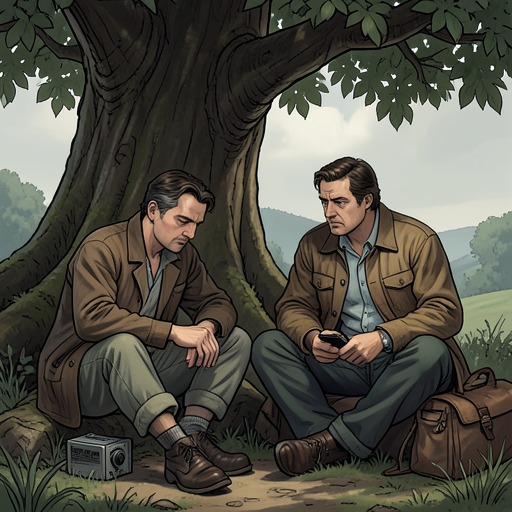
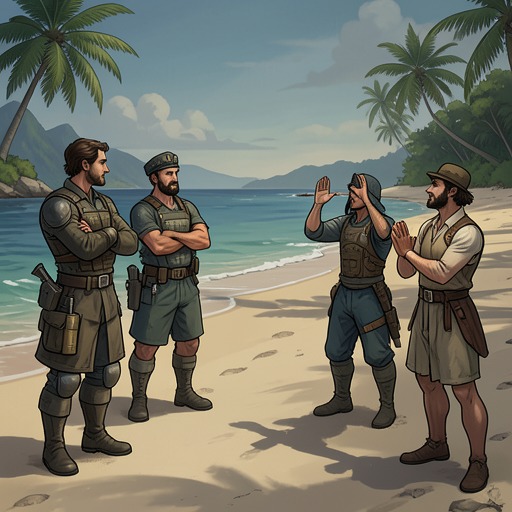
Michael meets Kensuke and is confined to one end of the island
Kensuke's KingdomMichael’s first encounter with Kensuke transforms an apparently empty refuge into a contested home. After Michael mistakes Kensuke for an orangutan and lights a fire in the hope of attracting a ship, the old man puts it out, names himself as the island’s owner, and draws a line that confines Michael to one end. What first appears to be arbitrary hostility is later explained by Kensuke’s fear that human visitors will endanger the island’s animals—and by the losses that have led him to avoid people.
The Apparent Orangutan
Michael has been trying to start a fire, hoping its warmth and smoke will help him endure the island and signal a passing ship. While Stella waits beside him, an animal emerges from the forest: large, brown, and moving on all fours. Michael identifies it as an orangutan. It sits nearby, regards him, then returns to the trees, leaving Michael to wonder whether the animal is responsible for the howling he has heard.
The encounter changes meaning when Michael returns from gathering wood. The fire has dwindled, and the figure he had taken for the orangutan is crouched beside it, scooping sand over the flames. As the figure approaches, Michael realizes it is a man. The mistake makes the encounter a reversal: the island’s unseen presence is neither simply wildlife nor an animal threat, but a person who has already been close enough to interfere with Michael’s attempt to attract rescue.
A Name and a Boundary
The stranger is a small, very old man dressed in tattered breeches, carrying a large knife and a stick. He is visibly angry and calls out at Michael, who cannot understand him. The tension eases when the man asks whether Michael is American or British. Michael answers that he is English, establishing their first limited point of communication.
The man explains that fire is no good and that Michael must not make one. Michael tries to explain that his parents may see the smoke and come for him, pointing out to sea, but the old man becomes angry again. His response is not merely to forbid the fire verbally: he uses his stick to draw in the sand. The marks resolve into a map of the island, with its two hills and a straight division cutting off the smaller end from the larger.
Pointing to the smaller end, where Michael’s cave is, the man assigns the boy a place there. He taps his chest and says, “Kensuke. I, Kensuke. My island.” Then he marks the division sharply and repeats that Kensuke belongs on one side and the boy on the other. He orders Michael away and forbids fire again. Michael does not argue; after he leaves, Kensuke kneels beside the embers and covers them with more sand until the fire is completely extinguished.
Immediate Consequences
Stella’s behaviour complicates Michael’s first impression of the encounter. She had growled at the orangutan, but does not bark at Kensuke; instead, she greets him like an old friend and is reluctant to leave his side. Michael calls her back and feels disappointed, even betrayed, by her evident familiarity with the stranger. Her recognition suggests a connection between Kensuke and the dog that Michael does not yet understand.
Michael spends the rest of the day in his cave, where he feels safe and has begun to think of the shelter as home. Yet the safety is uneasy. He believes that Kensuke may be the person who left him fish, bananas, and water, acts he had read as kindness or welcome. The same man has now banished him to one end of the island and made clear that he does not want them to meet. Michael cannot reconcile the care with the rejection and wonders whether Kensuke is mad.
The prohibition also threatens Michael’s plan for rescue. A visible fire seems to him the most direct way to draw a passing ship’s attention, while Kensuke’s rule removes that possibility. Michael sees himself as marooned in the middle of nowhere, with no assurance that anyone will find him; the island’s human presence offers neither explanation nor immediate companionship. The boundary thus gives practical form to the central conflict of their first meeting: Michael wants to make himself visible to the outside world, while Kensuke wants that world kept away.
The Rule Reconsidered
Kensuke later explains the history behind his anger. Hunters had come to the island armed with guns. Kensuke hid with the orangutans in his cave, but the hunters shot gibbons, killing mothers and taking their young. He came to think of people as killers and did not want to see anyone again. When Michael arrived, Kensuke carried him from the sea, left him food and water so he would not die, then tried to keep him on the beach and prevent the fire from drawing others to the island. The line in the sand was therefore a boundary of protection as Kensuke understood it, though Michael experienced it as confinement and rejection.
Kensuke’s later account also clarifies why he had intervened in Michael’s movements. After a storm, he knew the sea was full of dangerous jellyfish and ordered Michael not to swim. When Michael was stung, Kensuke brought him into the cave and treated him with vinegar he had made from berries. These actions reveal that the man who had forbidden fire and marked a boundary was also watching over Michael’s survival. The initial prohibition is neither erased nor made simple: care and control coexist in Kensuke’s conduct, shaped by his fear that people will bring violence to the island.
From Separation to Trust
The first meeting establishes a division that later becomes a relationship. Kensuke admits that he initially hated Michael and wanted him gone, but says that after a little while the boy became like a son to him. The two eventually fish, paint, and live together as a family; Michael accepts that description. What began as a map separating their places is replaced by a shared life, built through practical cooperation and Kensuke’s eventual willingness to explain his past.
The conflict over separation returns when rescue becomes possible. Kensuke recognizes that Michael wants to go home, even though he himself wants the boy to stay. He decides that Michael cannot spend his life on the island with an old man who will die, and agrees to help build a large fire so a ship can find him. When the Peggy Sue returns, however, Kensuke chooses to stay. He calls the island his kingdom and himself responsible for its orangutan family, while asking Michael to remember him and keep his existence secret for ten years. The original line in the sand anticipates this final division: Kensuke and Michael’s bond is real, but their homes and responsibilities lead them in different directions.