Michael’s father
Kensuke's KingdomMichael’s father is a hands-on repairman who responds to the closure of the brickworks not by settling for what little security remains, but by proposing that his family sail around the world. The voyage remakes his relationship with Michael: father and son become companions who share watches, danger, and decisions. Yet the limits of hope emerge after Michael is lost at sea. His father eventually gives him up for dead, while Michael’s mother continues searching; the eventual reunion does not erase that difference, but completes a family story shaped by movement, endurance, and faith.
Identity and Background
Before the voyage, Michael’s father works at the brickworks, where the brick dust contrasts with the clean air he enjoys while sailing. On family trips in a dinghy, he is in his element on the water and is described as a committed do-it-yourself enthusiast, the sort of man who will fix anything, whether or not it needs fixing. That practical confidence becomes important when the family must decide what to do after the brickworks closes and both parents lose their jobs.
The closure changes the family’s circumstances, but it also releases a dream his father had entertained for years. He explains that factory work had left him dreaming of a larger life, while unemployment made him ask whether the family should preserve its severance pay and savings or use them for something extraordinary. The plan is not presented as a sudden whim: his father has read about blue-water sailing and imagines a route through Africa, South America, Australia, and the Pacific. He acknowledges the risks and the family’s limited experience, but insists he has thought the decision through.
From Family Skipper to Shipmate
At the beginning of the voyage, Michael’s father appears newly animated. When the family arrives in Fareham, he is waiting at the station, bright-eyed and laughing, carrying the suitcases and teasing Michael with the familiar nickname “monkey face.” His excitement gives the move a sense of momentum before the family even sees the boat. At the marina, he reveals the Peggy Sue as their new home; his confidence has brought the family to a threshold between the familiar reservoir and the open sea.
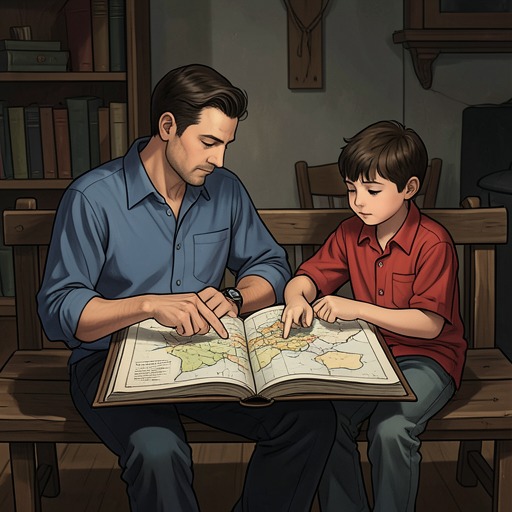
The voyage makes the relationship between father and son more equal in practice, even as Michael remains a child. Living close together aboard the yacht, they become friends and shipmates, relying on one another rather than relating only as parent and son. Their shared fear during enormous waves is part of that change: Michael describes them silently confronting the danger together, descending into deep troughs and climbing out again. Repeated survival makes them more confident in each other and in the boat.
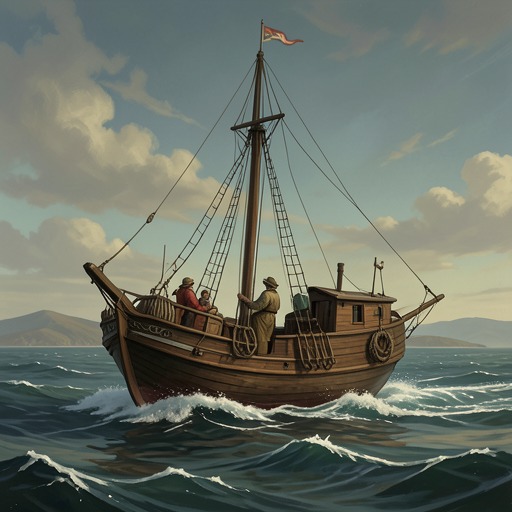
The family’s roles aboard the Peggy Sue are distinct. Michael’s mother masters the books and charts through sustained work and serves as skipper; Michael’s father and Michael take their places as first mate and ship’s boy. His father is not the family’s sole authority at sea, but a dependable member of a working team. On September 10, 1987, with the yacht loaded with stores and provisions, the family finally sets off. Michael’s father has helped turn the dream into a shared undertaking, and the ship’s log preserves the date as the beginning of their odyssey.
Life Aboard the Peggy Sue
The ship’s log presents the voyage through the changing scale of a child’s experience: watches, weather, wildlife, and the shifting distance between ocean and land. On October 11, the family sees Africa from the yacht. Michael’s mother explains their course down the west coast and across the Atlantic, while his father appears sunburned, with the skin peeling from the tops of his ears. These details place him inside the daily physical life of the journey, not just behind its original decision.
After the long ocean passage from Africa, the family reaches Australia. Off Perth, Michael records the contrast between loving the solitude of the sea and the exhilaration of sighting land. The family hugs and jumps at the sight of Australia, celebrating that they have sailed from England halfway around the world by themselves. The achievement belongs to the family team his father helped set in motion. Yet the arrival also brings a pressing concern: Michael’s mother’s stomach cramps have returned, and she promises to see a doctor in Australia.
By July 28, after the family has left Sydney, their circumstances have become much more precarious. A succession of storms has driven the Peggy Sue north across the Coral Sea; the rudder cable has snapped, and the self-steering no longer works. Someone must remain at the wheel, so Michael’s father or Michael has to take the watch while Michael’s mother is ill. His father wants to send a Mayday call, but she refuses, understanding it as giving in. With the mother unable to consult the charts, father and son navigate together, doing their best while uncertain of their position. The contrast with the triumphant landfall in Australia is stark: the same voyage that has proved the family’s resourcefulness now tests the limits of their knowledge and strength.
Michael’s Disappearance and the Search
When Michael disappears, his father’s confidence as a sailor cannot protect him from the uncertainty that follows. The novel ultimately reveals that he searched for nearly a year with Michael’s mother, sailing from island to island in the hope of finding their son. Their search continued despite other people’s disbelief that Michael could still be alive. His father, however, later admitted that he had given Michael up for dead; Michael’s mother never did, remaining certain that her son had survived.
The parents finally reach the island aboard the Peggy Sue. Michael sees the yacht come in and recognizes that his mother and father are on board; after watching from the edge of the forest, he runs down to meet them. His mother cries and embraces him, repeating that she had said they would find him. His father’s first words are the familiar greeting “Hello, monkey face.” The return of that private nickname makes the reunion intimate as well as momentous: after almost a year of searching and separation, the father addresses the boy he knew before the sea intervened.
Character and Narrative Significance
Michael’s father joins practical skill to appetite for possibility. Fixing things and managing a household boat belong to the same character as imagining a voyage across oceans; unemployment does not simply diminish his role but prompts him to commit the family’s limited resources to a different future. The expedition then turns that bold decision into lived responsibility, requiring him to share danger, keep watch, and navigate with his son when illness and damage leave the family exposed.
His admission that he had believed Michael dead prevents the search from becoming a simple tale of unbroken certainty. He and Michael’s mother persist together, but their inner responses differ: she holds to faith, while he acknowledges despair. The reunion restores their family in person, while the account preserves the cost of the absence and the distinction between hope and what a person can bear to believe. For Michael, his father is at once the dreamer who launched the voyage, the shipmate who shared its ordeals, and the parent whose return makes home visible again.