Michael’s mother
Kensuke's KingdomMichael’s mother turns a family’s abrupt loss of work into a voyage around the world, then becomes the emotional force behind the search that brings Michael home. A keen sailor who masters navigation and charts, she is both the Peggy Sue’s skipper and a parent whose resolve is tested by illness, storms, and the apparent loss of her son. Her story links the family’s life at sea to the book’s insistence that hope can outlast what others call impossible.
Identity and Background
Before the voyage, Michael’s mother works part-time in the office at the brickworks, alongside Michael’s father, who works there too. On Sundays the family sails a dinghy on the reservoir. She is already the undisputed skipper: in her blue cap, she finds the breeze and catches it, even when the outing is rough or the family is the only boat on the water. Michael remembers her throwing back her head in the wind at the tiller and celebrating the freedom of sailing. Those reservoir days establish the pleasure and practical confidence that will later underpin the much greater undertaking.
The family’s circumstances change when the brickworks announces its closure and both parents are laid off. Michael’s father proposes using their severance pay, savings, and money from the car to buy a boat and sail around the world. The plan is a response to unemployment, but also a gamble: the family has sailed only dinghies and has limited means. His mother does not simply follow his enthusiasm. She is included as the intended skipper, and the expedition depends on her acquiring the expertise to lead it.
Becoming Skipper of the Peggy Sue
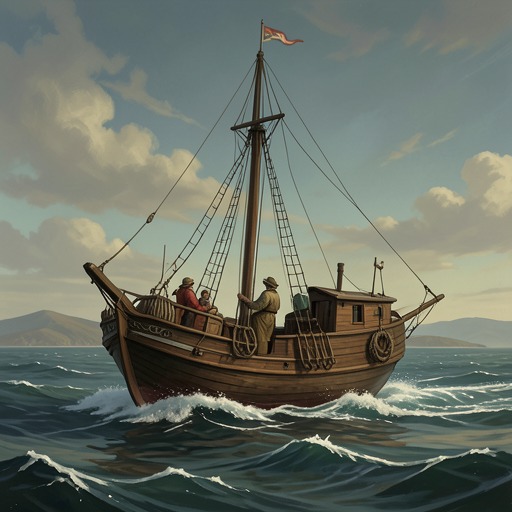
The plan gives Michael’s mother a demanding role. During six months of preparation, she is to earn her Yachtmaster’s certificate, while the family trains and learns the forty-two-foot Bowman they have bought. Michael’s father assigns himself the first mate and handyman’s place and Michael the role of ship’s boy. His mother agrees to the voyage after hearing the plan, and the boat is already purchased when she gives her assent. Their decision joins financial desperation to a deliberately chosen adventure: rather than watch their limited money dwindle, they set out to make a once-in-a-lifetime journey of it.
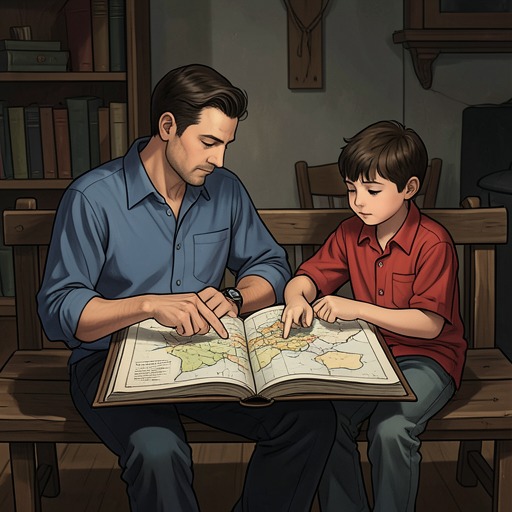
Preparation brings a change in how Michael sees her. She works night and day over books and charts until she has mastered them, and the family comes to trust her completely. She can be a tyrant about keeping the boat shipshape, but Michael and his father accept that discipline because she is the skipper who will take them around the world and back. The three become a close working crew, handling the winches, the helm, and the galley together.
On September 10, 1987, the family finally sails, with the boat stocked in every nook and cranny. Michael’s grandmother and friends gather to wave them off; as the Peggy Sue passes the Isle of Wight, the departure ceases to be a dream and becomes a real voyage. The ship’s log gives the journey its documentary shape. Michael, then eleven, records it in short entries that preserve both the route and his changing experience of the sea.
A Route Made of Discovery and Danger
On October 11, Michael’s mother identifies Africa in the distance and traces the family’s route down its west coast on the chart. From there, the wind will carry them across the Atlantic toward South America; she also warns that drifting off course could leave them becalmed in the Doldrums. The moment shows her navigating not only by experience but by explaining the geography and risks to Michael. His account places chart work beside the day’s heat, flying fish, and a shark sighted off the port bow, making the vast route legible through the family’s daily observations.
By April 3, the Peggy Sue is off Perth, Australia, after a long stretch of empty ocean from Africa. The family celebrates sighting land by hugging and jumping, recognizing that they have sailed from England to Australia and crossed halfway around the world on their own. Yet the arrival also sharpens concern about Michael’s mother: her stomach cramps have returned, and she promises to see a doctor in Australia. The achievement and the illness occupy the same entry, so that the voyage’s progress does not erase the body’s growing vulnerability.
The dangers intensify after the family leaves Sydney. Repeated storms drive the boat farther north across the Coral Sea; the rudder cable snaps, and the self-steering stops working. Someone must remain at the wheel, leaving Michael and his father to share the work because his mother is too sick. Her cramps are now much worse, she cannot eat, and for three days she has been unable to study the charts. Michael’s father wants to send a Mayday call, but she refuses, regarding it as giving in. The refusal reveals both the force and the cost of her resolve: the family continues without calling for help even as illness and mechanical failure undermine its ability to navigate.
Illness, Separation, and the Search
On the dark, calm night before Michael’s twelfth birthday, he is alone on watch while his parents sleep below. The stormy passage has left his father exhausted, his mother seriously ill, and the boat’s navigation uncertain. Michael keeps Eddie Dodds’s soccer ball beside him as a lucky object and hopes his mother will recover, recognizing that the family is in real trouble. Her absence from the charts, once an ordinary working responsibility she had mastered, has become a measure of how much the voyage depends on her and how precarious it is when she cannot take part.
After Michael disappears, his parents face a different ordeal on shore and at sea: finding a child whom others believe cannot still be alive. They search from island to island for almost a year. Michael’s father later admits that he had given up hope, but his mother never did; she was certain in her heart that Michael was alive. The distinction is central to her character. The determination that once kept her at the helm now directs the search, even when other people dismiss the possibility of success.
Return and Narrative Significance
When the Peggy Sue finally reaches the island, Michael sees his parents aboard after saying goodbye to Kensuke. His mother cries and hugs him, repeatedly recalling that she had said they would find him. The reunion answers the prolonged uncertainty with physical contact and recognition: the mother who refused to accept his presumed death is at last holding her son again. Michael’s father’s affectionate greeting accompanies her tears, but it is her sustained certainty that the narration identifies as the reason they kept searching.
Michael’s mother’s arc moves from competent local sailor to the leader of a transoceanic voyage, through illness that temporarily removes her from that role, and into a search sustained by faith when the voyage has become a family separation. Her character is not defined by unbroken physical strength: the worsening cramps leave her unable to eat, steer, or work at the charts. Rather, the narrative places those limits beside her continuing refusal to surrender, first during the storms and later in her insistence that Michael is alive. The Peggy Sue’s route from England toward Australia and the parents’ subsequent island-to-island search form two kinds of movement: one chosen in the hope of adventure, the other driven by the need to restore the family. The reunion makes the mother’s conviction more than private consolation; it has carried the search to its end.