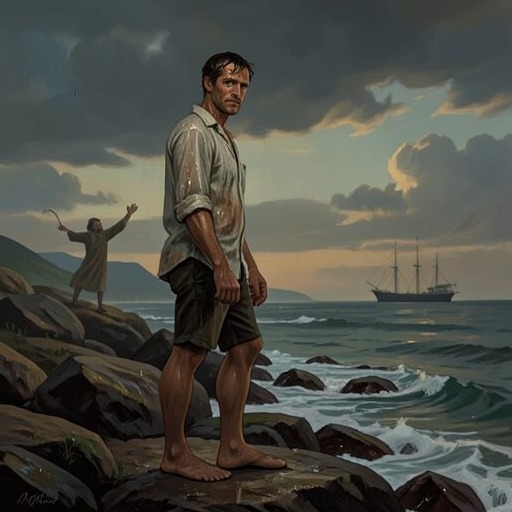
No Fires Allowed
Kensuke's KingdomNo Fires Allowed is Kensuke’s prohibition against Michael making a fire on the island. First stated as an absolute command, it prevents Michael from using smoke to attract rescuers and helps Kensuke preserve the isolation he believes protects him and the island’s animals. The rule is both a practical safeguard and a source of conflict: Kensuke provides for Michael while limiting his movement and choices, and Michael sees the ban as part of what keeps him from going home. Its eventual reversal, when the two build a rescue beacon together, marks a change from imposed protection to care that respects Michael’s need to leave.
The Prohibition and Its Purpose
When Michael tries to make a fire, Kensuke approaches and struggles to explain that fire is not allowed. Michael points out to sea, hoping his parents might see the smoke and come for him, but Kensuke does not understand his explanation. He draws a map of the island in the sand, marks the hills, and cuts off Michael’s end from the larger portion. Pointing to himself and declaring the island his, Kensuke sends Michael back toward his cave and covers the fire with sand.
Michael initially does not know why Kensuke is so determined to extinguish the fire. He still has fireglass, so after returning to his cave he resolves to try again somewhere Kensuke will not find him. The prohibition is thus established not by agreement but by Kensuke’s authority over the island and Michael’s dependence on his provisions. Kensuke gives Michael food and water, but also draws a boundary and insists that he obey.
Kensuke’s later explanation makes the purpose of the rule clearer. He had hidden from American soldiers during the war and heard them say that everyone had died in Nagasaki. He believed people might come to the island, shoot the orangutans and gibbons, or find and take him away. When Michael arrived, Kensuke wanted people to stay away; a fire might reveal the island’s location. His concern for the animals and for his own peace gives the prohibition a protective rationale, but it does not erase its cost to Michael, who is stranded and wants to be found.
Rescue, Dependence, and Resistance
The conflict becomes sharper when a supertanker crosses the horizon. Michael stands on Watch Hill and waves and shouts, but the ship continues without turning. He thinks that a fire might have made him visible and grows angry at Kensuke for forbidding one. He secretly gathers branches and dry leaves on the seaward side of the hill, intending to light the beacon only when another ship appears.
Kensuke discovers the attempt as Michael begins to kindle it. Without speaking, he stamps out the small flame, throws Michael’s fireglass against a rock and breaks it, and dismantles the carefully assembled pile. He then says only that fire is not allowed. Michael pleads that he wants to go home and cannot understand why Kensuke will not let him. Kensuke apologizes, but does not yet change the rule. Michael responds by crossing the boundary in deliberate defiance, a breach that leads into the wider confrontation between them.
The ban is not limited to fire. Kensuke also commands Michael not to swim after a storm has filled the sea with dangerous jellyfish. Michael resents the restrictions, but recognizes that he depends on Kensuke for food and water and complies. The contrast matters: Kensuke’s prohibitions can frustrate and confine Michael, yet the swimming command proves grounded in real danger. After Michael is stung, Kensuke brings him into the cave and treats him with vinegar made from berries. The protection is genuine, even when Kensuke’s reasons are hidden and his authority feels like captivity.
From Control to Shared Action
As Michael recovers, Kensuke gradually includes him in island life. He teaches him to fish and to find food, and their daily routine grows into a friendship. Michael still wants to return home, however, and Kensuke later learns that he has tried to send a message in a bottle without telling him. Kensuke says that withholding this intention was not honorable, but also recognizes why Michael acted: he wants both to remain with Kensuke and to go home. Kensuke accepts that the two desires can coexist.
The change is made concrete the next morning. Kensuke and Michael use much of the firewood stored at the back of the cave, including some of Kensuke’s best driftwood, to build a sizable beacon on the hill above the cave house. Kensuke says they can gather more wood and make the fire larger when needed. What had been a forbidden signal, destroyed whenever Michael tried to construct it alone, becomes a shared project prepared for the next ship.
Meaning and Consequences
The rule’s meaning shifts with the relationship. At first Kensuke uses it to guard the island against discovery, while Michael experiences it as an obstacle to rescue and a sign that Kensuke is keeping him prisoner. The island boundary and the fire ban reinforce one another: together they restrict Michael to one end of the island and prevent him from summoning help. Kensuke’s care is real, but so is the imbalance of power between the adult who controls the resources and the boy who depends on them.
By agreeing to build the beacon, Kensuke changes what protection requires. He has come to see Michael as a son, but also understands that Michael has a home and a life beyond the island. The signal will make departure possible rather than expose the animals for no reason; its purpose is now bounded by a shared decision to send Michael home. Kensuke later chooses to remain on the island and asks Michael to keep his presence secret, because he still fears that people will bring danger and destroy his peace. The prohibition is therefore not simply discarded: its original concern survives, while Kensuke relinquishes his attempt to keep Michael there. No Fires Allowed stands at the point where a rule imposed for safety becomes untenable as control, and care takes the form of helping Michael leave.