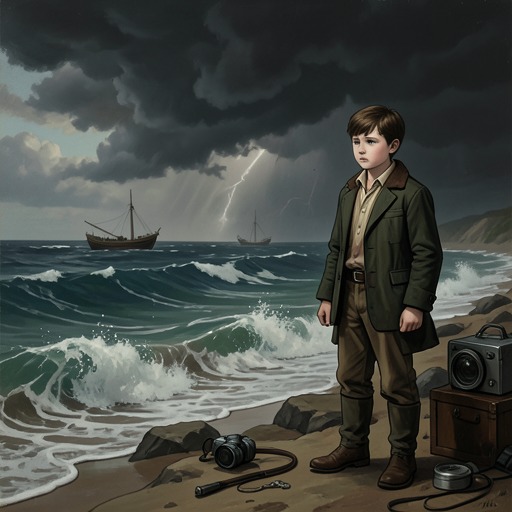
No Swimming After the Storm
Kensuke's KingdomNo Swimming After the Storm is Kensuke’s command that Michael stay out of the sea after a typhoon, a rule grounded in knowledge of the danger left behind by the storm. Michael initially experiences it as another unfair restriction imposed by the island’s old man. When he defies it, a jellyfish stings him and leaves him unable to save himself; Kensuke brings him to shelter and cares for him. The rule’s importance lies in this reversal: what Michael takes for arbitrary control is an act of protection, and the crisis begins to change their relationship.
The Command After the Typhoon
After a typhoon had kept Michael and Stella in their cave for four days, the storm cleared and the island steamed under the sun. Michael checked that his beacon had survived, but the wet materials could not yet be used to make a fire. In the heavy heat, he spent much of the day in the sea while Stella rested on the shore.
Kensuke hurried down the beach, waving his stick and calling for Michael to stop swimming. Though the sea appeared to Michael to be settling into gentle waves, Kensuke treated the danger as immediate. He waded out, took Michael by the arm, and led him forcibly back to the beach. There he made clear that this was a command, not advice, and pointed out to sea before walking back toward the forest. Stella followed him, but Michael called her back.
A Rule Michael Resents
The order came on top of restrictions Michael already resented. Kensuke had forbidden fire and confined him to one end of the island; the new ban seemed to take away even swimming. Michael considered defying Kensuke openly, but held back because he relied on the food and water the old man brought. The rule thus exposed Michael’s dependence: his anger did not give him the practical freedom to ignore Kensuke without consequence.
Michael’s frustration did not end with compliance. He made a life-size figure of Kensuke in the sand and jumped on it, a private expression of anger that did little to ease his distress. With his beacon still damp and no ship in sight, isolation and disappointment weighed on him. Over time, however, his anger revived his determination to escape. He resumed climbing Watch Hill to look for ships and stored dry leaves and twigs in a cleft in the rock so they would be ready for his beacon.
Defiance and the Jellyfish
Michael’s later disobedience grew out of that same conflict over limits. After watching a junk disappear toward the horizon, he deliberately crossed the boundary line in the sand and announced that he was going swimming, regardless of whether Kensuke watched or continued to feed him. He swam far from shore, turning the act into a direct rejection of Kensuke’s authority.
Kensuke appeared at the edge of the forest and shouted, but Michael was stung by a large jellyfish before he could return to safety. The painful stings left him unable to swim effectively, and he began to sink. The episode makes the danger behind Kensuke’s earlier warning concrete: Michael had mistaken the apparent calm after the typhoon for safety, while Kensuke recognized that the water remained hazardous.
Rescue and a Change in Their Relationship
Michael woke in a cave that was not his own, unable to move and still suffering from the jellyfish’s effects. Kensuke bent over him and introduced himself by name, telling him he was better. Stella’s presence beside him reassured Michael that she, too, had survived. The man who had enforced the swimming ban had brought him to shelter and stayed to care for him.
For days, Kensuke sat beside Michael, gave him fruit juice and warm soup, cooled him with water, and comforted him when the pain overwhelmed him. Michael could not speak, but Kensuke remained with him through his recovery. When Michael’s fingers first moved, he saw Kensuke smile. The change in the relationship is carried less by explanation than by this sustained care: the figure Michael had regarded as captor and persecutor had become his rescuer.
Kensuke later explained that, after the storm, the sea had filled with dangerous jellyfish. He had recognized the risk when he ordered Michael out of the water, and, seeing Michael’s fire on the hill and then his defiance in the sea, had feared the boy was dead. He treated Michael with vinegar he had made from berries. The account confirms that the prohibition arose from knowledge and concern, even though Michael had understood it as another hostile restriction.
Significance
The prohibition is an early instance of the gap between Michael’s interpretation and Kensuke’s intentions. At first, food and water from Kensuke coexist with banishment and rules that Michael cannot understand; from Michael’s isolated viewpoint, the old man seems arbitrary and possibly dangerous. The swimming order intensifies that uncertainty, but the jellyfish and rescue reveal its protective basis.
The episode also connects environmental danger with the practical limits of living on the island. A storm can pass while its consequences remain: the sea looks calmer, yet it still carries a threat that Michael cannot recognize. Kensuke’s local knowledge offers protection, while Michael’s dependence on that knowledge and on Kensuke’s supplies makes obedience a matter of survival as well as authority. The rule’s decisive consequence is relational: after Kensuke saves and nurses him, Michael’s enemy becomes a person capable of care, laying groundwork for their friendship.