Ship's log
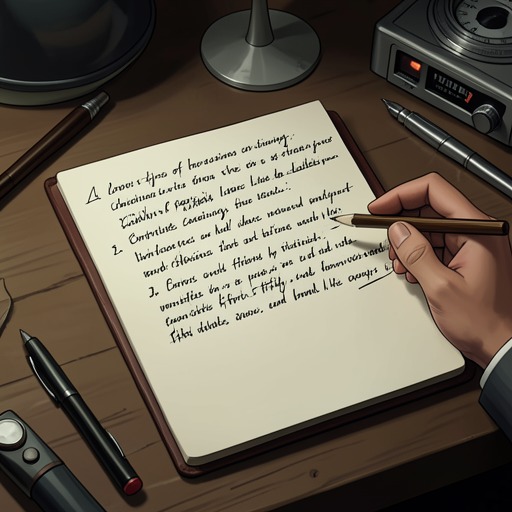
Kensuke's KingdomThe Ship's log serves two related purposes in the story: it records the route and work of the Peggy Sue’s round-the-world voyage, and it gives Michael a private place to turn experience into a first-person account. Its dates and observations make the journey traceable, while its last entry—written on the dark night before his twelfth birthday—stops at the edge of his disappearance. The empty pages that follow make the log not merely a record of travel, but a material witness to the moment when Michael’s written account can no longer continue.
Record of the Voyage
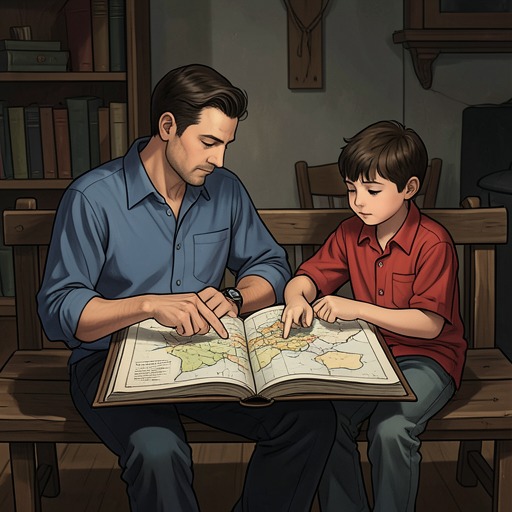
The log belongs to a voyage whose daily work is organized around record-keeping. Michael’s mother teaches him to use a sextant, take compass bearings, and plot a course on a chart; he must enter longitude and latitude every morning and evening. The log’s practical function therefore accompanies his growing participation in navigation, rather than simply preserving impressions after the fact. His mother also assigns him schoolwork tied to the journey: for geography and history he is to research each country they visit, while environmental studies and art require notes and drawings of the birds, creatures, and plants they encounter.
The voyage begins on September 10, 1987, when the fully provisioned Peggy Sue finally sets sail. Michael knows the date because he has the ship’s log in front of him as he writes. The dated record lets him look back across a journey that changes from a family’s planned adventure into a sequence of real distances, weather, and landfalls. Among its entries, October 11 records the first sight of Africa. His mother identifies the distant land and uses the chart to explain their route down the west coast, then across the Atlantic toward South America; she warns that drifting off course could leave them becalmed in the Doldrums.
An April 3 entry marks another major point on the route: the Peggy Sue is off Perth, Australia, after an expanse of empty ocean since Africa. Michael records the family’s exhilaration when land appears. They hug and jump together, astonished by the feeling of being the first sailors to discover the continent, and take pride in having sailed from England to Australia on their own. In the same entry, the log also notes his mother’s recurring stomach cramps and the family’s determination that she see a doctor in Australia. The record holds achievement and anxiety together: reaching land is a triumph, but it also brings the hope of medical care into view.
A Private Voice Within the Ship’s Record
The log is not only the official shipboard register of position. Michael’s parents expect him to keep a separate English record, encouraged to write every few weeks as a private account of the voyage. At school he had struggled to find a subject or a beginning; aboard the Peggy Sue, the experience of the journey gives him more to say than he can easily contain. He describes writing as speech carried from his head, down his arm, through his fingers and pencil, and onto the page. Looking back years later, he recognizes the entries as sounding like him talking.
Michael’s description of the surviving notebook makes its physical age part of the narrative frame. The paper is crinkled, the pages yellowed, and his scribbly handwriting faded but mostly legible. He presents the entries as selected extracts, short in form but sufficient to tell the tale of an eleven-year-old boy crossing the world aboard the Peggy Sue. The older Michael’s act of reading and selecting from the log turns a child’s contemporary record into a remembered narrative: the dated voice belongs to the voyage, while the account of what the pages mean comes from a later moment of recollection.
Night watch gives the private writing a particular setting. While the Peggy Sue is under wind-vane self-steering and the others sleep below, Michael is alone in the cockpit with the stars and the dark sea. He often does his English work then, making the log a companion to the solitude of watch. His sense that the family may be the last people alive, surrounded by sea and stars, contrasts with the log’s practical entries of bearings and coordinates: it preserves both the navigation of a vessel and a child’s effort to describe the scale of being far from land.
The Final Entry and the Broken Record
The entry dated July 28 is written on a dark, moonless night, one day before Michael’s twelfth birthday. He believes no one may remember the birthday. The log records the severe conditions since the family left Sydney: repeated storms have driven the Peggy Sue north across the Coral Sea, the rudder cable has snapped, and the self-steering no longer works. Someone must remain at the wheel, leaving Michael and his exhausted father to take turns because his mother is ill.
The entry gives the illness more immediate weight than the earlier April note. His mother’s stomach cramps are much worse; she cannot eat, lives on sugared water, and has been unable to study the charts for three days. His father wants to send a Mayday call, but she refuses, treating it as giving in. Michael and his father have taken on navigation together, yet Michael admits they may no longer know their position. The log thus records not just a broken steering system but a family’s diminishing command of its situation: the mother who led the voyage and taught navigation is incapacitated, while the child trained to help is confronting the limits of what he knows.
Michael is alone at the wheel when he writes the final words. His father and mother are asleep below; Michael has the signed soccer ball Eddie Dodds gave him at the departure, which he regards as lucky and now urgently needs. Stella is barking at the bow without her harness clipped on. After this entry, the pages are empty. Michael leaves the wheel to retrieve her, taking the ball to lure her away; it rolls overboard, and he lunges after it. The log’s abrupt cessation fixes the boundary between the voyage as recorded and the events that follow without written entries. Its ending is not a planned conclusion but an absence created by the accident.
Record, Object, and Memory
The log’s sequence of dates and observations gives the journey a route, but its significance depends equally on what it cannot record. It preserves the family’s departure, the sight of Africa, the arrival off Australia, and the growing danger before Michael disappears; after the last entry, the narrative must continue through his remembered account rather than through new pages from the notebook. That formal break makes the log an object with a double history: first a child’s working record and private exercise, then an aged document the older Michael consults as he tells the story.
The book describes the ship’s log as still in front of Michael when he writes about the departure date, and later as the worn notebook from which he chooses extracts. Its dated entries connect practical learning to emotional change: navigation lessons become shared work during his mother’s illness, and ordinary night-watch writing becomes the last recorded act before the crisis. The empty pages are consequently meaningful without supplying any additional events. They mark the limit of the written record, while the surviving fragments let Michael reconstruct the journey and give shape to the silence that follows.