The Peggy Sue’s voyage around the world
Kensuke's KingdomThe Peggy Sue’s voyage around the world transforms a family’s economic setback into a shared undertaking, then exposes how little planning can master the sea. It begins with an unemployed father’s decision to spend the family’s limited savings on a circumnavigation, gives Michael a practical education aboard the yacht, and carries the family from England to Australia and into the storm-struck Coral Sea. Its abrupt break leaves Michael stranded, making the voyage both an adventure of geographical discovery and the route by which he is separated from home.
From unemployment to a plan
The voyage grows out of the closure of the brickworks where Michael’s parents worked. The news ends their Sunday sailing and brings a creeping misery into the household: the parents search unsuccessfully for jobs, quarrel over small things, and Michael’s father stops repairing things around the house. Yet sailing, once a source of family pleasure, also supplies the alternative he can imagine. He has dreamed for years of blue-water sailing and, after losing his job, sees the crisis as a reason to attempt what employment and routine might otherwise have kept at the level of fantasy.
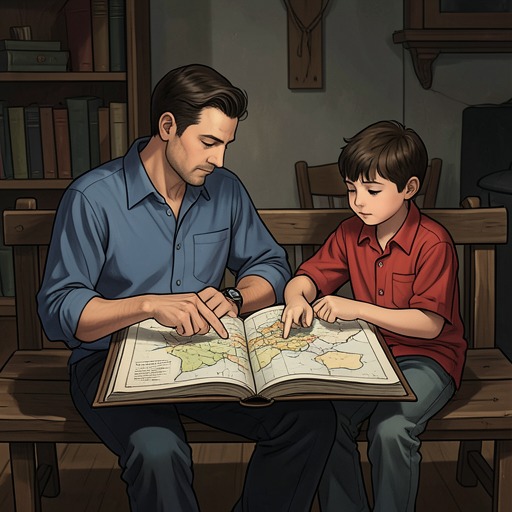
His plan rests on limited but specific resources: severance pay, some savings, and money from selling the car. Rather than let the money dwindle in the bank, he proposes spending it on a once-in-a-lifetime journey through Africa, South America, Australia, and the Pacific. The family will train for six months and sail for a year, perhaps eighteen months, depending on how long their money lasts. He has already chosen a forty-two-foot Bowman yacht and describes the voyage as something to be undertaken safely and properly, while acknowledging the risks and the family’s inexperience beyond reservoir and dinghy sailing.
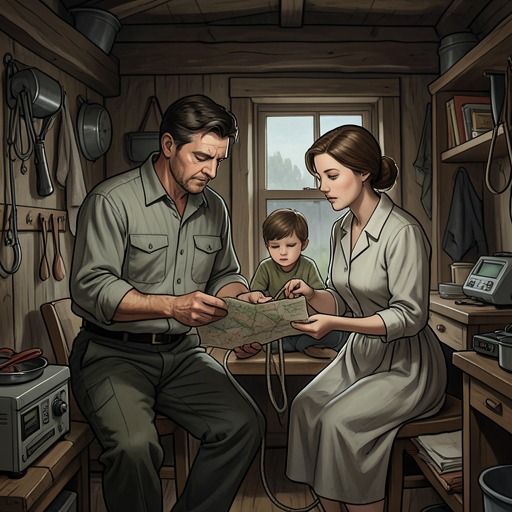
The plan assigns everyone a place aboard. Michael’s mother will earn her Yachtmaster’s certificate and skipper; his father will be first mate and handyman; Michael will be the ship’s boy; and Stella Artois will serve as the ship’s cat. His father has also asked about Michael’s schooling and says the family will take books and teach him aboard. His mother’s response is initially quiet: she listens to the explanation over tea, asks whether she really will be skipper, and raises the question of school. Once the arrangements are answered, she agrees to buy the yacht. The purchase has already happened: his father has bought the Peggy Sue before receiving her assent. The family understands the decision as a kind of madness, but one driven by desperation and inspiration together.
Setting sail and learning at sea
By the time they leave, the family has become a working crew. Michael’s mother studies books and charts until she masters the material, and her authority as skipper is accepted by both her husband and son. His father becomes Michael’s friend and shipmate, while their shared labor on the winches, at the helm, and in the galley makes them, in Michael’s account, a team. The change is a reversal of their earlier household roles: close quarters and practical dependence draw the parents and son into a more collaborative life, without erasing the mother’s command aboard.
On 10 September 1987, with the yacht loaded with stores and provisions, the family sets sail. Grandma comes to wave them off, as do friends including Barnacle Bill and Eddie Dodds. Eddie throws Michael his soccer ball as a lucky mascot and signs his name across it. Stella Artois barks at the people and boats as the Peggy Sue passes through the Solent, but falls quiet as they sail past the Isle of Wight. That moment marks the change from imagining a voyage to being committed to one: they are no longer setting out for a short trip on familiar waters but heading around the world.
The sea quickly makes the journey’s daily conditions tangible. Michael describes being soaked through, with even the sleeping bags damp below deck; only after the sea settles and the sun comes out can the family haul their belongings on deck to dry. The yacht becomes a clothesline from bow to stern, and dryness is a temporary luxury rather than a permanent state. Weather is not scenery around the family’s life but a force that dictates when they can rest, work, and regain comfort.
The voyage also reorganizes Michael’s education around its route. His parents devise a program that includes mathematics, research and writing about every country they visit, and drawings and notes on the birds, animals, and plants they encounter. His mother teaches navigation beyond the school curriculum: how to use a sextant, take compass bearings, and plot a course on a chart. Michael must enter longitude and latitude in the ship’s log every morning and evening. The lessons make the geography of the journey something he must actively read and record, while watchkeeping gives him a new sense of the night sea and its stars.
Michael’s own log becomes a different kind of record. His parents encourage him to write in it every few weeks, but the private account takes on a voice unlike his school writing: he finds that he can write by speaking his thoughts through pencil and onto the page. Years later, he looks back at the crinkled, yellowed sheets and presents selected short entries as the account of an eleven-year-old crossing the oceans aboard the Peggy Sue. The voyage is therefore preserved both as a route in the ship’s log and as a child’s developing voice.
The route: distance, landfall, and achievement
The family’s progress is measured through dated observations in Michael’s log. On 11 October, he sees Africa in the distance as the yacht travels down its western coast. His mother traces their route on the chart: the wind should carry them several hundred miles along the coast before they cross the Atlantic toward South America. She warns him about the Doldrums, where a lack of wind could leave them becalmed for weeks. The route depends not simply on distance covered but on reading wind and water well enough not to lose forward movement.
At sea, the family’s assigned work turns passing sights into study. Michael records flying fish and attempts to draw them; when his mother spots what she thinks is a basking shark, she tells him to note it and draw it even though he cannot see it through the binoculars. The journal joins discovery to instruction: the family’s surroundings are not just spectacles but material for observation, research, and a growing body of knowledge.
On 3 April, off Perth, Australia, Michael contrasts a long empty ocean passage from Africa with the excitement of sighting land. The family hugs and jumps up and down when Australia appears, delighted as if they were its first discoverers. The landfall confirms a substantial achievement: they have sailed from England to Australia, halfway around the world, under their own power. Yet the triumph is immediately complicated by Michael’s mother’s recurring stomach cramps. She promises to see a doctor in Australia, and Michael and his father mean to hold her to that promise. The milestone on the chart coincides with a warning that the crew’s health may constrain what comes next.
Storms and the break in the voyage
After leaving Sydney, the family encounters storm after storm in the Coral Sea. Each one blows the Peggy Sue farther north. The rudder cable snaps, and although Michael’s father does what he can to repair it, it remains unreliable. The yacht’s self-steering no longer works, so someone must stay at the wheel. Michael and his father take on that burden because Michael’s mother is too sick to do so. Her stomach cramps have worsened; she refuses food and can manage only sugared water, and she has been unable to consult the charts for three days.
The crisis is not only mechanical or medical. Michael’s father wants to send a Mayday call, but his mother refuses, treating it as giving in. Michael and his father navigate together, doing their best even as they lose confidence that they know where they are. In the dark on 28 July, the night before Michael’s twelfth birthday, he sits alone at the wheel while his parents sleep below. He has Eddie Dodds’s signed soccer ball beside him, once a lucky mascot and now an object of reassurance in a situation he cannot control. He needs his mother to recover and knows they are in real trouble if she does not.
The voyage’s planned passage around the world breaks at the point where the family’s resources and expertise are under the greatest pressure: repeated storms, a damaged steering system, worsening illness, and uncertain navigation converge. The log’s intimate focus on a child at the wheel makes the separation that follows feel like a rupture in an ongoing family undertaking, not a separate adventure detached from it. Michael’s experience of the sea changes from life aboard a yacht with his parents to survival after he is lost overboard and reaches the island.
Separation, reunion, and the meaning of the journey
The voyage’s consequences extend beyond the family’s intended itinerary. Michael’s parents continue to search for him, and the Peggy Sue eventually returns to the island. By then Michael’s stay there has become a life of its own: he has depended on Kensuke for food and water, learned to paint, and formed a bond that makes leaving painful. When the yacht arrives, Michael first watches from the forest’s edge as his parents call to Stella Artois and lower the anchor. He says goodbye to Kensuke, then runs out onto the sand to meet them. His mother embraces him and repeats that she had said they would find him.
The reunion closes the immediate arc of separation, but it does not turn the voyage back into the uncomplicated dream proposed in the galley. The journey’s route has carried the family from unemployment to shared purpose, from England to Australia, and from the confidence of a trained crew into illness, storm, and loss. Its strongest pattern is the tension between deliberate preparation and the sea’s refusal to be controlled: the family studies charts, practices navigation, and organizes work, yet the broken rudder cable and worsening illness leave them uncertain of their position. The Peggy Sue’s voyage matters as both a family adventure and the path by which Michael is separated from one home, makes another on the island, and is finally found again.