World War II
Kensuke's KingdomWorld War II shapes the island story long after the fighting has ended: it leaves Kensuke Ogawa alone, convinced that his family in Nagasaki is dead, and wary of the people he associates with violence. His account, told to Michael while they fish together, connects a global war to the rusted shipwreck on the shore and to the difficult friendship the two survivors build. The war is not presented as a complete historical record; it is Kensuke’s personal memory, and the damage it has done continues to govern his choices.
Kensuke’s Life Before and During the War
Kensuke was born and raised in Nagasaki, studied medicine in Tokyo, and became a doctor who cared for mothers and babies. He later studied at Guy’s Hospital in London before returning to Nagasaki, where he lived with his wife, Kimi, and their young son, Michiya. He remembers this as a happy family life, repeatedly returning to the ordinary fact of going home to them between naval duties.
As the war continued, Kensuke joined the Japanese Navy and served as a doctor aboard a large warship. He describes an early period when Japanese forces won battles and people celebrated, followed by a change in fortunes as American ships, aircraft, and bombs brought increasing pressure. His account moves from the broad course of the conflict to the moment it entered his own life: his ship was bombed, and, as a doctor, he stayed with the patients rather than leaving them.
The attack destroyed the ship’s community around him. Kensuke says that the patients and sailors had died, while he alone survived aboard a vessel whose engine was still running. Unable to steer it, he could only listen to the radio. There he heard that an atomic bomb had fallen on Nagasaki. Because his wife, son, mother, and other family members lived there, he concluded that they had all been killed. The broadcast does not establish their fate; it establishes what Kensuke heard and why he believed he had lost them.
Shipwreck and Isolation
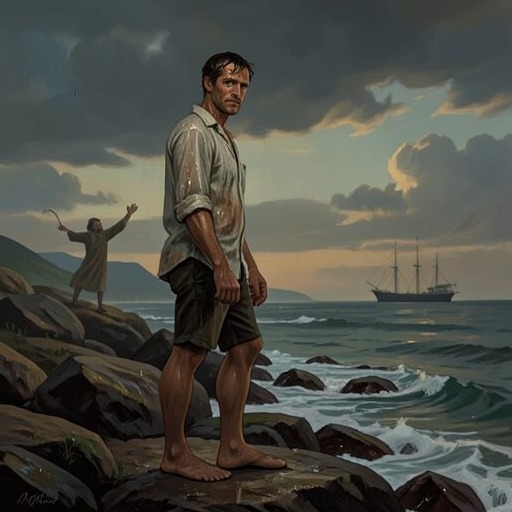
Kensuke’s vessel continued without his control. After Japan surrendered, its engine stopped; a storm then carried the ship to the island, where it came ashore without sinking. Kensuke found food and water and salvaged supplies, including clothes, sheets, pots, bottles, a knife, binoculars, medicine, and tools. He hid what he had gathered in a cave. Later, another storm drove the ship onto the rocks, and it went down. The rusting hull Michael discovers on the island is the physical trace that makes Kensuke’s wartime account fit the landscape.
Kensuke’s survival did not immediately bring relief. He says he felt that his friends and family were dead while he remained alive, and that he did not want to live. Meeting the island’s orangutans gradually changed how he understood his continued existence: he came to regard the island as beautiful and peaceful, a place without war, and decided he might stay. His choice to remain was therefore tied both to shelter and to the painful conviction that there was no family or home left for him to return to.
When American soldiers later came to the island, Kensuke hid in the forest with the orangutans rather than surrender. He feared them and believed surrender would be dishonorable. From his hiding place he heard soldiers say that everyone in Nagasaki was dead. Their words strengthened his assumption that his family had perished, though they did not provide him with direct knowledge of what had happened to Kimi or Michiya. The soldiers eventually left without finding him; by then, the wreck had sunk beneath the sand and become part of the island.
The War’s Afterlife on the Island
Years later, Kensuke describes the island as a refuge from the world of war, but it is not a place untouched by human violence. He tells Michael that armed hunters came to kill orangutans, and that they shot gibbons and took their young. The episode deepened his anger and his belief that people were killers. In this way, the war’s legacy extends beyond his shipwreck and bereavement: past violence shapes his response to new threats against the animals he has come to protect.
The island also preserves the war materially. Kensuke’s account explains the wreckage Michael saw and the objects salvaged from it, while the buried hull records the route by which a surviving doctor was carried out of the conflict and into isolation. These remnants do not resolve the uncertainty about Kensuke’s family. Instead, they show how the war remains present in what he possesses, what he remembers, and what he cannot yet bring himself to hope for.
Memory, Michael, and the Possibility of Return
Kensuke’s story reaches Michael as an explanation of their relationship as well as a history of the war. He reveals that he was the person who rescued Michael, Stella, and the football from the sea, then carried the boy to the island and left food and water for him. His initial hostility followed from fear that other people might find him, harm the animals, or take him away. The same fear helps explain why he extinguished Michael’s fire and tried to keep him within a boundary.
The narrative places Kensuke’s assumed loss beside Michael’s separation from his parents. Kensuke recognizes that Michael’s mother may be searching for him and imagines her holding him in her thoughts; he connects this with his own continuing memories of Kimi and Michiya. But memory has not made their circumstances identical. Kensuke says he has chosen to stay on the island, whereas Michael wants to go home, and he acknowledges that returning to Japan would be painful for him even as going home is right for Michael.
By the time he recounts the war, Kensuke describes Michael as a son and their life together as a family. That attachment does not erase his grief or his decision to remain, but it changes the meaning of his isolation: he has formed a bond again even while expecting to lose it. World War II thus reaches into the present not as a distant date or an abstract conflict, but through a mistaken belief about a family, a hidden wreck, years of withdrawal, and Kensuke’s effort to accept Michael’s return to the home he himself cannot yet imagine recovering.