Bay of Biscay
Kensuke's KingdomThe Bay of Biscay is the first major storm zone described during the Peggy Sue’s voyage around the world. Its violent weather turns the family’s early passage from a carefully planned journey into a test of the boat and the crew, establishing the sea as both the route that carries them onward and a force they cannot control.
Place in the Voyage
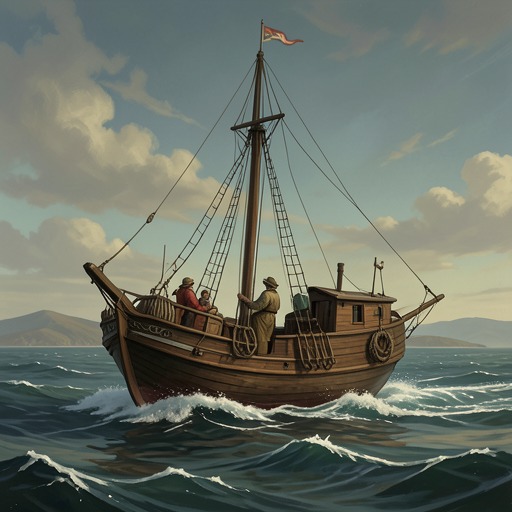
The family set sail from Southampton on September 10, 1987, with the Peggy Sue loaded with provisions for their “grand adventure.” The voyage was planned at roughly two hundred miles a day, or about eight knots, but during its first week the family was fortunate to make fifty miles a day. After a brief stay in La Coruña, they continued their passage, with Spain marking the destination reached after the Bay of Biscay crossing.
The storm was anticipated. Barnacle Bill had warned the family about the bay, so they expected rough conditions; expectation, however, did not lessen the force of the encounter. The crossing becomes an early measure of the gap between the voyage’s ambitious plan and the conditions that shape its actual pace.
The Gale and Its Immediate Danger
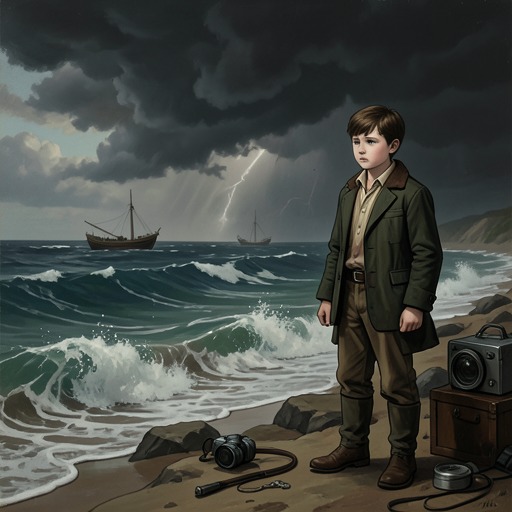
The weather rose to Force 9, and at times Force 10. The Peggy Sue was slammed about so violently that Michael believed the family might sink. At the crest of one wave, he saw the bow pointing straight up toward the moon; the boat was then hurled down the far side so quickly that he feared it would be carried to the bottom.
The account emphasizes the physical instability of the passage rather than treating the gale as a mere obstacle on a map. The boat pitches from apparent flight to a terrifying plunge, and Michael’s fear gives the crossing its defining emotional turn: the planned adventure becomes a possible struggle for survival. Yet the Peggy Sue holds together, and the family makes it to Spain.
Narrative and Thematic Significance
The Bay of Biscay serves as an early threshold in the voyage. Before the family has travelled far from England, the slow first week and the gale have already shown that their route cannot be governed by intention alone. Progress depends on weather and on the Peggy Sue’s ability to withstand it; the planned daily distance is an aspiration, not a guarantee.
The crossing also belongs to the voyage’s retrospective, log-shaped narrative. Michael presents it among selected extracts from the ship’s log, an eleven-year-old’s record of the family’s journey. The vivid image of the bow rising toward the moon preserves the immediacy of his fear, while the outcome—that the boat survives and reaches Spain—places that fear within the larger account of a voyage that continues across oceans.