Fireglass
Kensuke's KingdomFireglass is a fragment of clear glass that Michael finds on the island and tries to use to make fire by concentrating sunlight. Its importance grows beyond its practical function: it becomes Michael’s means of imagining rescue and acting on that hope, while its destruction makes tangible the collision between his wish to leave and Kensuke’s insistence on keeping the island hidden.
Discovery and Practical Use
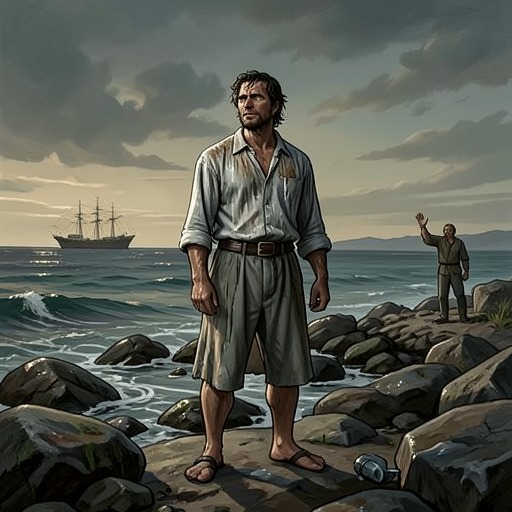
Michael comes upon the glass while exploring the beach near his cave. Stella Artois is scrabbling at what first looks like a wedge of rock, but proves to be a long, rusted sheet from a ship’s hull, sunk deep into the sand. Near the wreckage lies a fragment of clear bottle glass, hot to the touch. Its location among the remains of a ship suggests a world beyond the island, though Michael does not know what vessel was wrecked or whether anyone survived.
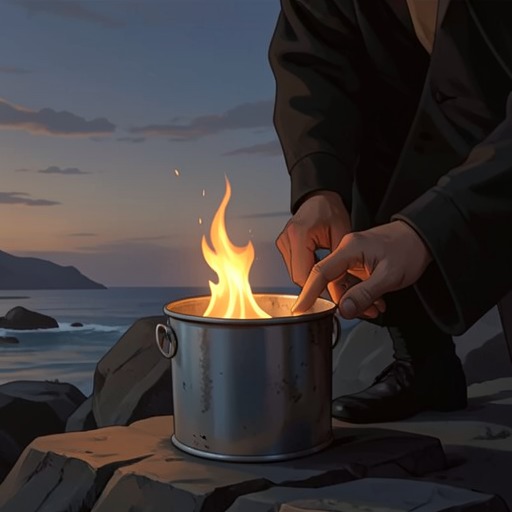
The hot glass prompts Michael to remember a schoolyard experiment with Eddie Dodds: they had used sunlight and glass to make a fire. Michael gathers dry leaves, twigs, and cane from beneath the trees, places them on the sand, and angles the glass over the tinder, waiting for smoke. He wants a fire for immediate survival—to sleep beside and keep flies and animals away—but also as a signal that a passing ship might see. He adjusts the arrangement with a frame of twigs and keeps trying, but this first attempt produces nothing. The glass offers a technique, not a guaranteed result.
A Tool of Hope and Defiance
After Kensuke has put out Michael’s fire and forbidden further fires, Michael finds that the piece is still in his pocket, pressing against his hip as he lies in his cave. The survival of this small object lifts his spirits: he resolves to try again somewhere Kensuke will not discover him. Fireglass now stands for a plan Michael can pursue alone, even as he imagines finding food and water and catching fish for himself.
The urgency of that plan sharpens when Michael watches a tanker move away without noticing him. He concludes that smoke might have given him a chance to be seen. Keeping the glass, he decides to prepare a large beacon on Watch Hill, hidden behind rocks and placed on the seaward side so that a ship could see it. He gathers branches over several days, intending to wait until a vessel appears before lighting the pile; he also plans to have dry leaves ready to catch the flame. Fireglass thus links a remembered school exercise to a deliberate rescue strategy, and Michael’s hope to leave becomes physical work on the hill.
Destruction and Conflict
When Michael eventually sees a junk at sea, he tries to kindle the beacon. After a long wait, smoke appears, followed by a flame along the edge of a leaf. Kensuke arrives before Michael can build it into a signal. Without speaking, he stamps out the nascent fire, takes the glass, and throws it against a rock, where it shatters. He then scatters the dry leaves and dismantles the beacon, with orangutans gathered to watch.
The breaking of the glass ends Michael’s ability to repeat the method he learned from Eddie Dodds, but it also exposes the stakes of their conflict. To Michael, the object is a possible route home; to Kensuke, fire risks attracting people who might find him and harm the island’s animals. Kensuke’s destruction of the glass therefore blocks a rescue attempt and intensifies Michael’s sense that he is being held on the island. The once-useful fragment becomes the point at which two different ideas of safety—escape through visibility and protection through concealment—meet in a single act.
Material Trace and Narrative Meaning
Fireglass is significant because its material properties drive the action: it focuses sunlight, remains portable in Michael’s pocket, and can be broken against rock. Its history is also layered with association. The fragment begins as an unexplained remnant beside a buried ship’s hull, becomes useful through a memory of Eddie Dodds, and is then transformed into the centerpiece of Michael’s secret beacon plan. Each change in its use follows a change in Michael’s circumstances, from initial exploration to isolation, renewed hope, and confrontation with Kensuke.
Its destruction makes the conflict visible in a way that words alone cannot. Michael’s hopes depend on an object he can carry and use, while Kensuke’s prohibition reaches into that same material world and removes the means of acting. Later, as Kensuke recounts why he feared discovery, he explains that armed hunters had come to the island, hunted animals, and taken young gibbons; he had hidden orangutans in his cave and come to think of people as killers. This account clarifies the danger Kensuke associates with a signal, without undoing the immediate consequence for Michael: the fireglass is gone, and the beacon lies scattered down the hill.