Gibbons
Kensuke's KingdomGibbons are among the first signs of animal life Michael encounters on the island, their calls carrying through the forest before he understands the risks of entering it. They are not merely part of the setting: their warning cries shape his movements, their trust in Kensuke reflects his long adaptation to island life, and their vulnerability to Hunters gives the human conflict an immediate cost for other species.
First Encounters and Warning Calls
Michael hears the Gibbons howling from the trees after he and Stella reach the island. Stella charges up the beach barking, but Michael recognizes the sound from a visit to London Zoo and tells her that the callers are “just funky gibbons.” His reassurance is tentative: he admits he cannot be sure they will not hurt them. The calls are musical rather than menacing, yet they announce a world beyond the beach that Michael does not know.
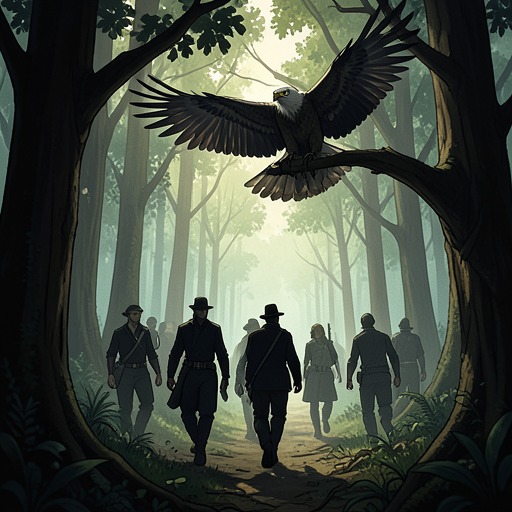
As Michael begins exploring, the Gibbons’ calls become part of what makes the forest seem dangerous. He later understands their howling as a warning, and their presence, together with the orangutans and the unknown creatures he imagines in the undergrowth, deters him from crossing into Kensuke’s territory. Their voices thus function both as sound and as a boundary: they signal that the island is inhabited and that Michael is not yet equipped to move freely through it.
Kensuke’s Bond with the Gibbons
Kensuke, by contrast, moves through the forest without being driven off by the Gibbons. When he gathers fruit, they swing above him and try to deter him, but he continues his work. His ease with the island’s animals comes from learned familiarity rather than from treating the forest as empty or wholly under human control.
Kensuke explains that he learned to survive by observing what the orangutans ate and how they behaved, and that he learned to heed animal warning signals. His account connects this patient attention to a broader relationship with island life, though the specific bond he describes is with the orangutans. The Gibbons remain distinct: their calls warn, their mothers and young are exposed to human violence, and their lives cannot simply be folded into Kensuke’s companionship with another species.
The Hunters’ Return
When Kensuke recognizes a junk offshore as the same boat associated with the Hunters, he fears they have returned to kill Gibbons and take their young. He and Michael go into the forest to gather the orangutans and bring them into the cave, using Kensuke’s singing to call them in. The Gibbons’ danger is immediate even though they are not the animals being assembled for shelter: Kensuke’s warning recalls what the Hunters previously did to them.
After the raid, the forest is quiet. Kensuke and Michael search for Kikanbo, then find the bodies of two dead Gibbon mothers. They bury them at the forest’s edge. Kensuke’s grief is visible, and the loss leaves both men without words or songs. The episode shows the Hunters’ violence extending beyond capture: the Gibbons suffer deaths that cannot be undone, even after the intruders leave.
Loss, Survival, and Significance
On their way back along the beach, Michael and Kensuke encounter Kikanbo, who emerges from the trees and climbs onto Kensuke. His return is a moment of relief after the search, but it does not erase the mothers’ deaths. That night, the two sing “Ten Green Bottles” over their fish soup, turning a shared song into both a mourning for the Gibbons and a celebration that Kikanbo survived.
The Gibbons’ story links animal agency and vulnerability to the island’s changing human relationships. Their calls first warn Michael away; their forest presence helps define the boundary he fears to cross; and their persecution becomes part of the history that explains Kensuke’s distrust of people. In the aftermath of the raid, the burial and song give the Gibbons’ loss weight beyond its effect on the human characters: the island is a home to other lives, and human arrival can endanger them.