Japanese Navy
Kensuke's KingdomThe Japanese Navy enters Kensuke Ogawa’s history through his service as a doctor aboard a warship during World War II. His account links that service to the destruction of his ship, his belief that his family died in Nagasaki, and the long solitude that followed; the institution is presented through an individual’s wartime experience rather than through its wider structure or command.
Kensuke’s Service
Kensuke says that he grew up in Nagasaki, studied medicine in Tokyo, and later continued his studies at Guy’s Hospital in London. After returning to Nagasaki, he married Kimi and had a son, Michiya. When war came and Japanese men were called into military service, Kensuke joined the Navy as a doctor aboard a large warship. His medical role placed him among the patients he remained with when the ship was attacked.
The Ship’s Destruction
Kensuke recalls that American aircraft bombed the warship, leaving fires and heavy damage. During a further attack, he believed he would die, but survived while the patients and sailors around him did not. The ship’s engine continued running, and he could neither steer it nor control where it went. He remained aboard and listened to the radio; there he heard that an atomic bomb had fallen on Nagasaki. Because his wife, son, mother, and other family members were there, he concluded that they had all been killed.
From Naval Wreck to Island Isolation
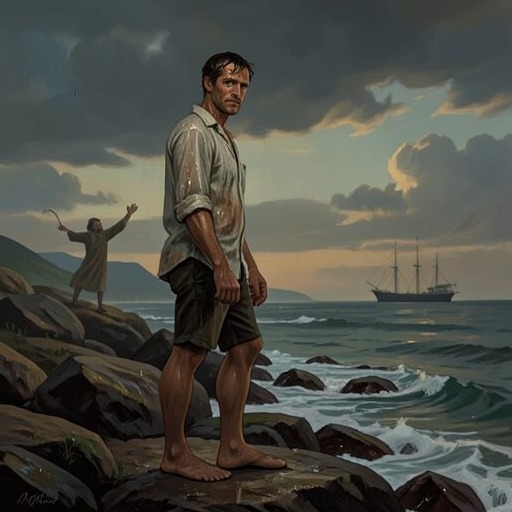
After the Japanese surrender, the engine stopped. A storm carried the still-afloat ship to an island, where it came ashore. Kensuke salvaged food, clothes, sheets, pots, bottles, a knife, binoculars, medicine, and tools before another storm drove the vessel onto rocks and sank it. He later hid from American soldiers who came to the island, believing surrender would be dishonourable and fearing them as well. He heard soldiers say that everyone in Nagasaki was dead, which strengthened his conviction that there was no family or home to return to. The shipwreck’s rusting remains, partly buried beneath sand, persisted as a material trace of the wartime journey.
Lasting Consequences
Kensuke describes feeling that his friends and family were dead while he alone had survived, and at first he did not want to live. The island offered distance from war and other people; after encountering the orangutans, he gradually learned how to live there and chose to stay. Years later, he told Michael that he had come to regard people as killers after hunters shot gibbons and took their young. His account reveals how his service and survival remained entangled with bereavement, fear, and withdrawal, even as his relationship with Michael eventually gave him a new familial bond. The Japanese Navy’s place in the story is therefore both concrete and personal: it is the setting of Kensuke’s duty as a doctor, and the point from which the wartime losses shaping his later life begin.