July 28, 1988
Kensuke's KingdomJuly 28, 1988, marks the night before Michael’s twelfth birthday and the beginning of his disappearance at sea. The date is a threshold in two senses: it interrupts a family voyage that had carried the Peggy Sue halfway around the world, and it becomes the point from which Michael must reconstruct how he survived and returned. His later account is not merely a tale of being lost; it is also an act of truth-telling after years of silence, undertaken in part to honor Kensuke, the man who saved him and became his friend.
A Date Preserved in the Log
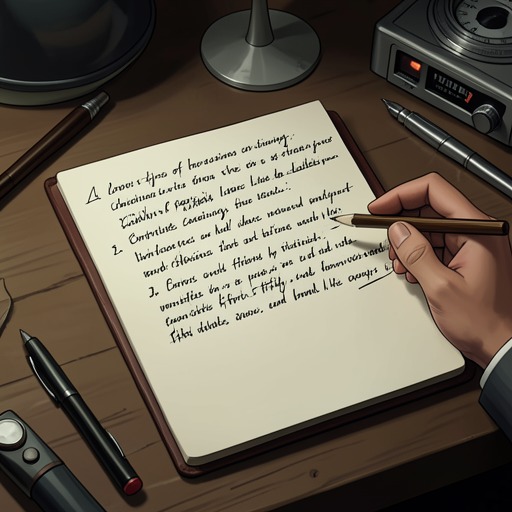
The date belongs first to the practical record of the voyage. Michael explains that he has the ship’s log before him as he writes, and that its entries preserve the journey as he experienced it at eleven. The yellowed pages and fading, still-legible writing make the record both a personal memory and a surviving document: the older narrator reads back through the voice of the boy who did not know what lay ahead.
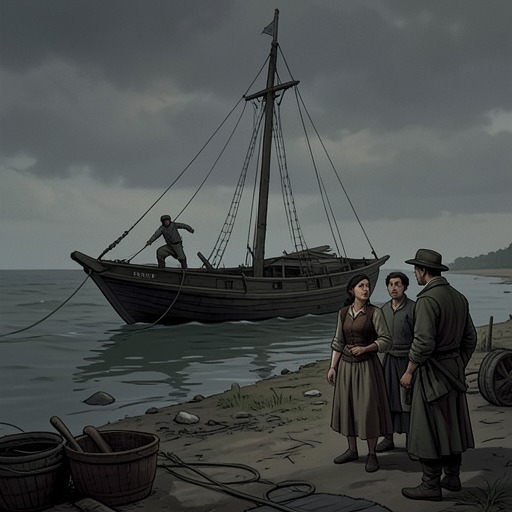
The log places July 28 within a long outward journey. On September 10, 1987, Michael’s family had set sail with their stores aboard the Peggy Sue, accompanied by friends who came to see them off. Near La Coruña, a Force 9 gale, sometimes Force 10, battered the boat before it reached Spain. Later, as the family sailed down Africa’s west coast, the charted route and the threat of the windless Doldrums gave the ocean’s geography an immediate, practical importance. These earlier passages establish that the July date followed months of navigation, weather, and family work at sea, rather than an isolated excursion.
By April 3, the family had reached Australia after crossing empty ocean from Africa. Their excitement at sighting land—hugging and jumping together—gave the voyage the force of a shared achievement: they had sailed from England to Australia on their own. But that milestone stood beside a recurring danger. Michael’s mother’s stomach cramps had returned, and she promised to see a doctor in Australia. By July, illness would limit her ability to navigate, changing the family’s balance of responsibility aboard the boat.
The Voyage Reaches a Crisis
Michael’s entry for July 28 opens in a calm, dark night before his birthday. The quiet comes after a succession of storms since the family left Sydney, each driving the Peggy Sue farther north across the Coral Sea. A calm interval offers no security: the voyage has already become more severe than the Bay of Biscay crossing that Michael once feared would sink the boat.
The family’s equipment and capacity have also been reduced. The rudder cable has snapped, and Michael’s father has been unable to restore it fully. With the self-steering no longer working, someone must remain at the wheel. Michael and his father take on that responsibility because Michael’s mother is sick. She has stopped eating, takes only sugared water, and has not been able to consult the charts for three days. The illness therefore affects not only her health but also the family’s ability to navigate and sustain the voyage.
The parents disagree about how to respond. Michael’s father wants to send a Mayday call; his mother refuses, treating it as surrender and insisting that she will not give in. Michael and his father have been navigating together, but Michael admits that they may no longer know where they are. The log’s birthday-night setting sharpens the isolation of this uncertainty: his parents are asleep below, his exhausted father has been pushed past his strength, and Michael is left on watch at the wheel with the family’s prospects unresolved.
He keeps Eddie Dodds’s soccer ball beside him. Eddie had thrown it to Michael as the family departed, calling it a lucky mascot, and had signed his name across it. Its presence on the night of the crisis connects the boy at sea to the friends and home he has left behind. The ball will later become more than a keepsake: when Michael is swept from the boat, its buoyancy helps him stay afloat.
Disappearance and Survival
Michael’s disappearance follows a sudden chain of events. While going forward to bring Stella Artois back, he has neither his safety harness nor his life jacket. A violent movement of the boat throws him into the sea before he can grasp the guardrail. The loss is immediate and terrifying: the lights of the Peggy Sue recede, and he believes the vessel is already too far away for his cries to be heard.
In the dark, Michael sees the soccer ball and clings to it. He initially mistakes a pale shape in the water for Stella, then realizes it is the ball and relies on its buoyancy as he calls for the dog. He eventually has to stop calling and concentrate on saving himself. His memory of rescue is confused: he dreams that the Peggy Sue returns and that strong arms lift him aboard, but wakes on a broad beach with Stella nearby and no boat in sight. He concludes that he must have stayed afloat with the ball until the sea carried him to land.
The beach changes the meaning of the date from a birthday eve into the start of an unknown life apart from his family. Michael calls for his mother and father until he can no longer continue, then recognizes that they are absent. He reaches the island weak, without the ball, and without knowing how he has survived. The account eventually corrects his understanding: Kensuke had found Michael, Stella, and the ball at sea and brought them to the island. Michael’s apparent arrival alone was therefore also the beginning of an unrecognized rescue.
The Date in Retrospect
At the time, Michael does not know what the date will come to mean. His first days on the island leave him frightened and disoriented; he thinks of himself as abandoned and begins to regard a cave as home because he has nowhere else. He also misreads Kensuke’s actions. Kensuke leaves him food and water but confines him to one end of the island and extinguishes his fire, seeking to keep other people from discovering the place and endangering its wildlife.
Kensuke later explains that his isolation grew from earlier loss and fear. Hunters had come to the island with guns; they killed adult gibbons and took their young, and Kensuke came to think of people as killers. He had rescued Michael in the sea but remained angry that the boy had arrived, because he feared further human intrusion and harm to the orangutans and gibbons. The explanation recasts the date’s aftermath: Michael’s confinement began not as simple hostility but as an attempt, shaped by Kensuke’s experience, to protect the island and its animals.
Their relationship changes over time. Kensuke says that Michael became like a son to him, while Michael came to regard Kensuke as family. Yet Kensuke distinguishes their futures: Michael has a home across the sea and should return to it; Kensuke has chosen to remain on the island. When the Peggy Sue finally comes back, Michael keeps his promise to tell the truth after at least ten years have passed. His family’s arrival resolves the disappearance, but it does not erase the bond formed on the island. By identifying July 28, 1988, as the date on which he disappeared, Michael opens a belated account that restores his own history and gives Kensuke the recognition he believes his friend deserves.